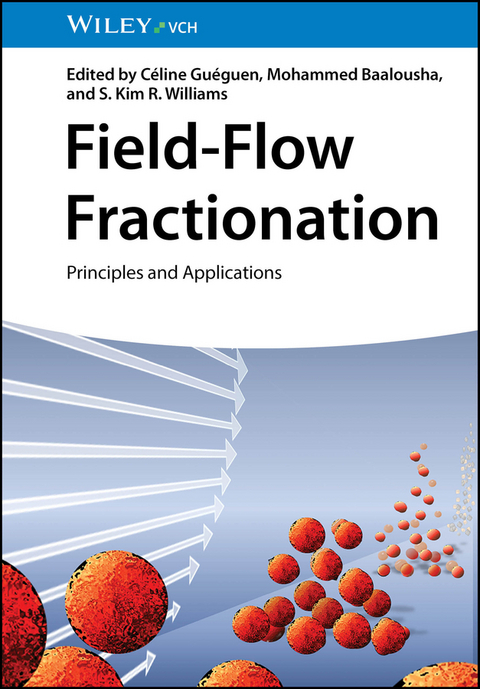
Field-Flow Fractionation
Wiley-VCH (Verlag)
978-3-527-34068-2 (ISBN)
- Noch nicht erschienen (ca. Januar 2026)
- Versandkostenfrei
- Auch auf Rechnung
- Artikel merken
Following introductory chapters on the theory, basic principles and instrumentation, a tutorial-style user guide addresses typical users' questions and problems. In the remaining part, the separation of all relevant particle classes is discussed, covering the latest developments in instrumentation as well as applications.
As a result, both beginners and experienced researchers can confidently rely on this book to confirm their own understanding or to improve their field-flow fractionation methods and the interpretation of the results.
Celine Gueguen is professor of chemistry and Canada Research Chair in Aquatic Science and Biogeochemistry at Trent University, where she has been actively involved in teaching and research since 2007. She completed a PhD on the role of natural colloids in metal speciation in natural waters at the University of Geneva in 2001. Her research interests include determination of aquatic macromolecule compositions, concentrations and roles, metal speciation and bioavailability and development of new techniques for aquatic macromolecules and nanoparticles. She has published over 40 peer review papers and two book chapters. Mohammed Baalousha is Assistant Professor of Environmental Nanoscience at the University of South Carolina, USA, since 2014. He received a MSc degree in Applied Mechanics in 2002 and a PhD in Environmental Biogeochemistry in 2006 from the University of Bordeaux, France, followed by a postdoctoral appointment at the University of Birmingham, UK. His major research interests are characterization and environmental fate of nanomaterials. S. Kim R. Williams is professor of chemistry and the Director of the Laboratory for Advanced Separations Technologies at the Colorado School of Mines. She began working with field flow fractionation as a postdoctoral fellow with the inventor of the technique, the late J. Calvin Giddings at the University of Utah, in 1987. She subsequently became the Assistant Director of the Field-Flow Fractionation Research Center and an Adjunct Assistant Professor at the University of Utah. In 1997, Kim joined the faculty of the Chemistry Department at the Colorado School of Mines. Research in the Williams group focuses on developing new capabilities for nanoparticle and macromolecular analyses using field flow fractionation and related methods.
PART I: THEORY
Chapter 1. The Basics
FFF Overview
Historical perspectives
Normal vs steric vs hyperlayer modes
Retention
Resolution, fractionation power
Chapter 2. FFF techniques
AF4 -
Flow FFF (asymmetric, frit inlet and outlet)
HF5- Hollow-fiber flow FFF
Sedimentation FFF
Thermal FFF
Electrical FFF
Novel techniques (including 2D-FFF)
Chapter 3. User guide
Which FFF is right for you?
How to use FF correctly?
General optimization strategies: carrier fluid, calibration, reproducibility
Sample overloading
Sample recovery
Which detector to choose?
How to troubleshoot FFF? (in general terms)
Chapter 4. Other physical fractionation techniques: focus on performance as compared to the FFF
Filtration/Ultrafiltration
Centrifugation/ultracentrifugation
Size exclusion chromatography
Liquid chromatography
Microfluidics
Precipitation
PART II: APPLICATIONS
Chapter 5. Polymer and latex
Chapter 6. Biological particles: Virus, DNA/RNA, drug delivery
Chapter 7. Nanoparticles in water and soil
Chapter 8. Manufactured nanoparticles
Chapter 9. Protein, enzymes
Chapter 10. Cell separations - blood and algal cells
Chapter 11. Food industry -
Starch
Chapter 12. Pharmaceutical industry - drug delivery
Chapter 13. Disease diagnosis
| Erscheinungsdatum | 18.07.2019 |
|---|---|
| Verlagsort | Berlin |
| Sprache | englisch |
| Maße | 170 x 244 mm |
| Themenwelt | Naturwissenschaften ► Biologie |
| Naturwissenschaften ► Chemie ► Analytische Chemie | |
| Schlagworte | Biowissenschaften • Chemie • Chemistry • Chromatographie / Trennverfahren • Chromatography / Separation Techniques • Life Sciences • Pharmaceutical & Medicinal Chemistry • Pharmazeutische u. Medizinische Chemie • Proteine u. Makromoleküle • Proteins & Macromolecules |
| ISBN-10 | 3-527-34068-8 / 3527340688 |
| ISBN-13 | 978-3-527-34068-2 / 9783527340682 |
| Zustand | Neuware |
| Informationen gemäß Produktsicherheitsverordnung (GPSR) | |
| Haben Sie eine Frage zum Produkt? |
aus dem Bereich