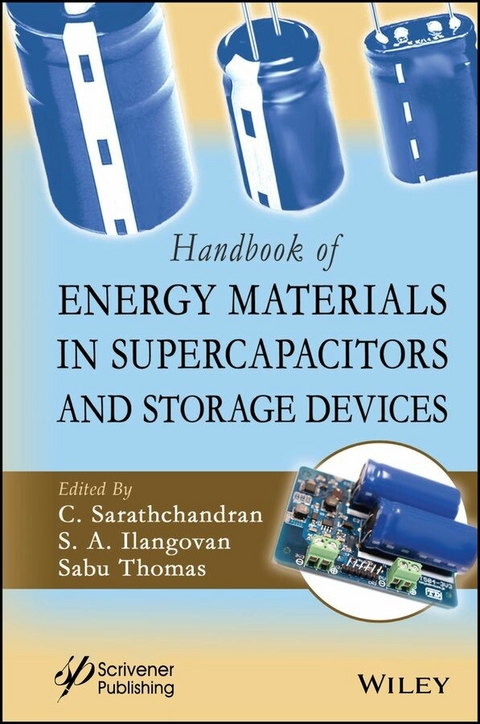
Handbook of Energy Materials in Supercapacitors and Storage Devices (eBook)
717 Seiten
Wiley-Scrivener (Verlag)
978-1-119-90123-5 (ISBN)
Accelerate your understanding of modern energy storage with this one-stop resource that provides a comprehensive guide to the basics, materials, and recent advancements in high-efficiency supercapacitor technology.
The increasing population, environmental pollution, and growing demand for energy underscores the importance of highly efficient energy storage devices. Supercapacitors, often referred to as ultracapacitors, have emerged as a pivotal technology in the realm of energy storage. Increasing demand for supercapacitors arises from the high energy density required by various modern applications like electric vehicles, UPS systems, wind turbines, space vehicles, regenerative braking, load leveling systems, etc. The above-mentioned applications require an improvement in working voltage (by preventing/reducing reaction between electrode and electrolyte surface), specific capacitance, and energy density (by increasing the surface area, addition of transition metal oxides/conducting polymers, etc.) of the existing supercapacitors. Global research is directed towards blending the high energy density of batteries with the high-power density of traditional capacitors, thereby enabling the supercapacitors to be ideal for applications demanding rapid charge and discharge cycles, high power output, and long cycle life.
This book is designed to cover the basics of supercapacitors and provide a current account of the recent advances in this field. It provides the basics of various materials, different stages of growth in this field, and recent developments, making it a one-stop resource for understanding and advancing the field of supercapacitor technology.
Readers will find in the volume;
- A detailed explanation of the electrochemical processes and energy storage mechanisms in supercapacitors, with a detailed introduction to supercapacitors;
- A comprehensive review of various electrode materials, including carbon-based materials, metal oxides, and conducting polymers;
- A detailed discussion on different electrolyte types (aqueous, organic, and ionic liquids) and their impact on supercapacitor performance;
- An exploration of the design considerations and manufacturing techniques for supercapacitors.
Audience
The book will be a valuable resource for researchers, engineers, and industry professionals involved in various fields, including electronics, automotive, renewable energy, and grid storage.
C. Sarathchandran, PhD is an assistant professor in the Department of Science, Amrita School of Engineering, Amrita Vishwa Vidyapeetham, Chennai, Tamil Nadu, India. His doctoral thesis centered around the development of epoxy resin poly- (trimethylene terephthalate) based blend systems for aerospace applications. His research interests include the development of supercapacitors, batteries, and aerogels for various applications.
S. A. Ilangovan, PhD is the Deputy Director at the Vikram Sarabhai Space Center, Trivandrum, Kerala, India, with more than 20 years of research experience in supercapacitors and batteries. He has published more than 20 research articles, ten patents, and one book.
Sabu Thomas, PhD is the former Vice-Chancellor at Mahatma Gandhi University, and currently at the International and Inter University Centre for Nanoscience and Nanotechnology, Mahatma Gandhi University, Kottayam, Kerala, India, as well as the Department of Physics and Electronics, CHRIST (Deemed to be University), Bengaluru, Karnataka, India. He has published more than 80 books, 750 research articles, and several patents.
1
Introduction to Supercapacitors
Shebin Stephen1, S. A. Ilangovan1, Sujatha S.2, Bibin John2, Ajeesh K. S.2 and C. Sarathchandran1*
1Materials Chemistry Research Laboratory (MCRL), Amrita School of Engineering, Amrita Vishwa Vidyapeetham, Chennai, Tamil Nadu, India
2Vikram Sarabhai Space Centre (VSSC), Indian Space Research Organization (ISRO), Trivandrum, Kerala, India
Abstract
The high power density, cycle stability, and eco-friendly nature of supercapacitors make them promising candidate to cater the demands of next generation applications. The working efficiency of a supercapacitor is influenced by the nature of electrolyte and electrode. The present chapter is designed to provide a fundamental understanding on double layer formation and on the science/technology of supercapacitors. This includes a detailed evaluation of history, mechanism for storage of charge and basic principles of supercapacitors.
Keywords: Supercapacitor, energy storage, EDLCs, pseudocapacitor, hybrid capacitor, electrodes, electrolytes
1.1 Introduction
Remarkable advancements in several fields and the expansion in world’s population over the past few decades have led to an increased consumption of energy resources including fossil fuels. The energy consumption of developed/developing countries is increasing at an alarming rate as can be seen from Figure 1.1 [1].
With coal, oil and gas being the major contributors towards satisfying global energy demands, their usage related issues including global warming, non-renewable nature and environmental pollution urge the need for an efficient energy storage system [2]. This has led to renewed interest in developing new energy sources and storage technologies with high power/energy density that can potentially reduce the problems associated with petroleum-based fuels by replacing them. The key factors taken into account while choosing an energy storage device includes particular energy, specific power, specific capacitance, cyclic life, reliability, and safety [3]. The supercapacitor/ultracapacitor and battery are major examples of energy storage technologies commonly used in a variety of fields, from the smart grid to portable electric devices [4, 5]. Rechargeable batteries offer high energy storage per unit volume/mass and long life cycle, but have low power per unit volume, high internal resistance, and their lifespan is sensitive to high current rates and fluctuating loading circumstances [6]. Supercapacitors are characterized by their high power density, low resistance to flow of current, and improved cycle stability, wider temperature range for operation, high performance, quick charging, and low maintenance (refer Figure 1.2) [7].
Figure 1.1 Energy consumption for different countries in million tons of oil equivalent (Mtoe)
(reproduced with permission from world energy consumption statistics).
Unlike ordinary capacitors, supercapacitors stores charge along the surface with an excess of electrons on one side and electron holes on the other side when suitable voltage is applied. The concept of charge separation/storage was first proposed in 1745, with the invention of Layden jar by Edward George von Kleist and Pieter van Mussehenbroek. In 1800, Wilhelm Weber described the basic principle of supercapacitors [8]. The interface of a parallel plate capacitor (two metal plates separated by a dielectric) was first modeled by Hermann von Helmholtz, and proposed that charged electrodes repel similar charge and attract opposite charge forming an electric double layer (refer to Figure 1.3(a)) [9], and the capacitance per unit area is defined by:
Figure 1.2 Evaluation of specific energy/power for various energy storage systems [8].
Figure 1.3 Different double layer models, (a) the model proposed by Helmholtz (b) proposed by Gouy and Chapman model, and (c) the model proposed by Stern [10].
Here ε0 and εr are the medium and free space permittivity, while l is the distance between electrodes. However, there are two main flaws in this concept: (1) it ignores the interactions happening away from the electrode surface excluding the first layer, and (2) effect of concentration of electrolyte is ignored [11–13]. Chapman and Gouy (C-G) (1910) modified the Helmholtz model by introducing the thermal motion of ions [14]. Accordingly, thermal fluctuations drive the ions away from electrode surface leading to a diffuse layer with charge density (Qd) given by,
and capacitance (CG-C) given by,
Where, is the bulk concentration of ions, charge (e), ionic charge (z), Boltzmann constant (kB), the electrode surface potential (ψ), the electrolyte-electrode interface potential (ψ0) and the thermodynamic temperature (T). C-G model assumes free movement of ions and are not firmly bonded to the surface. Due to diffusion of ions in solution, a counter potential is produced (refer Figure 1.3(b)). The diffused layer thickness is influenced by the kinetic energy of ions and this thickness measured experimentally was larger than predicted value. Later, Stern (1924) modified the EDL model using Helmholtz and C-G models by considering a plane (Stern plane (S-plane)) that separates the Stern layer (SL) and the diffuse layer (DL) (as presented in Figure 1.3(c)). Since effective surface charge is lower than the original charge on the surface of electrode, a rapid decrease of electrostatic potential is observed in the SL. Ions in the DL are considered as point charges and their electric potential is known as zeta potential. However, important flaws of Stern model include considering ions as point charges with Columbic interactions between them, and assuming the dielectric permittivity, electrolyte viscosity etc. to be constant. Grahame (1947) revised the Stern model by introducing the concept of specifically absorbed ions (ions that loose the solvation shell when in close proximity with the surface of electrode) [15]. Thereby, the Helmholtz layer was split into inner Helmholtz plane (IHP) and outer Helmholtz plane (OHP) as presented in Figure 1.3 (c). A supercapacitor consists of a dielectric material called electrolyte separating the cathode and anode with an ion permeable membrane separator as presented in Figure 1.4.
The working of supercapacitor rests on the basic principles of ion distribution between the electrolyte/surface of electrode and energy storage. The active material used in both electrodes can be similar (called symmetric supercapacitors) or different (known as asymmetric supercapacitors). The energy (E)/power (P) density of a supercapacitor is given by [16],
Figure 1.4 Different components of supercapacitors.
Here capacitance (C), the stability window (V) and the equivalent series resistance (Res) are the terms involved. Depending on the mechanism of charge storage, supercapacitors can be broadly categorized into (1) electrochemical double layer capacitors (EDLC), (2) pseudocapacitors (PC), and (3) hybrid capacitors as detailed in Figure 1.5.
EDLCs take advantage of the charge that builds up at interface of electrode/electrolyte without any chemical redox processes making it a non-Faradic process and the capacitance (total) in an EDLC is,
Here Cdiff and CHP represent capacitance of the DL and the Helmholtz plane. The capacitance in EDLC depend on electrode surface area, porosity (pore structure/size distribution), active material layers etc. and carbon materials are commonly used [17]. In PCs, different electrochemical reactions like (1) surface adsorption, (2) redox reactions, and (3) electrode doping contribute to specific capacitance (Csp) and the average capacitance (Cav) is given by
Figure 1.5 Different categories of supercapacitors and their electrode materials.
Here, total charge (Q) and voltage (V) are the terms involved. Depending on electrode material nature and engineering strategy undertaken, PCs can be intrinsic or extrinsic. Different processes (Faradaic) that lead to pseudocapacitance are shown in Figure 1.6.
Most commonly used PC materials include metal oxides (transition) (like RuO2, MnO2, Co3O4,), conductive polymers polyaniline, polypyrrole, thiophene derivatives etc. However, these materials suffer from low energy density, low operating potential, short cycle life, and mechanical stability. Due to the Faradaic processes these systems exhibits expansion and contraction during charge-discharge process and low power capability compared to that of an EDLC [4, 18–21]. The hybrid supercapacitor, as its name suggests, combines processes from both EDLCs and pseudocapacitors (so as to increase operating voltage and energy density). Hybrid systems have a combination of both battery and capacitor in the same cell (i.e. combination of faradic and non-faradic electrodes). The cell voltage can be raised with the right electrode combination, which thus...
| Erscheint lt. Verlag | 16.12.2025 |
|---|---|
| Sprache | englisch |
| Themenwelt | Naturwissenschaften ► Chemie |
| ISBN-10 | 1-119-90123-5 / 1119901235 |
| ISBN-13 | 978-1-119-90123-5 / 9781119901235 |
| Informationen gemäß Produktsicherheitsverordnung (GPSR) | |
| Haben Sie eine Frage zum Produkt? |
 EPUB (Adobe DRM)
Kopierschutz: Adobe-DRM
Adobe-DRM ist ein Kopierschutz, der das eBook vor Mißbrauch schützen soll. Dabei wird das eBook bereits beim Download auf Ihre persönliche Adobe-ID autorisiert. Lesen können Sie das eBook dann nur auf den Geräten, welche ebenfalls auf Ihre Adobe-ID registriert sind.
Details zum Adobe-DRM
Dateiformat: EPUB (Electronic Publication)
EPUB ist ein offener Standard für eBooks und eignet sich besonders zur Darstellung von Belletristik und Sachbüchern. Der Fließtext wird dynamisch an die Display- und Schriftgröße angepasst. Auch für mobile Lesegeräte ist EPUB daher gut geeignet.
Systemvoraussetzungen:
PC/Mac: Mit einem PC oder Mac können Sie dieses eBook lesen. Sie benötigen eine
eReader: Dieses eBook kann mit (fast) allen eBook-Readern gelesen werden. Mit dem amazon-Kindle ist es aber nicht kompatibel.
Smartphone/Tablet: Egal ob Apple oder Android, dieses eBook können Sie lesen. Sie benötigen eine
Geräteliste und zusätzliche Hinweise
Buying eBooks from abroad
For tax law reasons we can sell eBooks just within Germany and Switzerland. Regrettably we cannot fulfill eBook-orders from other countries.
aus dem Bereich