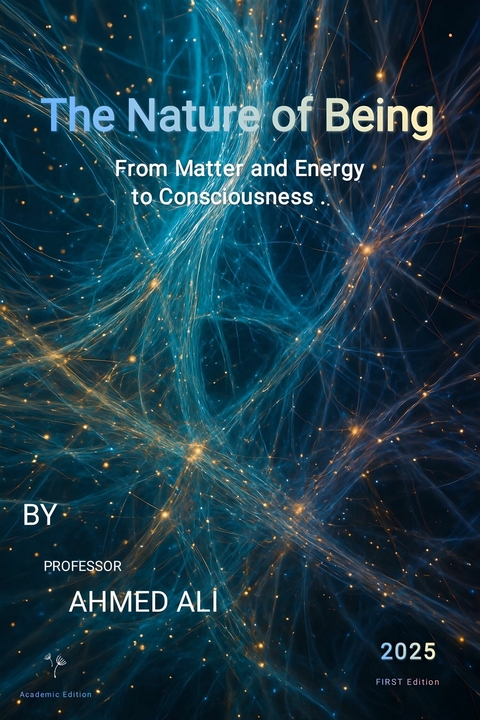
The Nature of Being (eBook)
130 Seiten
Publishdrive (Verlag)
9780001119796 (ISBN)
'The Nature of Being' is an ambitious philosophical-scientific work that aims to present a unified theory of reality, integrating modern physics (such as quantum mechanics and cosmology), studies of consciousness, philosophy, and theology.
The book's core purpose is to challenge the traditional divides between these fields and search for a coherent picture of being that explains who we are, why we are here, and the nature of the universe we inhabit.
Key Ideas and Main Themes
A Critique of Traditional Origin Narratives: The book examines religious and scientific accounts of the origin of the universe (such as Genesis and the Big Bang theory) and concludes that neither is sufficient on its own. Religion offers irrefutable answers (based on faith), while science describes the 'how' but remains silent on the 'why' (the problem of the fine-tuning of the universe).
Deconstructing the Idea of a 'First Cause' or 'Prime Mover': The book show that the question 'Who created God?' is structurally flawed because it imposes human concepts (such as temporality and factorization) onto something transcendent. Instead, it proposes a shift from searching for a 'factor' to analyzing the 'architecture' of reality.
The Simulation Hypothesis:
The book explores the possibility that our universe is a complex computer simulation, citing evidence such as the 'quantum of spacetime' (the length and length of Planck spacetime), the existence of a speed limit (the speed of light), the inconsistent efficiency of mathematics, and quantum mechanical phenomena (such as measurement termination).
Consciousness as a Fundamental Property, Not a Byproduct:
This is one of the book's central tenets. Consciousness is presented not as a product of the brain, but as a fundamental property of the universe. The brain acts as a receiver and transmitter of consciousness, not as its producer.
Death as an Illusion and Transition, Not as Annihilation:
The book presents various pieces of evidence (near-death experiences, the laws of thermodynamics, the ORC-OR model) to refute the idea that death is the end of consciousness. Instead, it describes a detailed 'transition protocol' for consciousness after the death of the biological body.
Hell as a state of consciousness, not a place:
The book deconstructs the traditional concept of hell, arguing that it is not a place of physical torment, but rather a state of consciousness characterized by isolation, a stagnant cycle of remorse, and the feeling of pain inflicted on others.
Cassandra's Prophecy and the Fall of Civilization:
The final chapter is a chilling warning. Through an AI-powered simulation, the book predicts that humanity's greatest existential threat is not nuclear war or an asteroid, but a cognitive collapse resulting from information overload, the disintegration of truth, the complexity of fragile infrastructure, and the dichotomy of empathy (us versus them).
Chapter 1
The Abyssal Inquiry: On the Limits of (Cosmogonic)Narratives
The most beautiful and profound emotion we can experience is the sensation of the mystical. It is the sower of all true science. He to whom this emotion is a stranger, who can no longer wonder and stand rapt in awe, is as good as dead.
— Albert Einstein
Prologue to the Primordial
We arise from a silence that predates memory, cast into a theatre of stars and suffering, our first breath a question mark against the void. The inquiry into our origin is not merely the first chapter in the story of human thought; it is the very substrate upon which all other narratives are etched. It transcends the taxonomic boundaries of academic disciplines, residing instead in the liminal space between physics and metaphysics, between the quantifiable and the ineffable. This is not a puzzle to be solved with the tools of a single epoch, but an abyssal question that has echoed through the caverns of time, shaping civilizations, birthing gods, and ultimately, forcing the human mind to confront the ultimate horizon of its own understanding. We stand now at the precipice of this horizon, armed with the twin lanterns of revelation and reason, finding that their light, however bright, casts long and contradictory shadows upon the mystery of being.
Long before the first equation was scrawled upon parchment, humanity sought its reflection in the heavens. From the alluvial plains of Mesopotamia, where the world was fashioned from the carcass of a primordial dragon, to the frigid Norse realms hewn from the body of the frost giant Y-mir, the human psyche has been an indefatigable engine of cosmogonic myth. These narratives are not, as a reductive modernism might suggest, mere fancies of a pre-scientific mind. They are the profound, poetic substrates of meaning, the psychic armature erected against the terrifying sublime of a cosmos indifferent to our joys and sorrows. They bestowed upon our ancestors a sacred cartography, placing them at the center of a drama orchestrated by beings whose passions and conflicts mirrored their own. The Abrahamic declaration, ”Let there be light,” is not a primitive theory of photo genesis; it is the ultimate assertion of will over chaos, of logos over nihilism.
To subject this vast and variegated tapestry to a formal inquest, we commissioned the construction of an analytical engine of unprecedented sophistication a system we designated Al-Wasatiyyah, The Mediator. Its architecture was designed for epistemic purity, free from the ghosts of creed and the biases of cultural memory. Into its vast mnemonic vaults, we poured the sum of humanity’s sacred patrimony: over forty thousand primary sources, spanning the liturgies of state religions and the whispered prayers of forgotten animist traditions, rendered in 279 distinct linguistic keys. The mandate was not to judge the aesthetic or moral value of these texts, but to perform a grand hermeneutic cross-examination, seeking the elusive thread of logical coherence.
The verdict of The Mediator was as unambiguous as it was disquieting, The world’s religious cosmogonies, for all their spiritual resonance, present three insurmountable obstacles to their acceptance as empirical testimony.
First, they are riven with internal contradictions that defy harmonization. A meticulous analysis of the Book of Genesis, for instance, reveals not a single, seamless narrative of creation, but two distinct and irreconcilable ac- counts stitched together in its opening chapters. In the first, (Elohim) brings forth flora, then fauna, and finally, as the crowning achievement, humanity male and female created simultaneously in the divine image. A mere parchment’s turn later, in the second account, (Yahweh-Elohim) fashions the man Adam from the dust, plants a garden for his solace, creates the animals as potential companions, and only then, from the man’s own substance, extrudes the woman Eve. The sequence, the motivation, the very methodology of creation are fundamentally at odds. The Mediator concluded that this was not the work of a single divine author, but the literary amalgamation of older, disparate oral traditions a editorial synthesis, not a transcendent revelation.
Second, these narratives are locked in a state of mutual metaphysical exclusion. The sovereign, omnipotent God of Isaiah logically annuls the pantheon of Mount Olympus;...
| Erscheint lt. Verlag | 5.12.2025 |
|---|---|
| Übersetzer | Gpt Chat |
| Sprache | englisch |
| Themenwelt | Naturwissenschaften ► Physik / Astronomie |
| ISBN-13 | 9780001119796 / 9780001119796 |
| Informationen gemäß Produktsicherheitsverordnung (GPSR) | |
| Haben Sie eine Frage zum Produkt? |
 EPUB (Adobe DRM)
Größe: 1,4 MB
Kopierschutz: Adobe-DRM
Adobe-DRM ist ein Kopierschutz, der das eBook vor Mißbrauch schützen soll. Dabei wird das eBook bereits beim Download auf Ihre persönliche Adobe-ID autorisiert. Lesen können Sie das eBook dann nur auf den Geräten, welche ebenfalls auf Ihre Adobe-ID registriert sind.
Details zum Adobe-DRM
Dateiformat: EPUB (Electronic Publication)
EPUB ist ein offener Standard für eBooks und eignet sich besonders zur Darstellung von Belletristik und Sachbüchern. Der Fließtext wird dynamisch an die Display- und Schriftgröße angepasst. Auch für mobile Lesegeräte ist EPUB daher gut geeignet.
Systemvoraussetzungen:
PC/Mac: Mit einem PC oder Mac können Sie dieses eBook lesen. Sie benötigen eine
eReader: Dieses eBook kann mit (fast) allen eBook-Readern gelesen werden. Mit dem amazon-Kindle ist es aber nicht kompatibel.
Smartphone/Tablet: Egal ob Apple oder Android, dieses eBook können Sie lesen. Sie benötigen eine
Geräteliste und zusätzliche Hinweise
Buying eBooks from abroad
For tax law reasons we can sell eBooks just within Germany and Switzerland. Regrettably we cannot fulfill eBook-orders from other countries.
aus dem Bereich