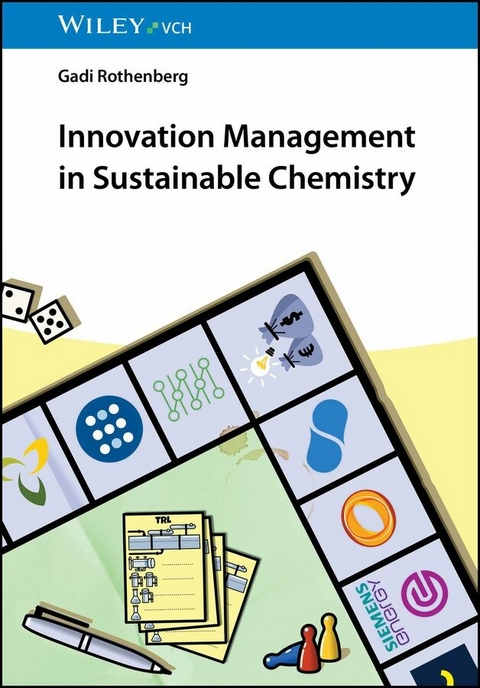
Innovation Management in Sustainable Chemistry (eBook)
668 Seiten
Wiley-VCH (Verlag)
978-3-527-84973-4 (ISBN)
Comprehensive resource on sustainable chemistry, bridging the skill gap between academic science education and innovation and entrepreneurship
Innovation Management in Sustainable Chemistry links science with business. Written for science and engineering students with an interest in start-ups and business ambitions, it shows how sustainable chemistry can move from the lab into the real world. The book takes a hands-on approach, offering exercises and teaching by example. It gives students a solid base in sustainable chemistry and business principles, combined with real-life case studies, providing both theory and practice.
Written by one of Europe's leading academics, who is also an inventor and entrepreneur, the book starts by teaching the basics of sustainable chemistry, sustainable development, and the circular economy. It then focuses on tools for evaluating sustainable innovation projects and ideas. You will learn about business archetypes and narratives, business models, value creation, and value capture. Team composition, IP strategy, and raising capital are covered next, with guidance drawn from experienced professionals.
The two foundation chapters are followed by seven real-life case studies. These follow the stories of start-ups and scale-ups in environmental sampling, catalysis, biodiesel, CO2 conversion, hydrogen storage, and bio-based polymers. Highlighting both successes and failures, the case studies show how the theory of sustainable chemistry is applied in practice. In each chapter, grey 'tech boxes' expand on technological aspects relevant to the case at hand.
Additional teaching materials, including lecture plans and in-class group exercises, can be downloaded for free from the publisher's website.
Gadi Rothenberg is Professor and Chair of Heterogeneous Catalysis and Sustainable Chemistry at the University of Amsterdam and Distinguished Visiting Professor at Tsinghua University. For the past 30 years, he has been teaching courses on catalysis, scientific writing and innovation and entrepreneurship. Rothenberg was voted 'lecturer of the year' by the chemistry students. He has published five books and 250 papers in peer-reviewed journals, invented 16 patents and co-founded four companies. His current research interests include clean energy, biomass conversion, and creating value from waste.
1
Understanding the Principles of Sustainable Chemistry
Learning Objectives
By the end of this chapter, you should be familiar with the core principles of green chemistry and its key metrics. You should understand elemental and material cycles – including the carbon and nitrogen cycles – and recognize the human impact on these systems. You should also be able to discuss how a shift to renewable resources and sustainable materials can create new business opportunities. Finally, you should understand how green chemistry contributes to the development of a circular economy.
This book is aimed at students who are interested in setting up new businesses based on innovations that are related to sustainability and the circular economy. It is based on a course that I have been teaching in Amsterdam for the past five years as part of the ‘Science, Business and Innovation’ bachelor, as well as on graduate workshops on innovation that I have been teaching in Europe and China. Since the students have different backgrounds, the introduction is broader, covering also the concepts of material cycles, waste management and environmental impact. We then discuss in more depth the principles of green chemistry, grouping them into six themes: preventing waste; reducing hazard and toxicity; using fewer solvents and reagents; saving energy; switching to renewable resources and making the most of catalysis and catalytic cycles.
An important recurring theme in this book is the emphasis on recognising real value [1]. This is especially important when dealing with sustainability and the circular economy. When people, governments and companies talk about these subjects, they tend to get starry‐eyed and imagine how things could turn out if our world was an ideal place. The world, however, is not an ideal place, and most investors know this. This is especially true for industrial chemical processes, which require a large capital outlay. I am all for optimism, and there is much personal satisfaction in developing products that will make the world a better place. But this ‘green premium’ cannot replace real value [2]. If you want to turn sustainability ideas into businesses, you need to learn how to recognise and assess real value.
But first, we must understand enough chemistry to talk with the scientists and engineers in their own jargon. You don't have to know the details of every reaction and unit operation, but the more you learn about what happens inside the reactor, the easier it will be for you to evaluate someone's new discovery (Figure 1.1). An invention or innovation often begins with a scientific/technical discovery. Sometimes, this discovery creates the possibility for new products that can open new markets or increase market demand. The technical solution is only one part of the process, but it's an essential part. Understanding the different drivers of sustainable chemistry will help you in recognising businesses that can be both ‘green’ and profitable.
Figure 1.1 The key ‘ingredients’ for transforming an idea in sustainable chemistry into a successful and sustainable business.
After explaining the principles, we take a look at two real‐life successful industrial examples that highlight both the chemical and economic benefits of sustainable chemistry: The first is the production of ethyl acetate, a common solvent used in many food applications, with a global production of over 4800 ktpa and a market value of ca. €4 billion. The second is the popular nonsteroidal anti‐inflammatory drug ibuprofen, with a global production of 45 ktpa and a market value of over €600 million (Figure 1.2). We follow the story of the manufacturing of these chemicals from the original processes to the new, sustainable alternatives, examining the drivers for change in each case.
Figure 1.2 Chemical structures of ethyl acetate and ibuprofen.
1.1 Background: Chemistry and the Global Importance of Sustainability
Of all the fields of science, chemistry is the one that has the most impact on our modern society, even if this impact is not obvious at first glance. Man‐made chemicals are all around us. The chemical and petrochemical industries have shaped our lives by supplying us with energy, medicines, crop protection, foodstuffs and new materials. Considering the 20,000‐year timeline of human history, these are recent developments. They began in the second half of the 19th century and expanded throughout the 20th century, the period correlating with what we term ‘modern society’. Thanks to the chemical industry, people in the 21st century live longer and healthier lives than in any other period in history. We have abundant food and enjoy an unprecedented quality of life with ample access to energy, shelter and modern medicines. Worldwide distribution of resources is not ideal, but this reflects bad management and greed rather than actual shortages. Even in rich, developed countries, people are bound to complain. But trust me – as a species, we never had it so good.
Ironically, modern life has changed so much since the advent of the large‐scale chemical industry in the late 19th century that these positive changes have caused a population increase that is itself creating problems on a global scale [3]. More people means more pressure on the world's fresh water, arable and habitable land, and energy resources. But more people also means more garbage and a larger environmental footprint, affecting biodiversity, polluting the air and the oceans, and even changing the Earth's climate.
Solving these problems is beyond the scope of this book. Indeed, there is no technological short‐term ‘magic solution’, because these problems are caused by long‐term societal and demographic changes [4]. We can optimise government regulations, management, planning and safety procedures, but the challenges of resource scarcity and end‐of‐life product disposal will remain. The best we can do is understand the problems' origin and try and adapt our lives to create a more sustainable environment.
The problems we face are complex because they involve many connected factors that affect each other both in the short term and in the long term. Two such examples are energy scarcity and plastic garbage. Are we really going to run out of fossil fuels in our lifetimes? Or before 2100? Is this the reason that oil prices are (sometimes) increasing? No, we are not, and it is not [5]. The short‐term prices of fossil‐based raw materials fluctuate because of geopolitics and national and regional economic policies. There are enough fossil carbon resources available to cover humanity's needs for centuries to come. But these resources will run out eventually, and exploiting some of them carries a large environmental penalty. The bigger and much more urgent problem is that burning fossil fuels is changing the climate – so much so that 198 countries that participated in the 28th Conference of the Parties (COP28) in Dubai in 2023 agreed that they should gradually phase out the use of fossil fuels to try and limit the long‐term effects of the resulting greenhouse gases [6]. Whether they will actually do it is another issue [4].
Similarly, while we all enjoy the abundance and attractive price/performance ratios of plastic bottles and plastic packaging in general, the accumulation of plastic garbage and the effects of microplastics and persistent pollutants are making people realise the importance of product life cycles [7, 8]. To put it simply, we must transform our ‘produce‐use‐waste’ linear economy into a circular one where the waste, if it cannot be avoided, is recycled back into resources and raw materials (Figure 1.3).
Figure 1.3 Comparing the linear economy and the circular economy.
A key aspect of this transition is how we view waste and resources. The so‐called waste management pyramid indicates an order of preference for reducing and managing waste, starting from prevention (the most favoured option) all the way down to disposal (see Figure 1.4) [9]. Moving from a linear economy to a circular one is a sensible idea that is easily understood by scientists and laypeople alike. Yet understanding something and doing it are two different things. Everyone agrees that a circular economy is much better in the long term, but the transition is costly and risky in the short term [4]. For example, recycling plastics is better for the environment than sourcing ‘pristine’ raw materials, but as long as new raw materials are available and cheap, there is no incentive for companies to switch their production processes. Governments may set sustainability goals, but it is up to companies, and the people heading those companies, to carry them out. This is the difference between wishful thinking (‘recycling waste back to raw materials is good for the environment and therefore good for everyone’) and reality (‘switching our process will cost a lot in the next five years, it’s risky, and I may not see the long‐term benefit') [10].
Figure 1.4 The waste management pyramid.
As we shall see in the following chapters, many worthy ideas are never implemented because...
| Erscheint lt. Verlag | 28.11.2025 |
|---|---|
| Sprache | englisch |
| Themenwelt | Naturwissenschaften ► Chemie ► Allgemeines / Lexika |
| Schlagworte | Biofuels • Business models • business narratives • catalytic cycles • chemistry energy • chemistry environment • chemistry renewable • chemistry Waste prevention • circular economy • Hydrogen • Intellectual Property • material cycles • renewable resources • scale-up company • Start-up Company • Strategic Investment • sustainable development • Team building • Value Capture • Value Proposition • Venture Capital • waste management |
| ISBN-10 | 3-527-84973-4 / 3527849734 |
| ISBN-13 | 978-3-527-84973-4 / 9783527849734 |
| Informationen gemäß Produktsicherheitsverordnung (GPSR) | |
| Haben Sie eine Frage zum Produkt? |
 EPUB (Adobe DRM)
Kopierschutz: Adobe-DRM
Adobe-DRM ist ein Kopierschutz, der das eBook vor Mißbrauch schützen soll. Dabei wird das eBook bereits beim Download auf Ihre persönliche Adobe-ID autorisiert. Lesen können Sie das eBook dann nur auf den Geräten, welche ebenfalls auf Ihre Adobe-ID registriert sind.
Details zum Adobe-DRM
Dateiformat: EPUB (Electronic Publication)
EPUB ist ein offener Standard für eBooks und eignet sich besonders zur Darstellung von Belletristik und Sachbüchern. Der Fließtext wird dynamisch an die Display- und Schriftgröße angepasst. Auch für mobile Lesegeräte ist EPUB daher gut geeignet.
Systemvoraussetzungen:
PC/Mac: Mit einem PC oder Mac können Sie dieses eBook lesen. Sie benötigen eine
eReader: Dieses eBook kann mit (fast) allen eBook-Readern gelesen werden. Mit dem amazon-Kindle ist es aber nicht kompatibel.
Smartphone/Tablet: Egal ob Apple oder Android, dieses eBook können Sie lesen. Sie benötigen eine
Geräteliste und zusätzliche Hinweise
Buying eBooks from abroad
For tax law reasons we can sell eBooks just within Germany and Switzerland. Regrettably we cannot fulfill eBook-orders from other countries.
aus dem Bereich