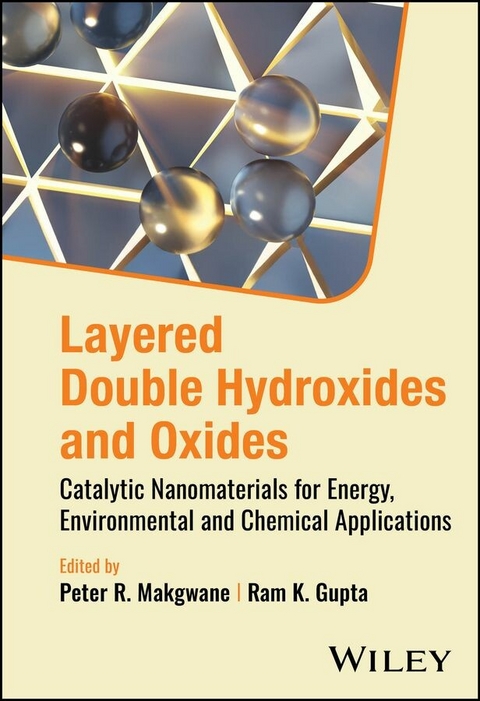
Layered Double Hydroxides and Oxides (eBook)
1019 Seiten
Wiley (Verlag)
978-1-394-26432-2 (ISBN)
The latest research and applications of layered double hydroxides (LDHs) and layered double oxides (LDOs) in the context of catalysis
Layered Double Hydroxides and Oxides delivers a first-of-its-kind and highly thorough overview of layered double hydroxides (LDHs) and layered double oxides (LDOs) in the context of catalysis, highlighting the distinctive structure-activity properties inherent in LDH- and LDO-based catalytic nanomaterials with emphasis on materials design, synthesis, and characterization as well as sustainable applications including batteries, solar fuels, fossil fuels, biomass, fossil chemical conversions, and environmental remediations of pollutants.
Layered Double Hydroxides and Oxides includes information on:
- Physicochemical, optical, and electronic properties and synthesis with controlled structure properties.
- Water splitting for hydrogen generation, electrocatalytic fuel cells, energy storage in sodium-ion batteries, and methane-reforming syngas generation and conversion.
- Photocatalytic and electrocatalytic CO2 reduction, catalytic fixation of nitrogen, and conversion of biomass to chemicals and fuel.
- Removal of organic wastewater pollutants, gas chemical sensing and detection, and antimicrobial and antibacterial disinfectants.
Layered Double Hydroxides and Oxides is an excellent reference on the subject for academic researchers and professional engineers/scientists working in the research and development areas of inorganic chemistry and catalysis, materials science, advanced nanomaterials, environmental science, solar energy, fossil energy conversion, batteries and energy storage.
Dr. Peter R. Makgwane is a Full Professor at the University of South Africa (UNISA) Institute of Catalysis and Energy Solutions (ICES). His research focuses on catalysis for green and sustainable processes.
Dr. Ram K. Gupta is an Associate Vice President for Research and Support and a Professor of Chemistry at Pittsburg State University. He was recently named by Stanford University as being among the top 2% of research scientists worldwide.
The latest research and applications of layered double hydroxides (LDHs) and layered double oxides (LDOs) in the context of catalysis Layered Double Hydroxides and Oxides delivers a first-of-its-kind and highly thorough overview of layered double hydroxides (LDHs) and layered double oxides (LDOs) in the context of catalysis, highlighting the distinctive structure-activity properties inherent in LDH- and LDO-based catalytic nanomaterials with emphasis on materials design, synthesis, and characterization as well as sustainable applications including batteries, solar fuels, fossil fuels, biomass, fossil chemical conversions, and environmental remediations of pollutants. Layered Double Hydroxides and Oxides includes information on: Physicochemical, optical, and electronic properties and synthesis with controlled structure properties.Water splitting for hydrogen generation, electrocatalytic fuel cells, energy storage in sodium-ion batteries, and methane-reforming syngas generation and conversion. Photocatalytic and electrocatalytic CO2 reduction, catalytic fixation of nitrogen, and conversion of biomass to chemicals and fuel.Removal of organic wastewater pollutants, gas chemical sensing and detection, and antimicrobial and antibacterial disinfectants. Layered Double Hydroxides and Oxides is an excellent reference on the subject for academic researchers and professional engineers/scientists working in the research and development areas of inorganic chemistry and catalysis, materials science, advanced nanomaterials, environmental science, solar energy, fossil energy conversion, batteries and energy storage.
List of Contributors
Alireza Abbasi
School of Chemistry, College of Science
University of Tehran
Tehran
Iran
Isaac Aidoo
Department of Chemistry
Kwame Nkrumah University of Science and Technology
Kumasi
Ghana
Sambandam Anandan
Department of Chemistry
National Institute of Technology
Trichy
Tamil Nadu
India
Prince Asante
Department of Chemistry
Kwame Nkrumah University of Science and Technology
Kumasi
Ghana
Nathaniel O. Boadi
Department of Chemistry
Kwame Nkrumah University of Science and Technology
Kumasi
Ghana
Mandla Chabalala
Mineral Processing Division
Randburg
South Africa
Nyiko Chauke
Catalysis Group, Advanced Materials Division
Mintek
Randburg
South Africa
Yogita Dahiya
Department of Physics
Malaviya National Institute of Technology
Jaipur
Rajasthan
India
Prajakta Dattakumar Dange
School of Physics
University of Hyderabad
Hyderabad
Telangana
India
Aditi De
Electrochemical Process Engineering (EPE) Division
CSIR‐Central Electrochemical Research Institute (CECRI)
Karaikudi
Tamil Nadu
India
and
Electrochemical Process Engineering (EPE) Division
Academy of Scientific and Innovative Research (AcSIR)
Ghaziabad
Uttar Pradesh
India
Rajnish Dhiman
Department of Physics
Malaviya National Institute of Technology
Jaipur
Rajasthan
India
Ratshilumela S. Dima
Next Generation Enterprises and Institutions Cluster
Council for Scientific and Industrial Research
Pretoria
South Africa
Nkhosikhona Dlamini
Department of Physics
University of the Free State
Bloemfontein
South Africa
Wisdom Dzansi
Department of Chemistry
Kwame Nkrumah University of Science and Technology
Kumasi
Ghana
Paria Eghbali
Department of Analytical Chemistry, Faculty of Pharmacy
Girne American University
Kyrenia
Mersin
Turkey
Junting Feng
State Key Laboratory of Chemical Resource Engineering, Beijing Engineering Center for Hierarchical Catalysts
Beijing University of Chemical Technology
Beijing
China
and
Quzhou Institute for Innovation in Resource Chemical Engineering
Quzhou
China
Peyman Ghorbani
School of Chemistry, College of Science
University of Tehran
Tehran
Iran
Xuanlin Guo
State Key Laboratory of Chemical Resource Engineering, Beijing Engineering Center for Hierarchical Catalysts
Beijing University of Chemical Technology
Beijing
China
and
Quzhou Institute for Innovation in Resource Chemical Engineering
Quzhou
China
Richard A. Harris
Department of Physics
University of the Free State
Bloemfontein
South Africa
Aydin Hassani
Department of Materials Science and Nanotechnology Engineering, Faculty of Engineering
Near East University
Nicosia
Mersin
Turkey
and
Research Center for Science, Technology and Engineering (BILTEM)
Near East University
Nicosia
Mersin
Turkey
Ankur Jain
Centre for Renewable Energy & Storage
Suresh Gyan Vihar University
Jaipur
Rajasthan
India
and
Natural Science Centre for Basic Research & Development
Hiroshima University
Hiroshima
Japan
Niki S. Jha
Department of Chemistry
National Institute of Technology
Patna
Bihar
India
Shailendra K. Jha
Advanced Materials & Corrosion Division
CSIR–National Metallurgical Laboratory
Jamshedpur
Jharkhand
India
and
Advanced Materials & Corrosion Division
Academy of Scientific and Innovative Research (AcSIR)
Ghaziabad
Uttar Pradesh
India
Benjamin Kokloku
Department of Chemistry
Kwame Nkrumah University of Science and Technology
Kumasi
Ghana
Pratap Kollu
School of Physics
University of Hyderabad
Hyderabad
Telangana
India
and
Centre for Advanced Studies in Electronics Science and Technology (CASEST), School of Physics
University of Hyderabad
Hyderabad
Telangana
India
Suresh Babu Naidu Krishna
Faculty of Health Sciences
Durban University of Technology
Durban
South Africa
and
School of Life Sciences
University of KwaZulu‐Natal
Durban
South Africa
Manoj Kumar
Department of Physics
Malaviya National Institute of Technology
Jaipur
Rajasthan
India
Alka Kumari
Advanced Materials & Corrosion Division
CSIR – National Metallurgical Laboratory
Jamshedpur
Jharkhand
India
and
Advanced Materials & Corrosion Division
Academy of Scientific and Innovative Research (AcSIR)
Ghaziabad
Uttar Pradesh
India
Subrata Kundu
Electrochemical Process Engineering (EPE) Division
CSIR‐Central Electrochemical Research Institute (CECRI)
Karaikudi
Tamil Nadu
India
and
Electrochemical Process Engineering (EPE) Division
Academy of Scientific and Innovative Research (AcSIR)
Ghaziabad
Uttar Pradesh
India
Tlabo C. Leboho
Department of Chemistry, School of Physical and Mineral Sciences
University of Limpopo
Sovenga
South Africa
Mpho Ledwaba
Hydrometallurgy Division
Mintek
Randburg
South Africa
Tumisang Lekgetho
Department of Chemistry
Tshwane University of Technology
Pretoria
South Africa
Jodinio Lemena
Department of Physics
University of Free State
Bloemfontein
South Africa
Cheng‐Hua Liu
Department of Environmental Engineering and Science
Feng Chia University
Taichung
Taiwan
David M. Mabena
Department of Chemistry
Tshwane University of Technology
Pretoria
South Africa
Pontsho S. Mbule
Department of Physics, CSET
University of South Africa
Johannesburg
South Africa
Peter R. Makgwane
Institute of Catalysis and Energy Solutions (ICES), College of Science Engineering and Technology
University of South Africa
Johannesburg
South Africa
Rethabile Makole
Department of Physics
University of the Free State
Bloemfontein
South Africa
Mabuatsela V. Maphoru
Department of Chemistry
Tshwane University of Technology
Pretoria
South Africa
Sivuyisiwe Mapukata
Nanotechnology Innovation Centre (NIC)
Advanced Materials Division
Mintek
Randburg
South Africa
Michael B. Mensah
Department of Chemistry
Kwame Nkrumah University of Science and Technology
Kumasi
Ghana
Andile Mkhohlakali
Analytical Chemistry Division
Mintek
Randburg
South Africa
Reagan Mohlala
Advanced Materials Division
Mintek
Randburg
South Africa
Teboho Mokhena
Nanotechnology Innovation Centre (NIC), Advanced Materials Division
Randburg
South Africa
William Moloto
Advanced Materials Division
Mintek
Randburg
South Africa
Revanasiddappa Moolemane
Department of Chemistry
PES University, Electronic City Campus
Bangalore
Karnataka
India
David E. Motaung
Department of Physics
University...
| Erscheint lt. Verlag | 25.11.2025 |
|---|---|
| Sprache | englisch |
| Themenwelt | Naturwissenschaften ► Chemie ► Anorganische Chemie |
| Schlagworte | layered double hydroxides battery • layered double hydroxides pollutant • layered double hydroxides solar fuel • layered double oxides battery • layered double oxides pollutant • layered double oxides solar fuel |
| ISBN-10 | 1-394-26432-1 / 1394264321 |
| ISBN-13 | 978-1-394-26432-2 / 9781394264322 |
| Informationen gemäß Produktsicherheitsverordnung (GPSR) | |
| Haben Sie eine Frage zum Produkt? |
 EPUB (Adobe DRM)
Kopierschutz: Adobe-DRM
Adobe-DRM ist ein Kopierschutz, der das eBook vor Mißbrauch schützen soll. Dabei wird das eBook bereits beim Download auf Ihre persönliche Adobe-ID autorisiert. Lesen können Sie das eBook dann nur auf den Geräten, welche ebenfalls auf Ihre Adobe-ID registriert sind.
Details zum Adobe-DRM
Dateiformat: EPUB (Electronic Publication)
EPUB ist ein offener Standard für eBooks und eignet sich besonders zur Darstellung von Belletristik und Sachbüchern. Der Fließtext wird dynamisch an die Display- und Schriftgröße angepasst. Auch für mobile Lesegeräte ist EPUB daher gut geeignet.
Systemvoraussetzungen:
PC/Mac: Mit einem PC oder Mac können Sie dieses eBook lesen. Sie benötigen eine
eReader: Dieses eBook kann mit (fast) allen eBook-Readern gelesen werden. Mit dem amazon-Kindle ist es aber nicht kompatibel.
Smartphone/Tablet: Egal ob Apple oder Android, dieses eBook können Sie lesen. Sie benötigen eine
Geräteliste und zusätzliche Hinweise
Buying eBooks from abroad
For tax law reasons we can sell eBooks just within Germany and Switzerland. Regrettably we cannot fulfill eBook-orders from other countries.
aus dem Bereich