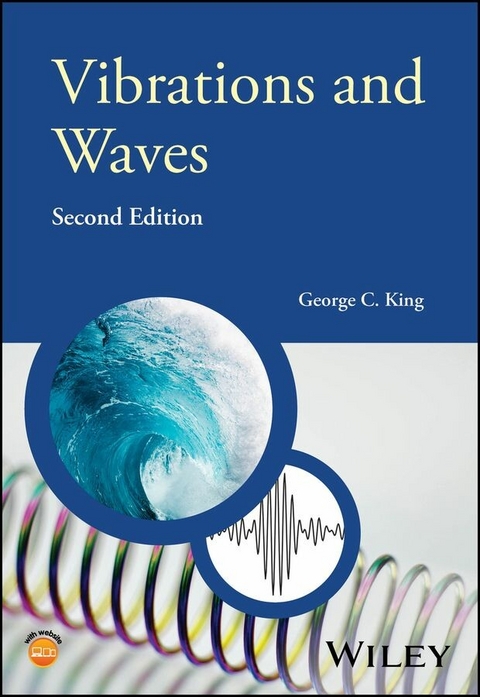
Vibrations and Waves (eBook)
530 Seiten
Wiley (Verlag)
978-1-394-24924-4 (ISBN)
Accessible, student-friendly textbook on a core subject in undergraduate physics courses, updated with more worked examples, exercises, and everyday problems
Emphasizing physical principles rather than mathematics, Vibrations and Waves, 2nd edition delivers a comprehensive and logical overview of the subject. Each topic begins with a discussion of the physical characteristics of the motion or system. The mathematics is kept as clear as possible and includes elegant mathematical descriptions where appropriate.
This book features many worked examples, frequently drawn from everyday life (e.g., why microwave ovens typically have rotating turntables), along with more cutting-edge ones. Each chapter includes problems ranging in difficulty from simple to challenging and provides hints for solving problems. This new edition has been updated with even more worked examples, exercises, and relations to everyday problems.
Vibrations and Waves discusses sample topics including:
- Simple harmonic motion, covering displacement, velocity, acceleration, and the physics of small vibrations
- The damped harmonic oscillator, covering light, leavy, and critical damping in its equation of motion
- Traveling waves, covering the transport of energy by a wave, waves at discontinuities, and waves in two and three dimensions
- The dispersion of waves, covering phase and group velocities and the superposition of waves in non-dispersive media
- Interference and diffraction of waves, covering Young's double-slit experiment and the Michelonson spectral interferometer
Vibrations and Waves is an essential textbook for all readers learning about waves and vibrations for the first time, either on their own or through an undergraduate or advanced undergraduate course.
George C. King is Emeritus Professor of Physics in the School of Physics & Astronomy at the University of Manchester, UK, and Fellow of the Institute of Physics. His research interests are the study of atoms and molecules using synchrotron radiation and electron impact excitation, and he is the author of over 200 published papers describing these studies. He has over 40 years teaching experience that includes lecturing a wide range of undergraduate and postgraduate courses.
1
Simple Harmonic Motion
In the physical world, there are many examples of things that vibrate or oscillate, i.e. perform periodic motion. Everyday examples include a swinging pendulum, a plucked guitar string and a car bouncing up and down on its springs. The most basic form of periodic motion is called simple harmonic motion (SHM). In this chapter, we develop quantitative descriptions of SHM. We obtain equations for the ways in which the displacement, velocity and acceleration of a simple harmonic oscillator vary with time and the ways in which the kinetic and potential energies of the oscillator vary. To do this, we discuss two particularly important examples of SHM: a mass oscillating at the end of a spring and a swinging pendulum. We then extend our discussion to electrical circuits and show that the equations that describe the movement of charge in an oscillating electrical circuit are identical in form to those that describe, for example, the motion of a mass at the end of a spring. Thus, if we understand one type of harmonic oscillator, then we can readily understand and analyse many other types. The universal importance of SHM is that, to a good approximation, many real oscillating systems behave like simple harmonic oscillators when they undergo oscillations of small amplitude. Consequently, the elegant mathematical description of the simple harmonic oscillator that we will develop can be applied to a wide range of physical systems.
1.1 Physical Characteristics of Simple Harmonic Oscillators
Observing the motion of a pendulum can tell us a great deal about the general characteristics of SHM. We could make such a pendulum by suspending an apple from the end of a length of string. When we draw the apple away from its equilibrium position and release it, we see that the apple swings back towards the equilibrium position. It starts off from rest but steadily picks up speed. We notice that it overshoots the equilibrium position and does not stop until it reaches the other extreme of its motion. It then swings back towards the equilibrium position and eventually arrives back at its initial position. This pattern then repeats with the apple swinging back and forth periodically. Gravity is the restoring force that attracts the apple back to its equilibrium position. It is the inertia of the mass that causes it to overshoot. The apple has kinetic energy because of its motion. We notice that its velocity is zero when its displacement from the equilibrium position is a maximum, and so its kinetic energy is also zero at that point. The apple also has potential energy. When it moves away from the equilibrium position, the apple’s vertical height increases, and it gains potential energy. When the apple passes through the equilibrium position, its vertical displacement is zero, and so all of its energy must be kinetic. Thus, at the point of zero displacement, the velocity has its maximum value. As the apple swings back and forth, there is a continuous exchange between its potential and kinetic energies. These characteristics of the pendulum are common to all simple harmonic oscillators: (i) periodic motion, (ii) an equilibrium position, (iii) a restoring force that is directed towards this equilibrium position, (iv) inertia causing overshoot and (v) a continuous flow of energy between potential and kinetic. Of course, the oscillation of the apple steadily dies away due to the effects of dissipative forces such as air resistance, but we will delay the discussion of these effects until Chapter 2.
1.2 A Mass on a Spring
1.2.1 A Mass on a Horizontal Spring
Our first example of a simple harmonic oscillator is a mass on a horizontal spring, as shown in Figure 1.1. The mass is attached to one end of the spring, while the other end is held fixed. The equilibrium position corresponds to the unstretched length of the spring, and x is the displacement of the mass from the equilibrium position along the x‐axis. We start with an idealised version of a real physical situation. It is idealised because the mass is assumed to move on a frictionless surface, and the spring is assumed to be weightless. Furthermore, because the motion is in the horizontal direction, no effects due to gravity are involved. In physics, it is quite usual to start with a simplified version or model because real physical situations are normally complicated and hard to handle. The simplification makes the problem tractable so that an initial, idealised solution can be obtained. The complications, e.g. the effects of friction on the motion of the oscillator, are then added in turn, and at each stage, a modified and improved solution is obtained. This process invariably provides a great deal of physical understanding about the real system and about the relative importance of the added complications.
Experience tells us that if we pull the mass so as to extend the spring and then release it, the mass will move back and forth in a periodic way. If we plot the displacement x of the mass with respect to time t, we obtain a curve like that shown in Figure 1.2. The amplitude of the oscillation is A, corresponding to the maximum excursion of the mass, and we note the initial condition that x = A at time t = 0. The time for one complete cycle of oscillation is the period T. The frequency ν is the number of cycles of oscillation per unit time. The relationship between period and frequency is
Figure 1.1 A simple harmonic oscillator consisting of a mass m on a horizontal spring.
Figure 1.2 Variation of displacement x with time t for a mass undergoing SHM.
The unit of frequency is hertz (Hz), where
For small displacements, the force produced by the spring is described by Hooke’s law, which says that the strength of the force is proportional to the extension (or compression) of the spring, i.e. F ∝ x, where x is the displacement of the mass. The constant of proportionality is the spring constant k, which is defined as the force per unit displacement. When the spring is extended, i.e. x is positive, the force acts in the opposite direction to x to pull the mass back to the equilibrium position. Similarly, when the spring is compressed, i.e. x is negative, the force again acts in the opposite direction to x to push the mass back to the equilibrium position. This situation is illustrated in Figure 1.3, which shows the direction of the force at various points of the oscillation. We can therefore write
where the minus sign indicates that the force always acts in the opposite direction to the displacement. All simple harmonic oscillators have forces that act in this way: (i) the magnitude of the force is directly proportional to the displacement and (ii) the force is always directed towards the equilibrium position.
The system must also obey Newton’s second law of motion, which states that the force is equal to the mass m times the acceleration a, i.e. F = ma. We thus obtain the equation of motion of the mass
Figure 1.3 The direction of the force acting on the mass m at various values of displacement x.
Recalling that velocity and acceleration a are, respectively, the first and second derivatives of displacement with respect to time, i.e.
we can write Equation (1.3) in the form of the differential equation
or
where
is a constant. Equation (1.6) is the equation of SHM, and all simple harmonic oscillators have an equation of this form. It is a linear second‐order differential equation: linear because each term is proportional to x or one of its derivatives and second order because the highest derivative occurring in it is of second order. The reason for writing the constant as ω2 will soon become apparent, but we note that ω2 is equal to the restoring force per unit displacement per unit mass.
1.2.2 A Mass on a Vertical Spring
If we suspend a mass from a vertical spring, as shown in Figure 1.4, we have gravity also acting on the mass. When the mass is initially attached to the spring, the length of the spring increases by an amount Δl. Taking displacements in the downward direction as positive, the resultant force on the mass is equal to the gravitational force minus the force exerted upwards by the spring, i.e. the resultant force is given by mg − kΔl. The resultant force is equal to zero when the mass is at its equilibrium position. Hence,
Figure 1.4 An oscillating mass on a vertical spring. (a) The mass at its equilibrium position. (b) The mass displaced by a distance x from its equilibrium position.
When the mass is displaced downwards by an amount x, the resultant force is given by
i.e.
Perhaps not...
| Erscheint lt. Verlag | 25.11.2025 |
|---|---|
| Reihe/Serie | Manchester Physics Series |
| Sprache | englisch |
| Themenwelt | Naturwissenschaften ► Physik / Astronomie |
| Schlagworte | Double Slit Experiment • harmonic motion • Harmonic oscillator • motion damping • small vibrations • vibration math • vibration physics • Vibration textbook • wave diffraction • Wave interference • wave math • Wave physics • wave textbook |
| ISBN-10 | 1-394-24924-1 / 1394249241 |
| ISBN-13 | 978-1-394-24924-4 / 9781394249244 |
| Informationen gemäß Produktsicherheitsverordnung (GPSR) | |
| Haben Sie eine Frage zum Produkt? |
 EPUB (Adobe DRM)
Kopierschutz: Adobe-DRM
Adobe-DRM ist ein Kopierschutz, der das eBook vor Mißbrauch schützen soll. Dabei wird das eBook bereits beim Download auf Ihre persönliche Adobe-ID autorisiert. Lesen können Sie das eBook dann nur auf den Geräten, welche ebenfalls auf Ihre Adobe-ID registriert sind.
Details zum Adobe-DRM
Dateiformat: EPUB (Electronic Publication)
EPUB ist ein offener Standard für eBooks und eignet sich besonders zur Darstellung von Belletristik und Sachbüchern. Der Fließtext wird dynamisch an die Display- und Schriftgröße angepasst. Auch für mobile Lesegeräte ist EPUB daher gut geeignet.
Systemvoraussetzungen:
PC/Mac: Mit einem PC oder Mac können Sie dieses eBook lesen. Sie benötigen eine
eReader: Dieses eBook kann mit (fast) allen eBook-Readern gelesen werden. Mit dem amazon-Kindle ist es aber nicht kompatibel.
Smartphone/Tablet: Egal ob Apple oder Android, dieses eBook können Sie lesen. Sie benötigen eine
Geräteliste und zusätzliche Hinweise
Buying eBooks from abroad
For tax law reasons we can sell eBooks just within Germany and Switzerland. Regrettably we cannot fulfill eBook-orders from other countries.
aus dem Bereich