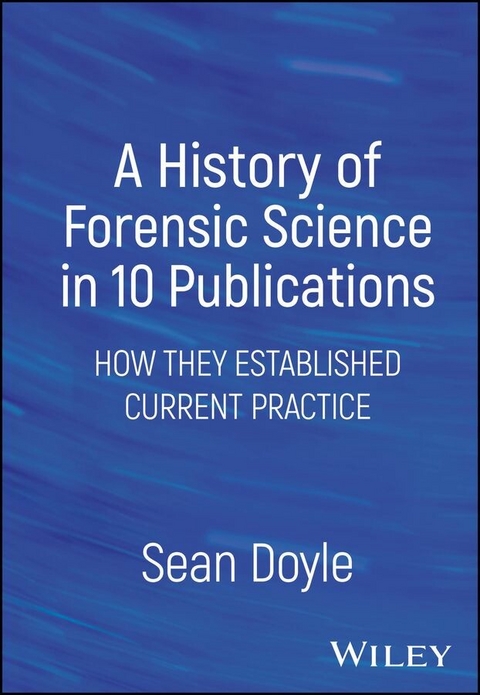
A History of Forensic Science in 10 Publications (eBook)
609 Seiten
Wiley (Verlag)
978-1-394-17078-4 (ISBN)
Explores the foundations of forensic science through its most influential and transformative publications
A History of Forensic Science in 10 Publications offers a unique and essential account of how forensic science has evolved into the complex, multidisciplinary field it is today. Unlike dramatized portrayals in popular media, this book provides a grounded, scholarly perspective on the real-world development of forensic practice through a detailed examination of ten pivotal publications. Author Sean Doyle, a highly respected practitioner with nearly five decades of experience in the field, charts the intellectual and scientific journey that has shaped modern forensic science-from early procedural texts to contemporary debates around interpretation, bias, and standardization.
Each chapter situates a landmark publication within its broader historical, scientific, and legal context, tracing its influence on subsequent research, professional standards, and the justice system. Doyle demonstrates how these works have sparked methodological shifts, provoked philosophical debates, prompted regulatory reforms, and led the way to current practices. The book's clear and engaging analytical narrative offers a structured way to understand how forensic science has been, and continues to be shaped by its literature.
Filling a critical gap in scholarship by focusing on the foundational texts that have informed both practice and policy, A History of Forensic Science in 10 Publications:
- Integrates historical, scientific, and legal perspectives into a unified narrative of forensic development
- Highlights lesser-known yet pivotal works that are often overlooked in current curricula and literature
- Connects foundational publications to contemporary practices such as probabilistic genotyping and forensic genealogy
- Discusses the evolving principles behind forensic interpretation, objectivity, and standardization
- Demonstrates how scientific literature has influenced legal outcomes, regulatory frameworks, and public understanding
Organized into thematic chapter groupings that guide readers through related developments and incremental research, A History of Forensic Science in 10 Publications: How They Established Current Practice is ideal for undergraduate students in forensic science, criminal justice, and criminology programs, as well as educators, legal professionals, and general readers interested in the science behind crime-solving.
Sean Doyle is a forensic scientist with extensive expertise in forensic chemistry, explosives, and crime scene investigation. He began his career at the UK Laboratory of the Government Chemist and later led casework and research at the Forensic Explosives Laboratory under the UK Ministry of Defence. He now directs Linked Forensic Consultants Ltd in New Zealand. An active lecturer and member of international forensic standards committees, Doyle has made significant contributions to forensic science practice and education.
Explores the foundations of forensic science through its most influential and transformative publications A History of Forensic Science in 10 Publications offers a unique and essential account of how forensic science has evolved into the complex, multidisciplinary field it is today. Unlike dramatized portrayals in popular media, this book provides a grounded, scholarly perspective on the real-world development of forensic practice through a detailed examination of ten pivotal publications. Author Sean Doyle, a highly respected practitioner with nearly five decades of experience in the field, charts the intellectual and scientific journey that has shaped modern forensic science from early procedural texts to contemporary debates around interpretation, bias, and standardization. Each chapter situates a landmark publication within its broader historical, scientific, and legal context, tracing its influence on subsequent research, professional standards, and the justice system. Doyle demonstrates how these works have sparked methodological shifts, provoked philosophical debates, prompted regulatory reforms, and led the way to current practices. The book s clear and engaging analytical narrative offers a structured way to understand how forensic science has been, and continues to be shaped by its literature. Filling a critical gap in scholarship by focusing on the foundational texts that have informed both practice and policy, A History of Forensic Science in 10 Publications: Integrates historical, scientific, and legal perspectives into a unified narrative of forensic developmentHighlights lesser-known yet pivotal works that are often overlooked in current curricula and literatureConnects foundational publications to contemporary practices such as probabilistic genotyping and forensic genealogyDiscusses the evolving principles behind forensic interpretation, objectivity, and standardizationDemonstrates how scientific literature has influenced legal outcomes, regulatory frameworks, and public understanding Organized into thematic chapter groupings that guide readers through related developments and incremental research, A History of Forensic Science in 10 Publications: How They Established Current Practice is ideal for undergraduate students in forensic science, criminal justice, and criminology programs, as well as educators, legal professionals, and general readers interested in the science behind crime-solving.
Terms, Definitions and Explanations
Introduction
In addition to the specialist, this work is also aimed at the general reader interested in the history of forensic science, so some technical terms are defined and explained in alphabetical order with some context to aid understanding.
Many of these explanations, or parts thereof, are repeated in the main text, but this section will enable the reader to quickly check meanings when necessary.
Bias – Cognitive Bias – Tunnel Vision – Observer Effects
Cognitive bias is an error in thinking. The fundamental premise is that human beings are not independent and objective observers. We tend to come with preconceived ideas, are receptive to information confirming those ideas, and reject information that does not. There is a whole raft of different cognitive biases that contribute to poor decision-making. Tunnel vision and confirmation bias are two (of many) that particularly affect crime investigation and, in turn, forensic science.
Tunnel vision is the tendency to select evidence to build a case to secure a conviction. Confirmation bias tends to favour information that confirms preconceptions independently of the information’s accuracy while ignoring conflicting or contradictory evidence.
The main remedy is for all involved, including forensic scientists, to keep an open mind.
Case Assessment and Interpretation
Case assessment and interpretation (CAI) is an approach to decision-making in an operational forensic science organisation based on the principles of Bayesian inference. In practice, it involves assigning likelihood ratios (LR) to candidate evidence types to determine which might deliver the most probative value, saving time and money. CAI engages the forensic scientist at an early stage of a criminal investigation and at the crime scene. The steps are as follows.
- Define customer requirement
- Assess how forensic science can help by assigning LRs to evidence types
- Agree on a forensic examination strategy
- Carry out examinations
- Interpret the results using an LR approach
- Communicate the test results and opinion
CAI is not a rigidly defined process, but it can guide workflow so that time and energy are spent on the issues and items expected to produce the most valuable information.
References to CAI occur throughout the book, with a detailed discussion in Chapter 8.
Chromosome
A chromosome is a package of DNA. The DNA molecule is about two meters long. Getting it to fit into the nucleus of a cell, which is between 5 and 20 millionths of a meter, is a challenge. To achieve that aim, the DNA is coiled and folded to form chromosomes, which compact and organise the DNA molecule within the cell nucleus.
It is important to think of chromosomes as packets or units of DNA. In the nucleus of a human cell, there are 46 chromosomes in 23 pairs, one of which determines sex. One of each pair is either from Mum or Dad.
Common Law and Civil Law
Strictly speaking, science should be the same everywhere. In contrast, legal systems differ and vary by jurisdiction. The major difference is between Common Law and Civil Law.
Common Law relies on an adversarial approach, where two opposing sides present their cases to uncover the truth. In contrast, civil law is inquisitorial or non-adversarial, considering any evidence that might be relevant and gathering all the facts. It is often conducted by a judge. Both systems aim to uncover the truth, and each has its strengths and weaknesses.
Common law is derived from the law of medieval England. In addition to operating in England and Wales, it also operates in former colonies of what was the British Empire, such as Australia, and parts of the United States.
Common law is based on precedent and judicial decisions, i.e. case law, rather than being documented or codified; it is evolutionary and adopts an adversarial approach to weighing evidence, uncovering the truth and delivering justice. In this system, lawyers act for the prosecution. Their role is to present the facts to prove the crime with which a defendant is charged. The prosecutor represents the state, whereas the defence lawyer, or attorney, acts primarily as the protector of the defendant’s rights and interests. The evidence is placed before a neutral judge and/or jury, which determines the truth. Perhaps the most important right is to a presumption of innocence, which applies in most jurisdictions. It is important to note in passing that these role differences produce divergent ethical responsibilities.
In the adversarial system, because of the presumption of innocence, the burden of proof usually lies with the prosecution. The defence is not required to prove anything, and the defendant is not required to give or present evidence.
The strength of evidence presented is tested by cross-examination of witnesses of both fact and opinion, and plea bargaining is common.
In the common law/adversarial system, for evidence to be admitted, it must be relevant and probative. Many rules exclude relevant evidence that might not be probative and vice versa. These rules aim to focus the court on the most cogent evidence. In simple terms, the adversarial system excludes evidence that might be considered in the civil law/inquisitorial system.
Despite the lofty claims made for the adversarial system, that it will uncover the truth, it is, in reality, a gladiatorial contest in which both sides want to win, and winning is more important than the truth. In addition, the prosecution often has all the resources of the state at its disposal, creating an uneven contest and far from an ‘equality of arms’. These factors can and do contribute to miscarriages of justice.
Civil law is codified, i.e. written down, and has its roots in Roman law and, more recently, the Napoleonic Code of 1804. This system applies in continental Europe, such as the Penal Code in France, and the former colonies of non-British European powers. Civil law has an inquisitorial approach. In contrast with the adversarial system, which has many rules that exclude certain types of evidence, an inquisitorial system is inclusive and considers all evidence that might be relevant. The inquiry is often led by a judge who establishes the facts based on the evidence. Experts are usually appointed by the court and are expected to act impartially, assisting the court to understand complex issues. As such, they are usually not subject to cross-examination, a key element in the adversarial system. In addition, Plea bargaining is rare.
Criminology and Criminalistics
Providing concise and simple definitions or explanations of these terms acceptable to all academics and practitioners, even today, would be a challenge. The distinctions have been and remain quite fluid. There is a section of Chapter 10 devoted to a discussion of these terms and their history.
While inconsistencies in meaning in the same language add to the confusion, translations have not helped. The German ‘kriminalistik’ and the French ‘criminalistique’ are often translated into English as ‘criminology’.
When this story starts back in the nineteenth century, those who considered themselves criminologists were mostly engaged in trying to identify the criminal type through physical characteristics (criminal anthropology) so that, once identified, measures could be taken to protect society from crime.
Today, criminology is a broad interdisciplinary field encompassing all aspects of crime: its causes, criminal behaviour and its punishment (penology), legislation, law enforcement, the criminal justice system and society’s response to crime. It is a subject founded on the social sciences rather than the natural and life sciences such as chemistry, physics and biology.
Criminalistics might be defined as the recognition, examination and interpretation of physical evidence utilising the natural and life sciences. However, for Edmond Locard, ‘criminalistique’ seems to have meant, more broadly, the scientific investigation of crime.
Applying the term criminalistics to a discipline somewhat akin to what is generally understood to be forensic science began in California in the 1940s. It was borrowed from European sources, where in some quarters it had the same meaning as criminology. It was used to distinguish those applying the natural and life sciences to the investigation of crime, criminalists, from criminologists. The term criminalistics, having been ‘born’ in California, has largely remained there.
Fallacy
A fallacy is an error in reasoning that results in poor decision-making. Two fallacies relevant to forensic science are the prosecutor’s and defender’s fallacies, which are the subject of Chapter 5. Respectively, these fallacies risk unfairly strengthening the prosecution or defence case.
Forensic Science and Terminological Ambiguity
Ambiguity extends to the meaning of ‘forensic science’ itself, which remains contested. Some seem to think it cannot be defined, only described (Fraser 2020). Others consider forensic science to be the science of the trace or ‘traceology’ (Margot 2011; Roux et al. 2021), and some more prosaically consider forensic science as science in the service of the law and justice (Doyle 2019). Many others take the far more utilitarian view that forensic science is any science that might be applied to the resolution of legal disputes. This understanding aligns with the broad view expressed in the...
| Erscheint lt. Verlag | 14.11.2025 |
|---|---|
| Sprache | englisch |
| Themenwelt | Naturwissenschaften ► Chemie |
| Schlagworte | Crime scene investigation • Forensic evidence • forensic science criminal justice • forensic science criminology • Forensic Science Education • Forensic science evolution • forensic science history • forensic science practice • forensic science publications |
| ISBN-10 | 1-394-17078-5 / 1394170785 |
| ISBN-13 | 978-1-394-17078-4 / 9781394170784 |
| Informationen gemäß Produktsicherheitsverordnung (GPSR) | |
| Haben Sie eine Frage zum Produkt? |
 EPUB (Adobe DRM)
Kopierschutz: Adobe-DRM
Adobe-DRM ist ein Kopierschutz, der das eBook vor Mißbrauch schützen soll. Dabei wird das eBook bereits beim Download auf Ihre persönliche Adobe-ID autorisiert. Lesen können Sie das eBook dann nur auf den Geräten, welche ebenfalls auf Ihre Adobe-ID registriert sind.
Details zum Adobe-DRM
Dateiformat: EPUB (Electronic Publication)
EPUB ist ein offener Standard für eBooks und eignet sich besonders zur Darstellung von Belletristik und Sachbüchern. Der Fließtext wird dynamisch an die Display- und Schriftgröße angepasst. Auch für mobile Lesegeräte ist EPUB daher gut geeignet.
Systemvoraussetzungen:
PC/Mac: Mit einem PC oder Mac können Sie dieses eBook lesen. Sie benötigen eine
eReader: Dieses eBook kann mit (fast) allen eBook-Readern gelesen werden. Mit dem amazon-Kindle ist es aber nicht kompatibel.
Smartphone/Tablet: Egal ob Apple oder Android, dieses eBook können Sie lesen. Sie benötigen eine
Geräteliste und zusätzliche Hinweise
Buying eBooks from abroad
For tax law reasons we can sell eBooks just within Germany and Switzerland. Regrettably we cannot fulfill eBook-orders from other countries.
aus dem Bereich