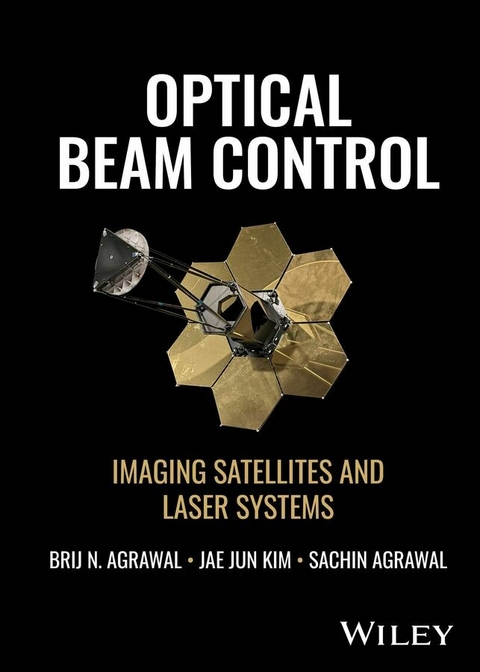
Optical Beam Control (eBook)
674 Seiten
Wiley (Verlag)
978-1-119-83041-2 (ISBN)
OPTICAL BEAM CONTROL
Imaging Satellites and Laser Systems
The authors have designed this timely new book in response to the need for up-to-date and complete coverage of multi-disciplinary basic principles of optical beam control for imaging satellites and laser systems. As the uses of imaging satellites and laser systems increase, optical beam control for these systems will occupy engineers and scientists for years to come. The book introduces space telescopes, ground telescopes, laser communications, and high energy laser systems, covering light sources, lenses, wave optics, diffraction, and polarization, as well as fine pointing control, classical control, modern control, Kalman filters, sensors, actuators, flexible control, slew maneuvers, and acquisition, tracking, and pointing.
The authors have over 30 years' experience in research, development, and testing of complex state-of-art systems, such as 3-meter diameter segmented mirror space telescopes and high energy laser beam control systems.
As a text and reference dealing with basics of optical beam control, this book includes information on:
- Sources of aberrations, vibration and jitter, optical aberrations, air turbulence, and measure of optical aberrations
- Vibration isolation and jitter control, active jitter control, strap down, and inertial stable platform
- Adaptive optics, wavefront sensors, wavefront reconstruction, adaptive optics configurations, and control systems
- Imaging satellites, telescope design, optical train components, image aberration, and performance analysis
- Laser beam control hardware, laser aberration, and laser performance analysis
Optical Beam Control is an essential reference for engineers working in imaging satellites and laser systems along with electrical engineers focused on optics, satellites, lasers, and control systems. The text is also valuable for students taking courses on laser technology, satellite control, spacecraft design, and optics and photonics.
Dr. Brij N. Agrawal is a Distinguished Professor in the Department of Mechanical and Aerospace Engineering and Director of the Spacecraft Research and Design Center at Naval Postgraduate School (NPS).
Dr. Jae Jun Kim joined the NPS in 2005. He is currently a Research Associate Professor in the Department of Mechanical and Aerospace Engineering.
Sachin Agrawal is an Engineer who has worked on spacecraft guidance, navigation, and control at Maxar Technologies and Lockheed Martin.
Chapter 1
Introduction
1.1 Optical Beam
The function of optical beam control is to meet the requirements of optical beams for pointing, pointing stability (jitter), quality of optical beams, slew maneuvers, object sensing, and tracking. It is a multidisciplinary field consisting of optics, control theory, structures, thermal analyses, vibrations, atmospheric turbulence, and lasers. This is a broad field, and this book will cover the fundamentals of each area with its applications to imaging satellites and laser systems.
Figure 1.1 shows the range of electromagnetic wave frequencies and wavelengths.
Figure 1.1 Electromagnetic wave frequencies and wavelengths.
The wavelengths of our interest are primarily in the visible range, 400–700 nm, and the near infrared range, 700–1100 nm. Because of small wavelengths, the requirements are challenging to meet, for example, typical telescope beam widths are 3–5 µrad. To mitigate most of the pointing loss, beam jitter should be less than 30% beam width, resulting in 0.9–1.5 µrad, pointing accuracy should be 0.1 times beam width, resulting in 0.3–0.5 µrad, and optical beam wave quality for diffraction limited performance, primary mirror surface RMS error, should be less than wavelength/30, 30 nm for the visible range. These requirements are very challenging and require state-of-the-art technologies to meet these performance requirements. For electromagnetic waves with larger wavelengths, such as radio waves with several orders of magnitude larger wavelengths, pointing, pointing stability, and beam quality requirements will be much easier to meet in comparison with optical beams.
Laser is an acronym for light amplification by stimulated emission of radiation. Ordinary visible light, say from a household light bulb or a flashlight, comprises multiple wavelengths, or colors, and is incoherent, meaning the crests and troughs of the light waves are moving at different wavelengths and in different directions. In a laser beam, the light waves are “coherent,” meaning the beam of photons is moving in the same direction at the same wavelength.
Laser light can travel hundreds of meters without being scattered. Since ordinary light is diffused, it cannot focus on a sharp point. Laser light can focus on a point with high intensity thanks to its directional structure. The intensity of ordinary light decreases rapidly with distance. For this reason, you can look at the ordinary light source without harming your eyes. In contrast, laser light is emitted in a narrow beam. Since the energy is concentrated in a very narrow area, looking at the laser light with the naked eye can damage the eye.
1.2 Telescopes
Most telescopes used by astronomers are on Earth. We call these ground-based telescopes. It is much easier and cheaper to build a telescope on Earth than in space. It is also much easier to fix if things go wrong. However, there are downsides as well. A telescope on the ground must look through Earth’s atmosphere to see into space. This is a problem because the atmosphere can blur our images.
The air, as shown in Figure 1.2, also blocks out light from parts of the electromagnetic spectrum like X-rays, gamma rays, infrared, and long radio waves. This means even if we have the right kind of telescope, it cannot see this type of light from Earth. The air gets in the way. That is why some telescopes are in space.
Figure 1.2 Atmospheric opacity of electromagnetic waves.
Source: [1]/wikimedia Commons/public Domain.
We call the parts of the light spectrum that can get through the air atmospheric windows. These are the parts of the electromagnetic spectrum where the opacity (how much light is blocked) is close to 0%. If the opacity is 100%, then no light with that wavelength can get through the air to reach the ground.
Building and using a space telescope is a huge challenge. It also costs a lot of money. It has only been possible since the 1980s. The first space telescope was the Hubble Space Telescope (HST). It began observing in 1990. It has taken over one million images so far.
Since 1990, there have been lots of other space telescopes. Some collect light which Earth’s atmosphere blocks out. Like Chandra, which observes in X-rays, and Fermi, which looks at gamma rays. Others can see microwaves or infrared. This has given us a new view of our Universe. The largest, the James Webb Space Telescope (JWST) was launched on December 24, 2021.
1.2.1 Space Telescope
Space telescopes have made many fantastic discoveries. Kepler found thousands of exoplanets. Spitzer was the first to image light from an exoplanet. Gaia observed a supernova outside the Milky Way. In the future, Laser Interferometer Space Antenna will try to detect gravitational waves in space.
Imaging satellites have been used for many civilian, scientific, and military applications, looking toward Earth and space. Here, we will briefly discuss the HST and the JWST. Both were developed by NASA for scientific research of planets.
1.2.1.1 Hubble Space Telescope
Figure 1.3 shows a picture and Figure 1.4 configuration of HST.
Figure 1.3 Hubble Space Telescope.
Figure 1.4 Hubble Space Telescope configuration.
Since its launch in April 1990, NASA’s HST [2] has continued this historic quest, providing scientific data and photographs of unprecedented resolution from which many new and exciting discoveries have been made.
This unique observatory operates around the clock above Earth’s atmosphere to gather information for teams of scientists studying virtually all the constituents of our universe, including planets, stars, star-forming regions of the Milky Way galaxy, distant galaxies and quasars, and the tenuous hydrogen gas lying between the galaxies.
The major elements of HST are the Optical Telescope Assembly, science instruments, Support System Module, and solar arrays. HST sensor operates in ultraviolet light, visible light, and infrared light with wavelengths 100 nm–1.8 µ. The main parameters are:
| Launch date | April 1990 |
| Launch vehicle | Space Shuttle Discovery |
| Mission duration | 15 years |
| Total payload mass | 11,110 kg |
| Optical system | Ritchey–Chretien design Cassegrain telescope |
| Primary mirror 94.5 in. (2.4 m) in diameter Secondary mirror 12.2 in. (0.3 m) in diameter |
| Optical resolution | 0.043 arcseconds (0.00001°) |
| Orbit | 320-mile (593 km) altitude, inclined 28.5° from the equator |
| Orbit time | Orbit time– 97 minutes per orbit |
| Pointing accuracy | 0.012 arcseconds (0.000003°), three-axis stabilized, zero momentum biased control system using reaction wheels. |
| Pointing stability | 0.007 arcseconds |
| Cost | US$2 billion |
1.2.1.1.1 Mission
The HST is the first observatory designed for extensive maintenance and refurbishment in orbit. The Discovery cargo bay is equipped with several devices to help the astronauts: the Flight Support System to berth and rotate the telescope; large, specially designed equipment containers to house the Orbital Replacement Units; and a remote manipulator arm from which astronauts can work and be maneuvered as needed.
After Hubble’s deployment in 1990, scientists realized that the telescope’s primary mirror had a flaw called spherical aberration (thickness of a human hair). The outer edge of the mirror was ground too flat by a depth of 2.2 µ. This aberration resulted in images that were fuzzy because some of the light from the objects being studied was being scattered. COSTAR (the Corrective Optics Space Telescope Axial Replacement) was developed as an effective means of countering the effects of the flawed shape of the mirror. COSTAR was a telephone booth-sized instrument that placed five pairs of corrective mirrors, some as small as a nickel coin, in front of the Faint Object Camera, the Faint Object Spectrograph, and the Goddard High Resolution Spectrograph. Servicing Mission 1, launched in December 1993, was the first opportunity to conduct planned maintenance on the telescope. In addition, new instruments were installed, and the optics of the flaw in Hubble’s primary mirror were corrected.
On November 13, 1999, the HST was placed into safe mode after the failure of a fourth gyroscope. In safe mode, Hubble could not observe targets, but its safety was preserved. This protective mode allows ground control of the telescope, but with only two gyros working, Hubble cannot be aimed with the precision necessary for scientific observations of the sky. Controllers closed the aperture door to protect the optics and aligned the spacecraft to ensure that Hubble’s solar panels would receive adequate power from the Sun. In servicing mission 3A, December 19–27, 1999, astronauts replaced all six gyroscopes.
In servicing mission 3B, March 1–12, 2022, astronauts replaced flexible, 8-year-old, solar array panels with smaller, rigid ones that produced 30% more power and improved pointing accuracy to eliminate control and structures...
| Erscheint lt. Verlag | 6.11.2025 |
|---|---|
| Sprache | englisch |
| Themenwelt | Naturwissenschaften ► Physik / Astronomie |
| Schlagworte | ground telescopes • high energy laser systems • Laser Communications • laser control • laser diffraction • laser lenses • laser light sources • Laser Optics • Laser Performance • laser polarization • laser wave optics • Space Telescopes |
| ISBN-10 | 1-119-83041-9 / 1119830419 |
| ISBN-13 | 978-1-119-83041-2 / 9781119830412 |
| Informationen gemäß Produktsicherheitsverordnung (GPSR) | |
| Haben Sie eine Frage zum Produkt? |
 EPUB (Adobe DRM)
Kopierschutz: Adobe-DRM
Adobe-DRM ist ein Kopierschutz, der das eBook vor Mißbrauch schützen soll. Dabei wird das eBook bereits beim Download auf Ihre persönliche Adobe-ID autorisiert. Lesen können Sie das eBook dann nur auf den Geräten, welche ebenfalls auf Ihre Adobe-ID registriert sind.
Details zum Adobe-DRM
Dateiformat: EPUB (Electronic Publication)
EPUB ist ein offener Standard für eBooks und eignet sich besonders zur Darstellung von Belletristik und Sachbüchern. Der Fließtext wird dynamisch an die Display- und Schriftgröße angepasst. Auch für mobile Lesegeräte ist EPUB daher gut geeignet.
Systemvoraussetzungen:
PC/Mac: Mit einem PC oder Mac können Sie dieses eBook lesen. Sie benötigen eine
eReader: Dieses eBook kann mit (fast) allen eBook-Readern gelesen werden. Mit dem amazon-Kindle ist es aber nicht kompatibel.
Smartphone/Tablet: Egal ob Apple oder Android, dieses eBook können Sie lesen. Sie benötigen eine
Geräteliste und zusätzliche Hinweise
Buying eBooks from abroad
For tax law reasons we can sell eBooks just within Germany and Switzerland. Regrettably we cannot fulfill eBook-orders from other countries.
aus dem Bereich