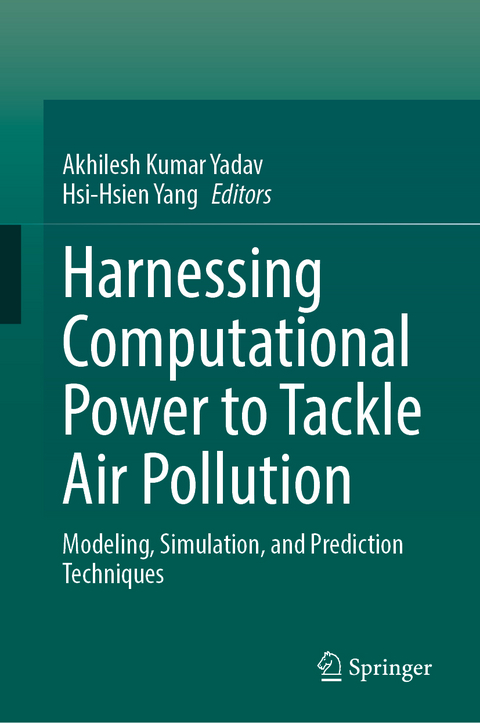
Harnessing Computational Power to Tackle Air Pollution
Springer International Publishing (Verlag)
978-3-032-13952-8 (ISBN)
- Noch nicht erschienen - erscheint am 03.03.2026
- Versandkostenfrei
- Auch auf Rechnung
- Artikel merken
This book examines the central role of computational methods in understanding, predicting, and mitigating air pollution, a critical challenge for both public health and environmental sustainability. The book offers foundations of air pollution modeling, emphasizing computational fluid dynamics for simulating pollutant dispersion and transport in relation to urban landscapes, meteorological conditions, and airflow. These approaches are complemented by statistical methods and models that broaden the scope of air quality simulations.
While highlighting major advances, the book also addresses persistent challenges: the demand for greater model accuracy, the need to manage uncertainty, the complexity of urban systems, and the computational intensity of many techniques. Developments such as parallel computing and reduced-order models are presented as promising directions for overcoming these obstacles.
Akhilesh Kumar Yadav graduated Bachelor of Technology in Electronics and Communication Engineering from Chaudhary Charan Singh University in Meerut, India. He then obtained a Master of Technology in Environmental Engineering from Madan Mohan Malaviya Engineering College in Gorakhpur, India (affiliated with Dr. A. P. J. Abdul Kalam Technical University, Lucknow). His doctoral degree, with a research focus on air pollution, was awarded by the Indian Institute of Technology (Banaras Hindu University), Varanasi, India. Dr. Yadav has served at various institutions, including Indian Institute of Technology (Banaras Hindu University), Varanasi, India; Indian Institute of Technology Bombay, Mumbai, India; Bhabha Atomic Research Centre, Mumbai, India (as a research collaborator); Manipal University Jaipur, Jaipur, India and Chaoyang University of Technology in Taichung, Taiwan. He has authored/co-authored several research and review articles, book chapters, and edited/authored books, and holds a patent. Dr. Yadav received the Young Engineer Award from the Institution of Engineers (India) and the Young Scientist Award from VDGOOD Technology Factory, Kolkata. His research interests include air, water, and soil pollution; climate change; vulnerability; human health risk assessments; and GIS applications in environmental pollution and management. He is an active member of several reputed international professional bodies, including the IEI (Kolkata), ECI (New Delhi), AEACI (Mumbai), MSI (New Delhi), and IASTA (Mumbai).
Hsi-Hsien Yang graduated his Ph.D. degree from Department of Environment, National Cheng Kung University in 1998. He is now the Dean of Research and Development Office at Chaoyang University of Technology. He has also been the Dean of College of Science and Engineering and Head of Department of Environmental Engineering and Management at Chaoyang University of Technology. His main research interests include atmospheric air pollution monitoring and measurement, environmental pollution monitoring and measurement, mobile emission monitoring and control technology, PM2.5 measurement and control. He has published more than 100 journal papers and served as Editor of international journals.
1 Computational Approaches for Air Pollution Assessment.- 2 Advanced Computational Methods for Air Pollution Modeling and Simulation.- 3 Adaptive Holistic Air Quality Modeling and Machine Learning.- 4 Transforming Air Quality Monitoring Through Artificial Intelligence.- 5 AI-driven Approaches to Air Pollution and Environmental Ethics.- 6 Artificial Intelligence for Real-time Air Quality Monitoring and Forecasting.- 7 Artificial Intelligence Driven Models for Air Pollution and Related Health Outcomes.- 8 Artificial Intelligence for Enhanced Air Pollution Monitoring and Prediction.- 9 Collaborative Data Science for Citizen-driven Air Pollution Monitoring and Prediction.- 10 Neural Network-Based PM10 Prediction of Mandideep.- 11 Enhancing Industrial Emission Predictions with the AirGuard Framework.- 12 Ethical Considerations for Air Pollution Research.- 13 Bridging the Gap in Sustainable Urban Development Through Pollution Control.- 14 Clean Air Insights Evaluating the Impact of Pollution Control Regulations in India.- 15 Harmful Effects of Indoor Air Pollution on Women.
| Erscheint lt. Verlag | 3.3.2026 |
|---|---|
| Zusatzinfo | VII, 254 p. 55 illus., 54 illus. in color. |
| Verlagsort | Cham |
| Sprache | englisch |
| Maße | 155 x 235 mm |
| Themenwelt | Naturwissenschaften ► Biologie ► Ökologie / Naturschutz |
| Naturwissenschaften ► Geowissenschaften | |
| Schlagworte | AI • Air Pollution Monitoring • Air Quality Forecasting • Emission inventories • machine learning • Policy interventions |
| ISBN-10 | 3-032-13952-X / 303213952X |
| ISBN-13 | 978-3-032-13952-8 / 9783032139528 |
| Zustand | Neuware |
| Informationen gemäß Produktsicherheitsverordnung (GPSR) | |
| Haben Sie eine Frage zum Produkt? |
aus dem Bereich