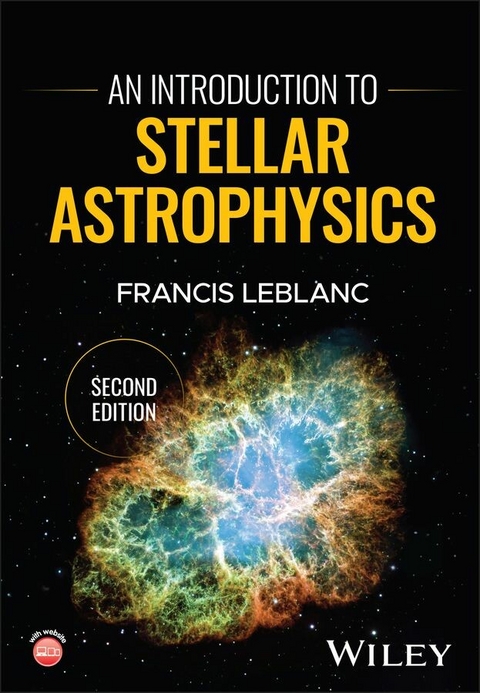
An Introduction to Stellar Astrophysics (eBook)
641 Seiten
Wiley (Verlag)
978-1-394-25180-3 (ISBN)
Accessible and student-friendly textbook on the astrophysics of stars, now with new observational data and physical concepts
An Introduction to Stellar Astrophysics is a concise textbook containing core content on and detailed examples of stellar physics and stellar astronomy. This new edition is revised and expanded and contains updated and new material on nearest and brightest stars, binary stars, Wolf Rayet stars and blue horizontal-branch stars, stellar evolution modeling and gravitational waves.
The book is divided in seven chapters: basic concepts, stellar formation, radiative transfer in stars, stellar atmospheres, stellar interiors, nucleosynthesis and stellar evolution, and chemically peculiar stars and diffusion. Student-friendly features include detailed examples, exercises with selected solutions, brief recalls of the most important physical concepts, chapter summaries, and optional and advanced sections that can be skipped on first reading.
A large number of graphs and figures are included to better explain the concepts covered. Only essential astronomical data are given, and the amount of observational results shown is deliberately limited in scope.
An Introduction to Stellar Astrophysics includes information on:
- The electromagnetic spectrum, blackbody radiation, luminosity, effective temperature, the Boltzmann and Saha equations, and the Hertzsprung-Russell diagram
- Hydrostatic equilibrium, the Virial theorem, the Jeans criteria, free-fall times, and pre-main-sequence evolution
- Radiative opacities, specific intensity and radiative moments, local thermodynamic equilibrium, radiative transfer and stellar atmospheres
- Energy transport in stars, polytropic models, stellar evolution, advanced nuclear burning, stellar remnants, and novae and supernovae
- Diffusion theory, radiative accelerations, and other transport processes
- New to this edition: sections on nearest and brightest stars, binary stars, the Eddington limit and stellar evolution modeling as well as several new special topics and additional exercises
Delivering intermediate knowledge on stars in a concise format, An Introduction to Stellar Astrophysics is an excellent textbook on the subject for advanced undergraduate and graduate students studying physics and astrophysics.
Francis LeBlanc, PhD, is Professor in the Department of Physics and Astronomy of Université de Moncton (Canada). His fields of expertise are diffusion in stars, chemically peculiar stars, and stellar atmospheres. Professor LeBlanc has taught several undergraduate courses on general astronomy, astrophysics and space sciences, and modern physics and nuclear physics, as well as a graduate course on stellar astrophysics. He has been invited to present talks and as an invited professor or researcher at several universities.
Accessible and student-friendly textbook on the astrophysics of stars, now with new observational data and physical concepts An Introduction to Stellar Astrophysics is a concise textbook containing core content on and detailed examples of stellar physics and stellar astronomy. This new edition is revised and expanded and contains updated and new material on nearest and brightest stars, binary stars, Wolf Rayet stars and blue horizontal-branch stars, stellar evolution modeling and gravitational waves. The book is divided in seven chapters: basic concepts, stellar formation, radiative transfer in stars, stellar atmospheres, stellar interiors, nucleosynthesis and stellar evolution, and chemically peculiar stars and diffusion. Student-friendly features include detailed examples, exercises with selected solutions, brief recalls of the most important physical concepts, chapter summaries, and optional and advanced sections that can be skipped on first reading. A large number of graphs and figures are included to better explain the concepts covered. Only essential astronomical data are given, and the amount of observational results shown is deliberately limited in scope. An Introduction to Stellar Astrophysics includes information on: The electromagnetic spectrum, blackbody radiation, luminosity, effective temperature, the Boltzmann and Saha equations, and the Hertzsprung-Russell diagramHydrostatic equilibrium, the Virial theorem, the Jeans criteria, free-fall times, and pre-main-sequence evolutionRadiative opacities, specific intensity and radiative moments, local thermodynamic equilibrium, radiative transfer and stellar atmospheresEnergy transport in stars, polytropic models, stellar evolution, advanced nuclear burning, stellar remnants, and novae and supernovaeDiffusion theory, radiative accelerations, and other transport processesNew to this edition: sections on nearest and brightest stars, binary stars, the Eddington limit and stellar evolution modeling as well as several new special topics and additional exercises Delivering intermediate knowledge on stars in a concise format, An Introduction to Stellar Astrophysics is an excellent textbook on the subject for advanced undergraduate and graduate students studying physics and astrophysics.
Chapter 1
Basic Concepts
1.1 Introduction
First, a definition must be given for what constitutes a star. A star can be defined as a self-gravitating celestial object in which there is, or there once was (in the case of dead stars), sustained thermonuclear fusion of hydrogen in their core. For example, in the Sun, hydrogen, which is the most abundant element in the Universe, is fused into helium via the nuclear reaction . Fusion is only present in the central regions of stars, because there exists a minimum threshold temperature at which this exothermic reaction can be ignited (which is of the order of 10 million degrees for this particular reaction). For hydrogen nuclei (protons) to be fused, they must have a close approach on the order of distance at which the strong nuclear force comes into play.1 The strong nuclear force is responsible for binding the nucleons (protons and neutrons) in the nucleus, and contrary to gravity, for instance, its field of action is limited to a distance on the order of 10−15 m. At the high temperatures found in the centers of stars, the kinetic energy of the protons is sufficient to vanquish the repulsive Coulomb force between them and bring the protons within the distance where the attractive strong nuclear force becomes dominant. Protons can then fuse together while emitting energy.
The energy emitted by thermonuclear reactions is given by Einstein’s famous formula, where is the difference in mass between the species on the left-hand and right-hand sides of the arrow found in the nuclear reaction given above, and is the speed of light in vacuum. However, the hydrogen-burning reaction given above can be a bit misleading, since it suggests that four protons meet to form a helium nucleus. In reality, a series of nuclear reactions is needed to give this global reaction. On another note, even though only a small fraction of a star’s mass will be transformed to energy during its lifetime, it will suffice to compensate for the energy irradiated at its surface. Details concerning various nuclear reactions of importance in stars will be discussed in Chapter 6.
Stars are formed following the gravitational collapse of cold molecular clouds found in the Universe. As the cloud or portions of it collapses, it can be shown (see Chapter 2) that approximately half of the gravitational energy gained is used to increase the internal temperature of the cloud and the remaining energy is irradiated as electromagnetic radiation in space. If the mass of the collapsed cloud is sufficient (i.e. more than approximately 8% of the mass of the Sun), the central temperatures will attain a value superior to the threshold temperature for sustained hydrogen fusion, which would, by definition, lead to star birth. The solar mass is , where the symbol represents the Sun.2 The physical properties of stars are often given in units of the corresponding value for the Sun. The gravitational collapse will continue until equilibrium is reached, where the nuclear energy generated per unit time (or its power) at the center of the star equals the power output at its surface due to radiation emission. A star at this stage of its life is commonly called a main-sequence star. Since gravity has radial symmetry, a star will have a spherical shape (unless it has a high rotational speed). More details concerning stellar formation will be given in Chapter 2.
A star shines (or emits radiation) because of its high surface temperature. For example, the surface temperature of the Sun is approximately 5800 K, while its central temperature is approximately 16 million K. The decrease of the temperature as a function of distance from the center is a natural occurrence that causes energy transport from the central regions to the surface of the Sun. Since the gas composing a star is characterized by an opacity to radiation, an observer looking at a star can only see its exterior regions, which is commonly called the photosphere or stellar atmosphere, having a geometrical depth of up to a few percent of the stellar radius. This is similar to looking in a cloud of fog, being able to see only a certain distance before light signals are attenuated. The radiative field exiting a star depends on the temperature of these outer layers and is associated to their blackbody spectra. The physical properties of blackbodies will be discussed in Section 1.3 and will lead to an explanation why stars have different colors.
There are three modes of transportation of energy in stars. The most important is radiation. For this mode, the energy is transported when electromagnetic radiation diffuses from the central regions of stars toward their exterior. In regions where the radiative opacity becomes large, convection can dominate energy transport. Convection is the transport of energy by the vertical movements of cells of matter in the stars. Conduction is the third mode of transportation of energy in stars. However, this mode is rarely important. More details concerning energy transport will be discussed in Chapters 3 and 5.
As mentioned above, a star begins its life by transforming hydrogen to helium in its core. As time passes, the abundance of hydrogen gradually decreases in the star’s core, and eventually, the fuel for this particular nuclear process, namely hydrogen, will all be spent. As hydrogen is transformed into helium, the structure of the star readjusts. The core contracts, causing an increase of the central temperatures until possibly, depending on the initial mass of the star, helium fuses to produce carbon via the well-known triple-α reaction: . Meanwhile, the outer regions of the star expand. The star then becomes what is called a red giant. The final destiny of a star depends almost solely on its initial mass; it will become a white dwarf, a neutron star, or a black hole. More details concerning stellar evolution will be given in Chapter 6.
For massive stars, a succession of nuclear reactions will occur during their different stages of evolution. The thermonuclear reactions in these stars are responsible for the synthesis of various elements, such as carbon, oxygen, silicon, etc., up to iron. This process is called nucleosynthesis. As known from the Big Bang theory, at the beginning of the Universe, only hydrogen, helium, and trace amounts of lithium were created. The formation of the other elements takes place in stars. Stars can therefore be seen as the Universe’s production factories, generating all atoms heavier than helium, except for some lithium. In astronomy, elements heavier than helium are called metals, and the fraction of the mass composed of metals is called the metallicity . The metallicity of the outer layers of the Sun is approximately . Meanwhile, the mass fraction of hydrogen and helium at the surface of the Sun are, respectively, and (and therefore ). All of the atoms of these heavy elements found on Earth were created in stars, which then exploded in the form of supernovae ejecting this enriched matter into space. Some of this enriched matter was later found in the primordial cloud from which the Sun and the Earth were created. Life itself would be impossible without the creation of the elements in stars.
This is why stars are fundamental for our existence and can be considered as the main building blocks of the Universe. It is then crucial to understand them via the study of stellar astrophysics. This field of study is fascinating since it incorporates all major fields of physics (see Figure 1.1): nuclear, atomic, molecular and quantum physics, electromagnetism, relativity, thermodynamics, hydrodynamics, etc. This book aims to give the reader an introduction to this fundamental subject by emphasizing the physical concepts involved and their specific importance in stars.
Figure 1.1 Figure illustrating the various fields of physics that intervene in stars.
1.2 The Electromagnetic Spectrum
As is known from quantum mechanics, electromagnetic radiation has two personalities. It sometimes behaves like waves and at other times like particles. These particles are called photons. These two aspects of radiation are known as the wave–particle duality. For most radiative processes in stars, like an atomic absorption of a photon, for example, radiation will act like a photon, rather than a wave. The wave–particle duality also applies to matter.
The energy of photons is related to the frequency and wavelength of the associated electromagnetic wave via the following expression
where is the Planck constant and is the speed of light in vacuum.
Even though a photon of wavelength has no mass, it possesses momentum equal to
As will be shown later, this physical quantity is of great importance in stars. Momentum transfer occurs from the radiation field to the stellar plasma following atomic absorption of photons, and this causes what is called radiation pressure.
The electromagnetic spectrum can be divided into a number of regions (see Table 1.1). It should be noted that the boundaries of these regions can vary from one source to another. For example, in astronomy the radio region often includes microwaves . The visible part of the electromagnetic spectrum is in the range , where Å represents a unit of length called the angstrom and is equal to 10−8 cm. Within the visible part of the spectrum, several colors (blue, yellow, etc.) can be observed that are defined by wavelength. The approximate (or representative) wavelengths of these colors are given in Table...
| Erscheint lt. Verlag | 3.11.2025 |
|---|---|
| Sprache | englisch |
| Themenwelt | Naturwissenschaften ► Physik / Astronomie ► Astronomie / Astrophysik |
| Schlagworte | Binary stars • Brightest Stars • double stars • nearest stars • Nucleosynthesis • radiative transfer stars • stellar atmospheres • stellar evolution • stellar formation • stellar interiors • stellar remnants • white dwarfs • Wolf Rayet stars |
| ISBN-10 | 1-394-25180-7 / 1394251807 |
| ISBN-13 | 978-1-394-25180-3 / 9781394251803 |
| Informationen gemäß Produktsicherheitsverordnung (GPSR) | |
| Haben Sie eine Frage zum Produkt? |
 EPUB (Adobe DRM)
Kopierschutz: Adobe-DRM
Adobe-DRM ist ein Kopierschutz, der das eBook vor Mißbrauch schützen soll. Dabei wird das eBook bereits beim Download auf Ihre persönliche Adobe-ID autorisiert. Lesen können Sie das eBook dann nur auf den Geräten, welche ebenfalls auf Ihre Adobe-ID registriert sind.
Details zum Adobe-DRM
Dateiformat: EPUB (Electronic Publication)
EPUB ist ein offener Standard für eBooks und eignet sich besonders zur Darstellung von Belletristik und Sachbüchern. Der Fließtext wird dynamisch an die Display- und Schriftgröße angepasst. Auch für mobile Lesegeräte ist EPUB daher gut geeignet.
Systemvoraussetzungen:
PC/Mac: Mit einem PC oder Mac können Sie dieses eBook lesen. Sie benötigen eine
eReader: Dieses eBook kann mit (fast) allen eBook-Readern gelesen werden. Mit dem amazon-Kindle ist es aber nicht kompatibel.
Smartphone/Tablet: Egal ob Apple oder Android, dieses eBook können Sie lesen. Sie benötigen eine
Geräteliste und zusätzliche Hinweise
Buying eBooks from abroad
For tax law reasons we can sell eBooks just within Germany and Switzerland. Regrettably we cannot fulfill eBook-orders from other countries.
aus dem Bereich