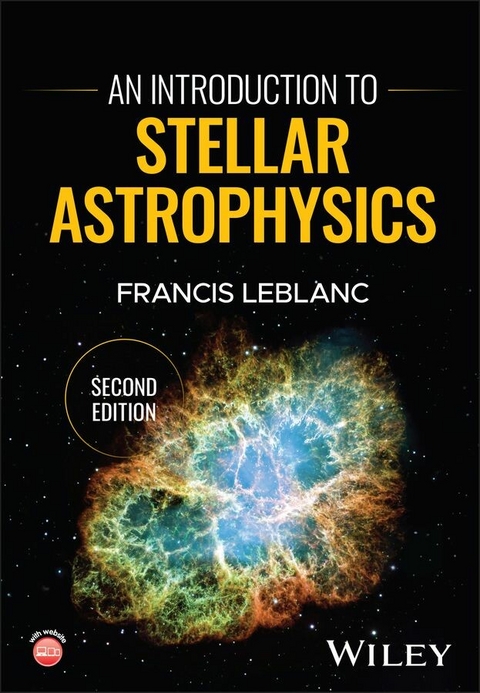
An Introduction to Stellar Astrophysics (eBook)
355 Seiten
Wiley (Verlag)
978-1-394-25181-0 (ISBN)
Accessible and student-friendly textbook on the astrophysics of stars, now with new observational data and physical concepts
An Introduction to Stellar Astrophysics is a concise textbook containing core content on and detailed examples of stellar physics and stellar astronomy. This new edition is revised and expanded and contains updated and new material on nearest and brightest stars, binary stars, Wolf Rayet stars and blue horizontal-branch stars, stellar evolution modeling and gravitational waves.
The book is divided in seven chapters: basic concepts, stellar formation, radiative transfer in stars, stellar atmospheres, stellar interiors, nucleosynthesis and stellar evolution, and chemically peculiar stars and diffusion. Student-friendly features include detailed examples, exercises with selected solutions, brief recalls of the most important physical concepts, chapter summaries, and optional and advanced sections that can be skipped on first reading.
A large number of graphs and figures are included to better explain the concepts covered. Only essential astronomical data are given, and the amount of observational results shown is deliberately limited in scope.
An Introduction to Stellar Astrophysics includes information on:
- The electromagnetic spectrum, blackbody radiation, luminosity, effective temperature, the Boltzmann and Saha equations, and the Hertzsprung-Russell diagram
- Hydrostatic equilibrium, the Virial theorem, the Jeans criteria, free-fall times, and pre-main-sequence evolution
- Radiative opacities, specific intensity and radiative moments, local thermodynamic equilibrium, radiative transfer and stellar atmospheres
- Energy transport in stars, polytropic models, stellar evolution, advanced nuclear burning, stellar remnants, and novae and supernovae
- Diffusion theory, radiative accelerations, and other transport processes
- New to this edition: sections on nearest and brightest stars, binary stars, the Eddington limit and stellar evolution modeling as well as several new special topics and additional exercises
Delivering intermediate knowledge on stars in a concise format, An Introduction to Stellar Astrophysics is an excellent textbook on the subject for advanced undergraduate and graduate students studying physics and astrophysics.
Francis LeBlanc, PhD, is Professor in the Department of Physics and Astronomy of Université de Moncton (Canada). His fields of expertise are diffusion in stars, chemically peculiar stars, and stellar atmospheres. Professor LeBlanc has taught several undergraduate courses on general astronomy, astrophysics and space sciences, and modern physics and nuclear physics, as well as a graduate course on stellar astrophysics. He has been invited to present talks and as an invited professor or researcher at several universities.
Accessible and student-friendly textbook on the astrophysics of stars, now with new observational data and physical concepts An Introduction to Stellar Astrophysics is a concise textbook containing core content on and detailed examples of stellar physics and stellar astronomy. This new edition is revised and expanded and contains updated and new material on nearest and brightest stars, binary stars, Wolf Rayet stars and blue horizontal-branch stars, stellar evolution modeling and gravitational waves. The book is divided in seven chapters: basic concepts, stellar formation, radiative transfer in stars, stellar atmospheres, stellar interiors, nucleosynthesis and stellar evolution, and chemically peculiar stars and diffusion. Student-friendly features include detailed examples, exercises with selected solutions, brief recalls of the most important physical concepts, chapter summaries, and optional and advanced sections that can be skipped on first reading. A large number of graphs and figures are included to better explain the concepts covered. Only essential astronomical data are given, and the amount of observational results shown is deliberately limited in scope. An Introduction to Stellar Astrophysics includes information on: The electromagnetic spectrum, blackbody radiation, luminosity, effective temperature, the Boltzmann and Saha equations, and the Hertzsprung-Russell diagramHydrostatic equilibrium, the Virial theorem, the Jeans criteria, free-fall times, and pre-main-sequence evolutionRadiative opacities, specific intensity and radiative moments, local thermodynamic equilibrium, radiative transfer and stellar atmospheresEnergy transport in stars, polytropic models, stellar evolution, advanced nuclear burning, stellar remnants, and novae and supernovaeDiffusion theory, radiative accelerations, and other transport processesNew to this edition: sections on nearest and brightest stars, binary stars, the Eddington limit and stellar evolution modeling as well as several new special topics and additional exercises Delivering intermediate knowledge on stars in a concise format, An Introduction to Stellar Astrophysics is an excellent textbook on the subject for advanced undergraduate and graduate students studying physics and astrophysics.
| Erscheint lt. Verlag | 23.10.2025 |
|---|---|
| Sprache | englisch |
| Themenwelt | Naturwissenschaften ► Physik / Astronomie ► Astronomie / Astrophysik |
| Schlagworte | Binary stars • Brightest Stars • double stars • nearest stars • Nucleosynthesis • radiative transfer stars • stellar atmospheres • stellar evolution • stellar formation • stellar interiors • stellar remnants • white dwarfs • Wolf Rayet stars |
| ISBN-10 | 1-394-25181-5 / 1394251815 |
| ISBN-13 | 978-1-394-25181-0 / 9781394251810 |
| Informationen gemäß Produktsicherheitsverordnung (GPSR) | |
| Haben Sie eine Frage zum Produkt? |
 PDF (Adobe DRM)
Kopierschutz: Adobe-DRM
Adobe-DRM ist ein Kopierschutz, der das eBook vor Mißbrauch schützen soll. Dabei wird das eBook bereits beim Download auf Ihre persönliche Adobe-ID autorisiert. Lesen können Sie das eBook dann nur auf den Geräten, welche ebenfalls auf Ihre Adobe-ID registriert sind.
Details zum Adobe-DRM
Dateiformat: PDF (Portable Document Format)
Mit einem festen Seitenlayout eignet sich die PDF besonders für Fachbücher mit Spalten, Tabellen und Abbildungen. Eine PDF kann auf fast allen Geräten angezeigt werden, ist aber für kleine Displays (Smartphone, eReader) nur eingeschränkt geeignet.
Systemvoraussetzungen:
PC/Mac: Mit einem PC oder Mac können Sie dieses eBook lesen. Sie benötigen eine
eReader: Dieses eBook kann mit (fast) allen eBook-Readern gelesen werden. Mit dem amazon-Kindle ist es aber nicht kompatibel.
Smartphone/Tablet: Egal ob Apple oder Android, dieses eBook können Sie lesen. Sie benötigen eine
Geräteliste und zusätzliche Hinweise
Buying eBooks from abroad
For tax law reasons we can sell eBooks just within Germany and Switzerland. Regrettably we cannot fulfill eBook-orders from other countries.
aus dem Bereich