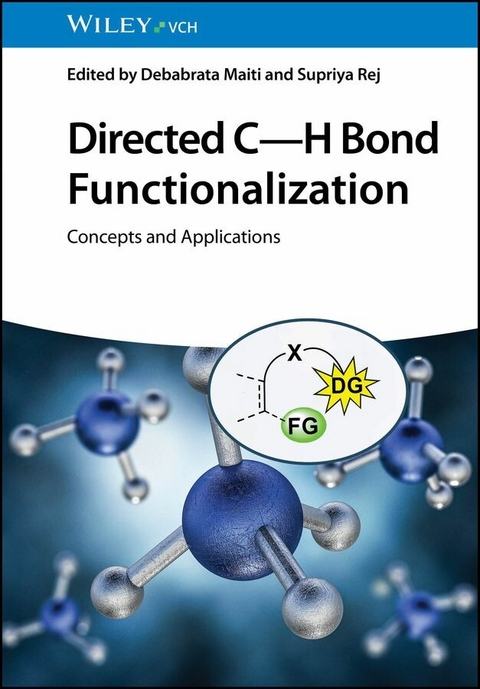
Directed C-H Bond Functionalization (eBook)
992 Seiten
Wiley-VCH (Verlag)
978-3-527-84846-1 (ISBN)
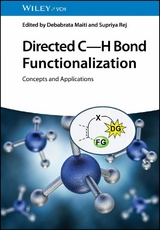
Streamlined, cost-effective, and environmentally benign concepts for the synthesis of chemical building blocks and pharmaceuticals
Directed C-H Bond Functionalization summarizes recent advances in the field of selective and efficient C-H bond functionalization using directing groups.
Written by a team of experts in the field, Directed C-H Bond Functionalization includes information on:
- History of the C-H bond activation and its discovery
- In-built functional group-directed C-H functionalization, proximal C-H bond functionalization, and template-assisted distal C-H bond functionalization
- Transient-directing group-assisted C-H bond functionalization and bifunctional non-covalent template-assisted C-H functionalization
- Redox catalytic methods and metal-free directed C-H functionalization reactions
- Industrial and synthetic application of directed C-H bond functionalization in organic synthesis, medicinal, and process chemistry
With its all-encompassing approach, Directed C-H Bond Functionalization is a timely, essential reference for synthetic chemists in academia and industry working in the fields of organic synthesis, catalysis, sustainable chemistry, and drug design.
Debabrata Maiti is Professor and Institute Chair in the Department of Chemistry, IIT Bombay, India. His research interests are focused on the development of new and sustainable synthetic and catalytic methodologies. He is an Associate Editor for the Journal of Organic Chemistry (ACS).
Supriya Rej is a Ramanujan faculty in the Department of Chemistry at IIT Dharwad, India. His current research focuses on bond activation and synthetic methodology development.
1
History of Directed C—H Bond Activation and its Discovery
Susmita Mondal1,*, Sumit Ghosh2,*, Asim Kumar Ghosh2, and Alakananda Hajra2
1Department of Chemistry, Central Ayurveda Research Institute, 4‐CN Block, Bidhannagar, Kolkata, 700091, West Bengal, India
2Department of Chemistry, Visva‐Bharati (A Central University), Santiniketan, 731235, West Bengal, India
1.1 Introduction
C—H Functionalization is a groundbreaking technique in synthetic organic chemistry that allows the direct transformation of C—H bonds into C—C or C—X (X = heteroatom) bonds [1]. However, regioselective functionalization of C—H bonds is a highly challenging task due to its ubiquitous nature [2]. Thus, in past decades, pre‐functionalization was performed on starting molecules for further functionalization [3]. Within this realm, transition metal‐catalyzed C—H bond activation for the construction of C—C and C—X bonds is one of the most significant and challenging fields of research due to its more research‐laboratory‐friendly conditions, high efficiency, and selective C—H functionalization [4]. A molecular complex can be built from readily available simple hydrocarbon counterparts by using this strategy [5]. Therefore, functional‐group‐assisted site‐selective C—H bond activation for functionalization shows great promise to researchers. The coordination of transition metal catalysts with the directing group controls the site selectivity of the reaction. The pioneering work in the field was reported by Lewis and Murai in 1986 who reported regioselective mono‐ and di‐ortho‐alkylations of phenol with ethylene, which proceed through the formation of ruthenium phosphite complex [6]. After that, various directing group‐assisted chelation‐controlled C—H activation strategies have been developed for the incorporation of various functional groups like amide, anilide, imine, heterocyclic, amine, carboxylic acid, ester, ketone, and hydroxyl [7]. There are mainly two types of directing group‐assisted C—H functionalizations: one is the built‐in directing group‐assisted C—H bond functionalization and another is the removable directing group‐assisted C—H bond functionalization. The built‐in directing group is already present in the functionalized molecule; thus, it reduces the step economic issue, whereas the removal directing group may be pre‐installed or installed in situ in a molecule to achieve a favored coordination with the metal for selective C—H bond functionalization. In the former directing group, there is a possibility of unprecedented reactions due to the weak coordination ability to a metal, but the removal directing group has an optimum coordinating ability toward the metal catalyst and is widely used for the functionalization of a non‐biased C—H bond.
Figure 1.1 Schematic representation of the evolution of C—H activation.
Therefore, a brief overview on the history of directed C—H functionalization is much needed. Our group has also worked on directed C—H functionalization [8]. In this chapter, we have presented a strategic evaluation of directing group‐assisted selective C—H bond functionalization via C–H activation. We have included early discoveries on stoichiometric metal‐promoted proximal C—H bond activation, directing group (both built‐in functional group and removal directing group)‐assisted catalytic proximal C—H bond functionalization, and directing group‐assisted distal (both meta & para) C—H bond activation in this chapter. Figure 1.1 represents the historical evolution of C—H bond activation.
1.2 Importance of C—H Activation
C—H Bond activation allows the synthesis of compounds without the requirement of pre‐halogenated or pre‐functionalized starting materials, which are typically required in traditional methods; hence, this approach is more environmentally friendly. On the other hand, C—H bond activation simplifies the synthetic process by reducing the number of steps needed. It also allows for the direct functionalization of hydrocarbons, which are the primary raw materials derived from oil and natural gas used in the chemical industry. Not only that, it has a significant interest in late‐stage modification in the pharmaceutical and material industries.
1.3 Early Discoveries in Stoichiometric Metal‐promoted Proximal C—H Bond Functionalization
In 1937, A. Farkas and L. Farkas first discovered the interaction between a C—H bond and a transition metal during the catalytic exchange of benzene and D2 on a platinum foil [9]. After that, Garnett [10] and Parshall [11] also reported the metal atom interaction with either aromatic or aliphatic C—H bond. These discoveries inspired researchers to activate unreactive C—H bonds for functionalization purposes. In this regard, in 1955 and 1956, Murahashi and Horiie [12] carried out Co‐promoted C—H carbonylation with carbon monoxide of a Schiff base and azobenzene, respectively (Scheme 1.1a). The following two reactions proceeded through the formation of a five‐membered cobaltacycle. After that, a number of research groups were actively involved in the carbonylation of different moieties via C—H bond activation. In 1958, Rosenthal et al. [13] reported Co‐promoted ortho‐carbonylation of benzophenone oxime (Scheme 1.1b), and Bagga et al. [14] developed Fe‐promoted carbonylation of a Schiff base (Scheme 1.1c). Other metallacycles like nickelacycle [15], ferrocycle [16], platinacycle [17], and palladacycle [17] (formed from corresponding metal complexes with the interaction of N‐atom of organic core) have been isolated, which may serve as a directing group for C—H functionalization via the activation of a C—H bond. In this connection, Fahey group [18] used palladacycles formed from the reaction of azobenzene and PdCl2 for halogenation (chlorination and bromination) of azobenzenes (Scheme 1.1d). Komiya group [19] used a ruthenium hydride complex for the deuteration of a C—H bond with DCl (Scheme 1.1e).
Scheme 1.1 Pioneering reports on directed C—H functionalization reactions.
1.4 Directing Group‐assisted Catalytic Proximal C—H Bond Functionalization
1.4.1 In‐built Functional‐Group‐directed Proximal C—H Bond Functionalization
In the previous section, we have discussed transition‐metal‐complex‐mediated C—H bond activation for functionalization. Meanwhile, catalytic‐directed C—H activation was first done by Nugent et al. [20] in 1983, who reported C—H bond activation of dimethylamine for alkylation with alkenes using a metal dimethylamide precursor (Scheme 1.2).
Scheme 1.2 C—H bond activation of dimethylamine for alkylation.
One of the essential catalytic C—H activation reactions was reported by Murai et al. [21] in 1993 (Scheme 1.3). They used a ketone as a directing group for the regioselective ortho‐C—H alkylation of aromatic ketones with alkenes. The reaction proceeds through a metallacycle, which was the key intermediate of the reaction.
Scheme 1.3 Regioselective ortho‐C—H alkylation of aromatic ketones.
After that, numerous research works have been published on this field using various functional groups as directing moiety, such as carbonyl, amine, amides, hydroxyl, carboxylic acid, and sulfonic acid derivatives. Daugulis and Zaitsev [22] reported palladium‐catalyzed ortho‐arylation (both mono‐ and di‐) of anilides using amide as a directing group and aryl iodides as an arylating agent in 2005 (Scheme 1.4). The method is highly tolerant to functional groups showing up to 1000 turnovers for this reaction.
Scheme 1.4 Palladium‐catalyzed ortho‐arylation of anilides.
Kuninobu et al. [23] developed a method for direct aryl C—H addition to aldehyde using N‐containing directing group in the presence of 5 mol% [MnBr(CO)5] in toluene (Scheme 1.5). This present protocol could be applied for asymmetric transformation using an aromatic compound with a chiral substituent.
Scheme 1.5 Mn‐catalyzed remote C—H addition to aldehyde.
In 2009, Zhang and Yu [24] developed a versatile method for ortho‐hydroxylation of benzoic acids using Pd catalyst under O2 atmosphere (Scheme 1.6). Mechanistic investigations suggested that direct oxygenation took the place of aryl‐Pd species from molecular O2. A wide range of functional groups were well tolerable in the reaction.
Scheme 1.6 Pd‐catalyzed ortho‐hydroxylation of acid derivatives.
Rhodium‐catalyzed Grignard‐type arylation of activated...
| Erscheint lt. Verlag | 31.10.2025 |
|---|---|
| Sprache | englisch |
| Themenwelt | Naturwissenschaften ► Chemie ► Organische Chemie |
| Schlagworte | C-H Bond Activation • C-H bond discovery • directed C-H functionalization • metal-free directed C-H functionalization reactions • proximal C-H bond functionalization • Redox catalytic methods • template-assisted distal C-H bond |
| ISBN-10 | 3-527-84846-0 / 3527848460 |
| ISBN-13 | 978-3-527-84846-1 / 9783527848461 |
| Informationen gemäß Produktsicherheitsverordnung (GPSR) | |
| Haben Sie eine Frage zum Produkt? |
 EPUB (Adobe DRM)
Kopierschutz: Adobe-DRM
Adobe-DRM ist ein Kopierschutz, der das eBook vor Mißbrauch schützen soll. Dabei wird das eBook bereits beim Download auf Ihre persönliche Adobe-ID autorisiert. Lesen können Sie das eBook dann nur auf den Geräten, welche ebenfalls auf Ihre Adobe-ID registriert sind.
Details zum Adobe-DRM
Dateiformat: EPUB (Electronic Publication)
EPUB ist ein offener Standard für eBooks und eignet sich besonders zur Darstellung von Belletristik und Sachbüchern. Der Fließtext wird dynamisch an die Display- und Schriftgröße angepasst. Auch für mobile Lesegeräte ist EPUB daher gut geeignet.
Systemvoraussetzungen:
PC/Mac: Mit einem PC oder Mac können Sie dieses eBook lesen. Sie benötigen eine
eReader: Dieses eBook kann mit (fast) allen eBook-Readern gelesen werden. Mit dem amazon-Kindle ist es aber nicht kompatibel.
Smartphone/Tablet: Egal ob Apple oder Android, dieses eBook können Sie lesen. Sie benötigen eine
Geräteliste und zusätzliche Hinweise
Buying eBooks from abroad
For tax law reasons we can sell eBooks just within Germany and Switzerland. Regrettably we cannot fulfill eBook-orders from other countries.
aus dem Bereich