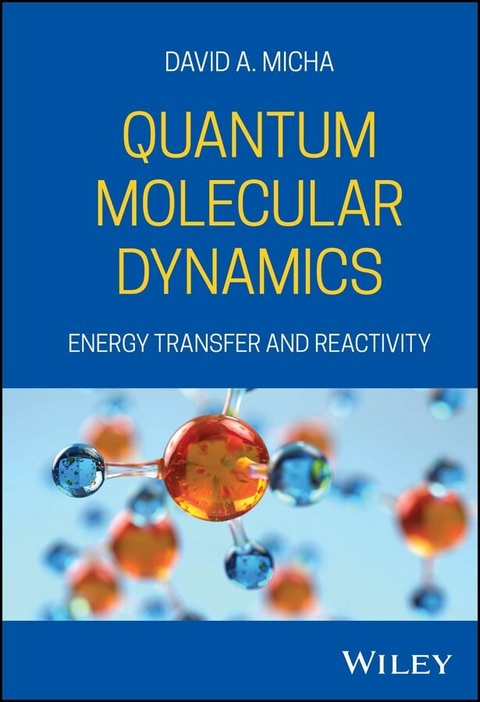
Quantum Molecular Dynamics (eBook)
591 Seiten
Wiley (Verlag)
978-1-119-31926-9 (ISBN)
Presents theoretical, computational, and practical aspects of collision-induced phenomena with emphasis on the treatment of physical and chemical kinetics using quantum molecular dynamics
Quantum Molecular Dynamics provides a state-of-the-art overview of molecular collisions for energy-transfer and reactivity phenomena in gases. Grounded in the quantal theory of scattering and its semiclassical limits, this comprehensive volume covers key concepts and theory, computational approaches, and various applications for specific physical systems.
Detailed chapters describe elastic, inelastic and reactive collisions, that lead to energy transfer, electronic transitions, chemical reactions, and more. Starting from the electronic structure and atomic conformation of molecules, the text proceeds from introductory material to advanced modern treatments relevant to applications to new materials, the environment, biological phenomena, and energy and fuels production.
- Provides a thorough introduction to collision dynamics with realistic intermolecular forces
- Covers thermal rates and cross sections of molecular collisions phenomena
- Examines electronic excitation and relaxation phenomena mediated by molecular collisions
- Discusses many-atom scattering theory as an introduction to more advanced descriptions
- Presents the computational aspects required to calculate and compare cross-sections with experimental data
- Includes worked examples and applications to different physical systems
Quantum Molecular Dynamics is an important resource for researchers and advanced undergraduate and graduate students in physical, theoretical, and computational chemistry, chemical physics, materials science, as well as chemists, engineers, and biologists working in the energy and pharmaceutical industries and the environment.
David A. Micha is a Professor of Chemistry and Physics at the University of Florida. His many research interests include intermolecular forces, collisional energy transfer, electron transfer, photoinduced dynamics, reactions in gas phase collisions, energy and electron transfer, and photodynamics at solid surfaces. Dr. Micha has also been co-organizer of the international 'Sanibel Symposium on Theory and Computation for the Molecular and Materials Sciences' in the USA since 1985. He is a co-editor of several science books, and author of numerous science publications. He has been the organizer of several Pan-American Workshops on Molecular and Materials Sciences.
Presents theoretical, computational, and practical aspects of collision-induced phenomena with emphasis on the treatment of physical and chemical kinetics using quantum molecular dynamics Quantum Molecular Dynamics provides a state-of-the-art overview of molecular collisions for energy-transfer and reactivity phenomena in gases. Grounded in the quantal theory of scattering and its semiclassical limits, this comprehensive volume covers key concepts and theory, computational approaches, and various applications for specific physical systems. Detailed chapters describe elastic, inelastic and reactive collisions, that lead to energy transfer, electronic transitions, chemical reactions, and more. Starting from the electronic structure and atomic conformation of molecules, the text proceeds from introductory material to advanced modern treatments relevant to applications to new materials, the environment, biological phenomena, and energy and fuels production. Provides a thorough introduction to collision dynamics with realistic intermolecular forcesCovers thermal rates and cross sections of molecular collisions phenomenaExamines electronic excitation and relaxation phenomena mediated by molecular collisionsDiscusses many-atom scattering theory as an introduction to more advanced descriptionsPresents the computational aspects required to calculate and compare cross-sections with experimental dataIncludes worked examples and applications to different physical systems Quantum Molecular Dynamics is an important resource for researchers and advanced undergraduate and graduate students in physical, theoretical, and computational chemistry, chemical physics, materials science, as well as chemists, engineers, and biologists working in the energy and pharmaceutical industries and the environment.
1
Collisional Phenomena, Cross Sections, and Rates
CONTENTS
- 1.1 Electronic and Nuclear Motions in Collisional Phenomena
- 1.2 Collisional Cross Sections
- 1.3 Quantal Description of Collisions
- 1.4 Examples of Physical Systems and Phenomena
- 1.5 Transport, Energy Relaxation, and Reaction Rates in Gases
- 1.6 Concepts and Methods in the Quantal Modelling
- References
1.1 Electronic and Nuclear Motions in Collisional Phenomena
Matter consisting of particles such as atoms or molecules in a gas, where interparticle average distances are large compared to the size of the constituent particles, can be described in terms of pair interactions during collisions, insofar the probability of finding a third particle nearby is small and its effect on the interaction pair is negligible.
Collisions in a gas can be described in terms of the properties of constituent particles, their positions and velocities, and their interaction potential energies [1–4]. This can sometimes be done with classical mechanics or more generally within quantum mechanics. For colliding particles A and B, it is convenient to describe their relative motion in terms of their interparticle distance and their relative velocities. The rate of encounters (or number of collisions per unit time) is proportional to the relative flux (or number of collisions per unit time and unit area traversed by the relative-motion trajectories), with the proportionality factor equal to a collisional cross section, a measure of the diameters of the particles dependent on their relative velocity.
If the gas has been in contact with a medium of a given temperature, it will eventually reach thermal equilibrium through energy exchange during collisions, and rate processes can be assumed to occur near thermal equilibrium. This remains stable insofar individual pair interactions occur in a diluted system with low particle densities.
There is extensive literature on concepts and applications of molecular collision phenomena and their relation to experimental methods such as molecular beam scattering and spectroscopy. At the introductory level, some (among many others) relevant books are in references [5–10]. At an intermediate level, a classic text is [11] among others [12–17], dealing with quantitative treatments. Advanced treatments with extensive use of the quantum formalism of scattering theory are found in [18–24]. Applications involving models, and calculations of cross sections of interest in the interpretation of experimental results obtained with molecular beam and spectroscopic techniques, are available in [25–35], and the use of cross sections as inputs in molecular reaction rates, gaseous transport, and kinetics, can be found in [36–45]. Mathematical and computational methods developed for the calculation of cross sections can be found in [46–51]. Applications to surface phenomena are also covered in several books, among them [52–54].
The interaction of molecules with photons leading to photoinduced phenomena such as dissociation and ionization and related theory can be found in [15, 55–57], and scattering of electrons by atoms and molecules are found in [11, 58, 59]. In addition, many recent relevant chapters about molecular collisions in gases and at surfaces and about molecular interactions with photons are found in volumes of several edited series on advances, such as Advances in Chemical Physics; Advances in Quantum Chemistry; Advances in Atomic, Molecular and Optical Physics; and Annual Review of Physical Chemistry.
Given all this literature on molecular collisional phenomena and applications, it is relevant to point out why there is a need for yet another presentation of these subjects. It helps to introduce subjects in some detail, starting from fundamental concepts and proceeding to advanced methods, as done in what follows here in every chapter. Also, many new developments have occurred in recent years in new computational methods prompted by the derivation of new algorithms and by the availability of more powerful computer hardware and software. Many new results have been generated involving complex phenomena and for larger molecular systems. Recent developments in information sciences and artificial intelligence provide large amounts of organized relevant data and ways to retrieve it. The language of concepts and methods in what follows provides tools to access desired data. They provide new insights and data useful in many applications. Some of these new methods and results are integrated into what follows after covering the traditional subjects on molecular collisions and gaseous kinetics. The presentation in each chapter begins at a level accessible to undergraduate students with knowledge of differential equations and special functions, who are familiar with introductions to quantum mechanics, and proceeds to present recent developments.
Insights on the quantum dynamics of molecular interactions involving a many-atom system can best be derived from the interplay of accurate experimental measurements, such as those obtained from crossed molecular beams or from time-resolved spectroscopy, and detailed theoretical treatments from quantum mechanics and statistics. Theory provides an interpretation of measurements and resulting data on molecular interactions and dynamics, while experimental measurements provide checks on the accuracy of models and calculations.
Figure 1.1 shows relationships mediated by quantum chemistry, molecular dynamics, and statistical mechanics, leading from electrons, nuclei, and photons present in molecules and electromagnetic fields, to physical properties. Collisional cross sections, transport coefficients, and reaction rates follow from potential energy functions by means of molecular dynamics and statistical mechanics. Obtained from reference [4].
Figure 1.1 Relationships mediated by quantum chemistry, molecular dynamics, and statistical mechanics, leading from electrons, nuclei, and photons present in molecules and electromagnetic fields, to physical properties. Collisional cross sections, transport coefficients, and reaction rates follow from potential energy functions by means of molecular dynamics and statistical mechanics.
Obtained from reference [4] / John Wiley & Sons.
1.2 Collisional Cross Sections
1.2.1 Definition of a Cross Section
Let us consider a collision process
where the collision species A, B, C, and D may be electrons, atoms, molecules, ions, photons, or even a surface. The index p is a collection of quantum numbers specifying the internal (electronic and rovibrational) state of A, and similarly for the others. The pair (p, q) and the initial relative motion momentum define the reactant-channel state , and similarly β is used for products C and D and final momentum .
For two stationary beams with velocities and colliding in a laboratory (LAB) frame, as shown in Figure 1.2, with an incoming flux of A relative to B, equal to the number of A particles moving toward B per unit area and unit time, with nA (or nB) the number of particles A (or B) per unit volume, the increment of the α → β reaction rate (pairs/unit time) may be expressed as
Here = is the relative velocity of the particles, τ is the reaction volume, and dΩC is an increment of solid angle subtended by the detector of emerging product species C.
Figure 1.2 Two stationary beams with velocities and colliding in a laboratory (LAB) frame, leading to the formation of species C and D. Here τ is the reaction volume and dΩC is an increment of solid angle subtended by the detector of particle C.
Hence nB τ is the number of particles B in the reaction volume and nA is the flux of particles A relative to each B. The function is a differential cross section in the laboratory frame, with units of area. The integral cross section is defined by
1.2.2 Conservation Laws
As long as each pair collision may be considered an isolated event, we must have conservation of the total mass, momentum, angular momentum, and energy of the system. Indicating the final values with primed symbols, we have conservation of
- (a) Mass,...
| Erscheint lt. Verlag | 31.10.2025 |
|---|---|
| Sprache | englisch |
| Themenwelt | Naturwissenschaften ► Chemie ► Physikalische Chemie |
| Schlagworte | chemical kinetics in gases • energy relaxation phenomena • energy transfer in gases • gaseous kinetics • intermolecular forces gases • many-atom dynamics • molecular collisions in gases • quantum dynamics • Reaction Dynamics • thermal rates in gases |
| ISBN-10 | 1-119-31926-9 / 1119319269 |
| ISBN-13 | 978-1-119-31926-9 / 9781119319269 |
| Informationen gemäß Produktsicherheitsverordnung (GPSR) | |
| Haben Sie eine Frage zum Produkt? |
 EPUB (Adobe DRM)
Kopierschutz: Adobe-DRM
Adobe-DRM ist ein Kopierschutz, der das eBook vor Mißbrauch schützen soll. Dabei wird das eBook bereits beim Download auf Ihre persönliche Adobe-ID autorisiert. Lesen können Sie das eBook dann nur auf den Geräten, welche ebenfalls auf Ihre Adobe-ID registriert sind.
Details zum Adobe-DRM
Dateiformat: EPUB (Electronic Publication)
EPUB ist ein offener Standard für eBooks und eignet sich besonders zur Darstellung von Belletristik und Sachbüchern. Der Fließtext wird dynamisch an die Display- und Schriftgröße angepasst. Auch für mobile Lesegeräte ist EPUB daher gut geeignet.
Systemvoraussetzungen:
PC/Mac: Mit einem PC oder Mac können Sie dieses eBook lesen. Sie benötigen eine
eReader: Dieses eBook kann mit (fast) allen eBook-Readern gelesen werden. Mit dem amazon-Kindle ist es aber nicht kompatibel.
Smartphone/Tablet: Egal ob Apple oder Android, dieses eBook können Sie lesen. Sie benötigen eine
Geräteliste und zusätzliche Hinweise
Buying eBooks from abroad
For tax law reasons we can sell eBooks just within Germany and Switzerland. Regrettably we cannot fulfill eBook-orders from other countries.
aus dem Bereich