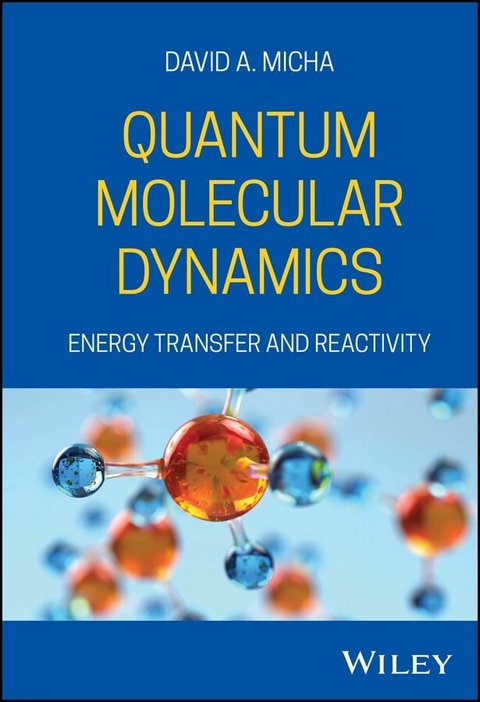
Quantum Molecular Dynamics (eBook)
339 Seiten
Wiley (Verlag)
978-1-119-31924-5 (ISBN)

Presents theoretical, computational, and practical aspects of collision-induced phenomena with emphasis on the treatment of physical and chemical kinetics using quantum molecular dynamics
Quantum Molecular Dynamics provides a state-of-the-art overview of molecular collisions for energy-transfer and reactivity phenomena in gases. Grounded in the quantal theory of scattering and its semiclassical limits, this comprehensive volume covers key concepts and theory, computational approaches, and various applications for specific physical systems.
Detailed chapters describe elastic, inelastic and reactive collisions, that lead to energy transfer, electronic transitions, chemical reactions, and more. Starting from the electronic structure and atomic conformation of molecules, the text proceeds from introductory material to advanced modern treatments relevant to applications to new materials, the environment, biological phenomena, and energy and fuels production.
- Provides a thorough introduction to collision dynamics with realistic intermolecular forces
- Covers thermal rates and cross sections of molecular collisions phenomena
- Examines electronic excitation and relaxation phenomena mediated by molecular collisions
- Discusses many-atom scattering theory as an introduction to more advanced descriptions
- Presents the computational aspects required to calculate and compare cross-sections with experimental data
- Includes worked examples and applications to different physical systems
Quantum Molecular Dynamics is an important resource for researchers and advanced undergraduate and graduate students in physical, theoretical, and computational chemistry, chemical physics, materials science, as well as chemists, engineers, and biologists working in the energy and pharmaceutical industries and the environment.
David A. Micha is a Professor of Chemistry and Physics at the University of Florida. His many research interests include intermolecular forces, collisional energy transfer, electron transfer, photoinduced dynamics, reactions in gas phase collisions, energy and electron transfer, and photodynamics at solid surfaces. Dr. Micha has also been co-organizer of the international 'Sanibel Symposium on Theory and Computation for the Molecular and Materials Sciences' in the USA since 1985. He is a co-editor of several science books, and author of numerous science publications. He has been the organizer of several Pan-American Workshops on Molecular and Materials Sciences.
Presents theoretical, computational, and practical aspects of collision-induced phenomena with emphasis on the treatment of physical and chemical kinetics using quantum molecular dynamics Quantum Molecular Dynamics provides a state-of-the-art overview of molecular collisions for energy-transfer and reactivity phenomena in gases. Grounded in the quantal theory of scattering and its semiclassical limits, this comprehensive volume covers key concepts and theory, computational approaches, and various applications for specific physical systems. Detailed chapters describe elastic, inelastic and reactive collisions, that lead to energy transfer, electronic transitions, chemical reactions, and more. Starting from the electronic structure and atomic conformation of molecules, the text proceeds from introductory material to advanced modern treatments relevant to applications to new materials, the environment, biological phenomena, and energy and fuels production. Provides a thorough introduction to collision dynamics with realistic intermolecular forcesCovers thermal rates and cross sections of molecular collisions phenomenaExamines electronic excitation and relaxation phenomena mediated by molecular collisionsDiscusses many-atom scattering theory as an introduction to more advanced descriptionsPresents the computational aspects required to calculate and compare cross-sections with experimental dataIncludes worked examples and applications to different physical systems Quantum Molecular Dynamics is an important resource for researchers and advanced undergraduate and graduate students in physical, theoretical, and computational chemistry, chemical physics, materials science, as well as chemists, engineers, and biologists working in the energy and pharmaceutical industries and the environment.
| Erscheint lt. Verlag | 28.10.2025 |
|---|---|
| Sprache | englisch |
| Themenwelt | Naturwissenschaften ► Chemie ► Physikalische Chemie |
| Schlagworte | chemical kinetics in gases • energy relaxation phenomena • energy transfer in gases • gaseous kinetics • intermolecular forces gases • many-atom dynamics • molecular collisions in gases • quantum dynamics • Reaction Dynamics • thermal rates in gases |
| ISBN-10 | 1-119-31924-2 / 1119319242 |
| ISBN-13 | 978-1-119-31924-5 / 9781119319245 |
| Informationen gemäß Produktsicherheitsverordnung (GPSR) | |
| Haben Sie eine Frage zum Produkt? |
 PDF (Adobe DRM)
Kopierschutz: Adobe-DRM
Adobe-DRM ist ein Kopierschutz, der das eBook vor Mißbrauch schützen soll. Dabei wird das eBook bereits beim Download auf Ihre persönliche Adobe-ID autorisiert. Lesen können Sie das eBook dann nur auf den Geräten, welche ebenfalls auf Ihre Adobe-ID registriert sind.
Details zum Adobe-DRM
Dateiformat: PDF (Portable Document Format)
Mit einem festen Seitenlayout eignet sich die PDF besonders für Fachbücher mit Spalten, Tabellen und Abbildungen. Eine PDF kann auf fast allen Geräten angezeigt werden, ist aber für kleine Displays (Smartphone, eReader) nur eingeschränkt geeignet.
Systemvoraussetzungen:
PC/Mac: Mit einem PC oder Mac können Sie dieses eBook lesen. Sie benötigen eine
eReader: Dieses eBook kann mit (fast) allen eBook-Readern gelesen werden. Mit dem amazon-Kindle ist es aber nicht kompatibel.
Smartphone/Tablet: Egal ob Apple oder Android, dieses eBook können Sie lesen. Sie benötigen eine
Geräteliste und zusätzliche Hinweise
Buying eBooks from abroad
For tax law reasons we can sell eBooks just within Germany and Switzerland. Regrettably we cannot fulfill eBook-orders from other countries.
aus dem Bereich