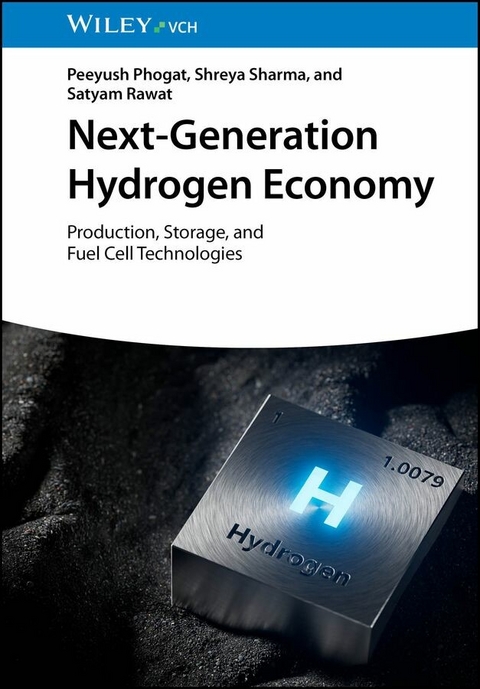
Next-Generation Hydrogen Economy (eBook)
386 Seiten
Wiley-VCH (Verlag)
978-3-527-85510-0 (ISBN)
Provides a comprehensive guide to hydrogen technologies for sustainable energy production and practical deployment
With the growing urgency to reduce greenhouse gas emissions, decarbonize heavy industries, and diversify energy sources, hydrogen stands out as a versatile, clean energy carrier. Next-Generation Hydrogen Economy: Production, Storage, and Fuel Cell Technologies serves as an interdisciplinary roadmap for understanding and leveraging hydrogen's vast potential. This timely volume meets the pressing need for a unified, research-informed resource that integrates hydrogen science, engineering, and policy-addressing both theoretical foundations and real-world implementation.
Written by experts in material science and energy research, Next-Generation Hydrogen Economy thoroughly examines hydrogen's role in modern and future energy systems. The authors explore advanced production methods such as electrolysis, photocatalysis, and biological synthesis, while also detailing innovative storage technologies including metal hydrides, metal-organic frameworks (MOFs), and liquid organic hydrogen carriers (LOHCs). Practical chapters on hydrogen fuel cells highlight applications in transportation, grid storage, and heavy industry, with in-depth discussions on commercialization, economic feasibility, infrastructure challenges, and safety standards. Bridging research and practice, the book also delves into AI-driven catalyst development, smart hydrogen cities, and other emerging areas in the fields.
Equipping readers with the knowledge to drive innovation and make informed decisions in the rapidly evolving hydrogen economy, Next-Generation Hydrogen Economy:
- Integrates multidisciplinary insights from material science, electrochemistry, energy systems, and public policy
- Highlights novel hydrogen production techniques including photocatalysis and biological routes
- Analyzes the techno-economic challenges and opportunities of industrial-scale hydrogen deployment
- Features clear diagrams and process flowcharts to illustrate complex technical concepts and up-to-date case studies and global policy frameworks to contextualize hydrogen adoption
- Discusses safety standards, regulatory compliance, and risk mitigation strategies for hydrogen technologies
Emphasizing cross-sectoral integration of hydrogen, Next-Generation Hydrogen Economy: Production, Storage, and Fuel Cell Technologies is ideal for graduate and postgraduate students in courses such as Renewable Energy Systems, Energy Materials, and Sustainable Engineering within physics, chemistry, and energy engineering programs. It also serves as a valuable reference for professionals in electrochemistry, clean energy R&D, and energy policy analysis.
Dr. Peeyush Phogat is a Project Associate at CSIR-National Institute of Science Communication and Policy Research (NIScPR), India. He has extensive research expertise in energy materials, particularly solar energy and capacitor technologies.
Dr. Shreya Sharma is a Project Associate at CSIR-NIScPR, India. Her research focuses on nanomaterials and their electrochemical properties, with an emphasis on transition metal dichalcogenides and other 2D materials.
Satyam Rawat is currently pursuing an M.Sc. in Physics at Netaji Subhas University of Technology, India. His research interests include nanocomposite development for energy storage devices such as supercapacitors and photodetectors.
| Erscheint lt. Verlag | 27.10.2025 |
|---|---|
| Sprache | englisch |
| Themenwelt | Naturwissenschaften ► Chemie ► Physikalische Chemie |
| Schlagworte | fuel cell technologies • hydrogen clean energy • hydrogen commercial applications • hydrogen economy • hydrogen energy policy • hydrogen energy storage • hydrogen industrial applications • Hydrogen Production • hydrogen renewable energy • hydrogen science |
| ISBN-10 | 3-527-85510-6 / 3527855106 |
| ISBN-13 | 978-3-527-85510-0 / 9783527855100 |
| Informationen gemäß Produktsicherheitsverordnung (GPSR) | |
| Haben Sie eine Frage zum Produkt? |
 PDF (Adobe DRM)
Kopierschutz: Adobe-DRM
Adobe-DRM ist ein Kopierschutz, der das eBook vor Mißbrauch schützen soll. Dabei wird das eBook bereits beim Download auf Ihre persönliche Adobe-ID autorisiert. Lesen können Sie das eBook dann nur auf den Geräten, welche ebenfalls auf Ihre Adobe-ID registriert sind.
Details zum Adobe-DRM
Dateiformat: PDF (Portable Document Format)
Mit einem festen Seitenlayout eignet sich die PDF besonders für Fachbücher mit Spalten, Tabellen und Abbildungen. Eine PDF kann auf fast allen Geräten angezeigt werden, ist aber für kleine Displays (Smartphone, eReader) nur eingeschränkt geeignet.
Systemvoraussetzungen:
PC/Mac: Mit einem PC oder Mac können Sie dieses eBook lesen. Sie benötigen eine
eReader: Dieses eBook kann mit (fast) allen eBook-Readern gelesen werden. Mit dem amazon-Kindle ist es aber nicht kompatibel.
Smartphone/Tablet: Egal ob Apple oder Android, dieses eBook können Sie lesen. Sie benötigen eine
Geräteliste und zusätzliche Hinweise
Buying eBooks from abroad
For tax law reasons we can sell eBooks just within Germany and Switzerland. Regrettably we cannot fulfill eBook-orders from other countries.
aus dem Bereich