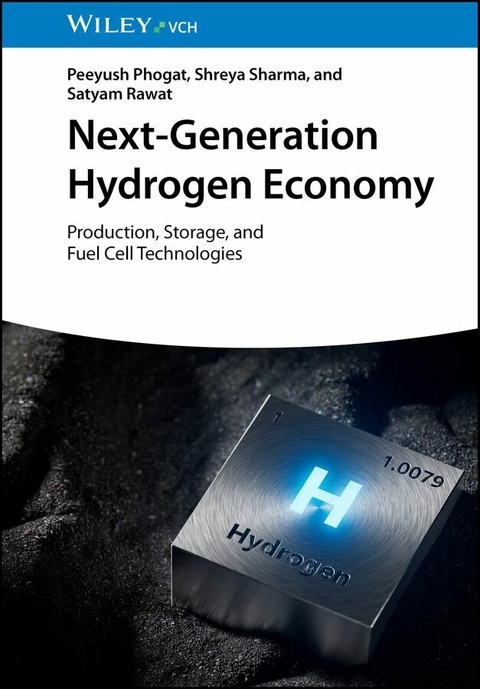
Next-Generation Hydrogen Economy (eBook)
709 Seiten
Wiley-VCH (Verlag)
978-3-527-85509-4 (ISBN)
Provides a comprehensive guide to hydrogen technologies for sustainable energy production and practical deployment
With the growing urgency to reduce greenhouse gas emissions, decarbonize heavy industries, and diversify energy sources, hydrogen stands out as a versatile, clean energy carrier. Next-Generation Hydrogen Economy: Production, Storage, and Fuel Cell Technologies serves as an interdisciplinary roadmap for understanding and leveraging hydrogen's vast potential. This timely volume meets the pressing need for a unified, research-informed resource that integrates hydrogen science, engineering, and policy-addressing both theoretical foundations and real-world implementation.
Written by experts in material science and energy research, Next-Generation Hydrogen Economy thoroughly examines hydrogen's role in modern and future energy systems. The authors explore advanced production methods such as electrolysis, photocatalysis, and biological synthesis, while also detailing innovative storage technologies including metal hydrides, metal-organic frameworks (MOFs), and liquid organic hydrogen carriers (LOHCs). Practical chapters on hydrogen fuel cells highlight applications in transportation, grid storage, and heavy industry, with in-depth discussions on commercialization, economic feasibility, infrastructure challenges, and safety standards. Bridging research and practice, the book also delves into AI-driven catalyst development, smart hydrogen cities, and other emerging areas in the fields.
Equipping readers with the knowledge to drive innovation and make informed decisions in the rapidly evolving hydrogen economy, Next-Generation Hydrogen Economy:
- Integrates multidisciplinary insights from material science, electrochemistry, energy systems, and public policy
- Highlights novel hydrogen production techniques including photocatalysis and biological routes
- Analyzes the techno-economic challenges and opportunities of industrial-scale hydrogen deployment
- Features clear diagrams and process flowcharts to illustrate complex technical concepts and up-to-date case studies and global policy frameworks to contextualize hydrogen adoption
- Discusses safety standards, regulatory compliance, and risk mitigation strategies for hydrogen technologies
Emphasizing cross-sectoral integration of hydrogen, Next-Generation Hydrogen Economy: Production, Storage, and Fuel Cell Technologies is ideal for graduate and postgraduate students in courses such as Renewable Energy Systems, Energy Materials, and Sustainable Engineering within physics, chemistry, and energy engineering programs. It also serves as a valuable reference for professionals in electrochemistry, clean energy R&D, and energy policy analysis.
Dr. Peeyush Phogat is a Project Associate at CSIR-National Institute of Science Communication and Policy Research (NIScPR), India. He has extensive research expertise in energy materials, particularly solar energy and capacitor technologies.
Dr. Shreya Sharma is a Project Associate at CSIR-NIScPR, India. Her research focuses on nanomaterials and their electrochemical properties, with an emphasis on transition metal dichalcogenides and other 2D materials.
Satyam Rawat is currently pursuing an M.Sc. in Physics at Netaji Subhas University of Technology, India. His research interests include nanocomposite development for energy storage devices such as supercapacitors and photodetectors.
Chapter 1
The Hydrogen Paradigm – Past, Present, and Future
1.1 Introduction to Hydrogen as an Energy Carrier
1.1.1 Definition and Fundamental Properties of Hydrogen
Hydrogen, the lightest and most abundant element in the universe, plays a crucial role in both natural and engineered energy systems. It is represented by the chemical symbol H and has an atomic number of 1, meaning it contains only one proton in its nucleus. As a fundamental building block of the universe, hydrogen is a primary component of stars and gas giants and is widely found in water, hydrocarbons, and biological systems. Its significance in energy applications arises from its high-energy density and clean combustion properties, making it an ideal candidate for sustainable fuel alternatives [1].
The atomic structure of hydrogen is the simplest among all elements, consisting of a single proton and an electron. However, hydrogen exhibits multiple isotopic forms, which are distinguished by the number of neutrons in the nucleus. The three naturally occurring isotopes of hydrogen are:
- Protium (^1H) – The most abundant isotope, accounting for over 99.98% of naturally occurring hydrogen. It consists of a single proton and no neutrons.
- Deuterium (^2H or D) – This isotope contains one proton and one neutron, making it twice as heavy as protium. Deuterium is stable and occurs naturally in small quantities (about 0.015% of Earth’s hydrogen). It is commonly used in nuclear fusion research and heavy water applications in nuclear reactors.
- Tritium (^3H or T) – A radioactive isotope containing one proton and two neutrons. Tritium has a half-life of 12.3 years and is primarily produced in nuclear reactions. It is used in specialized applications such as nuclear fusion research and self-luminous materials.
Hydrogen’s placement in the periodic table highlights its unique properties and chemical versatility (as illustrated in Figure 1.1). Despite being positioned in Group 1 due to its single valence electron, hydrogen exhibits behavior distinct from alkali metals, and in some respects, resembles halogens. It readily forms bonds with other elements, contributing to a vast range of compounds, including water (H2O), hydrocarbons (CH4, C2H6), and acids (HCl, H2SO4) [2].
Figure 1.1 Hydrogen’s position in the periodic table and its key properties. Reproduced with permission of [5]/John Wiley & Sons.
The properties of hydrogen that make it particularly attractive as an energy carrier are its lightweight nature, high-energy content, and environmental benefits [3]. Some key physical and chemical characteristics of hydrogen relevant to energy applications are as follows:
- Low Atomic and Molecular Mass – Hydrogen is the lightest element, with an atomic mass of 1.008 u. Molecular hydrogen (H2) has a molecular weight of 2.016 g/mol, making it significantly lighter than other fuels. Its low density (0.0899 g/L at standard conditions) presents challenges for storage and transportation, necessitating advanced containment techniques such as compression, liquefaction, or chemical storage. These storage challenges are particularly important in applications where large quantities of hydrogen need to be transported or stored over extended periods.
- High-Energy Density – Despite its low volumetric density, hydrogen has an exceptionally high gravimetric energy density of 120 MJ/kg, nearly three times that of gasoline (44 MJ/kg). This property makes hydrogen a promising alternative for applications requiring lightweight, high-energy fuels, such as aerospace, fuel cell vehicles, and portable power systems. Its high-energy density per unit mass also positions hydrogen as an ideal candidate for energy applications in sectors that demand significant power with minimal weight, such as aviation and heavy-duty transport.
- Chemical Reactivity and Combustion – Hydrogen exhibits strong reducing properties, allowing it to participate in various chemical reactions, including redox processes and catalysis. When burned in the presence of oxygen, hydrogen reacts exothermically:
This reaction releases a significant amount of energy and produces only water vapor as a byproduct, making hydrogen a zero-emission fuel when used in combustion engines or fuel cells (as illustrated in Figure 1.1). The clean nature of hydrogen combustion positions it as an attractive alternative to fossil fuels, which emit harmful greenhouse gases and pollutants.
- Flammability and Explosion Limits – Hydrogen has a wide flammability range (4–75% in air) and a low ignition energy, making it highly reactive. This characteristic necessitates strict safety measures in hydrogen storage and handling. However, due to its low molecular weight, hydrogen dissipates quickly in the atmosphere, reducing the risk of prolonged exposure to explosive concentrations. These safety considerations are essential in ensuring the safe adoption of hydrogen in various energy systems.
- Electrochemical Potential in Fuel Cells – Hydrogen’s ability to release electrons in an electrochemical reaction makes it an ideal fuel for proton exchange membrane (PEM) fuel cells, where hydrogen is split into protons and electrons to generate electricity. This application is central to hydrogen-powered vehicles, backup power systems, and stationary fuel cell applications. The efficiency of hydrogen fuel cells, combined with their zero-emission nature, offers a promising solution for a wide range of applications, from transportation to stationary power generation.
- Interaction with Metals and Storage Challenges – Hydrogen can diffuse through metals, leading to hydrogen embrittlement, which weakens structural materials over time. This property impacts pipeline transport and metal storage solutions, requiring specialized materials to contain hydrogen safely. Engineers are working to develop advanced materials that can withstand the effects of hydrogen embrittlement, ensuring the safe transport and storage of hydrogen.
- Cryogenic Liquefaction – Hydrogen has a boiling point of −252.87 °C, necessitating cryogenic technology for liquid hydrogen storage. Liquefied hydrogen (LH2) is often used in rocket propulsion and energy storage applications where high-density storage is required. The cryogenic liquefaction of hydrogen enables its storage in compact, dense forms, making it suitable for high-energy applications such as space exploration.
Hydrogen’s distinct physical and chemical properties underscore its potential as a clean and sustainable energy source, while also presenting technical challenges that require innovative solutions for widespread adoption. As the world shifts toward decarbonization and renewable energy integration, hydrogen will continue to play a pivotal role in shaping the future energy landscape [4].
1.1.2 Why Hydrogen Is Considered a Clean Energy Carrier
Hydrogen has gained global recognition as a clean energy carrier due to its potential to provide a sustainable, zero-emission alternative to conventional fossil fuels. Its unique properties, including high-energy density, efficiency in energy conversion, and versatility across multiple sectors, make it a promising candidate for the future of energy. Hydrogen can be used in fuel cells, internal combustion engines, and industrial applications while producing minimal environmental impact. The key reasons hydrogen is considered a clean energy carrier include its zero-emission potential, high efficiency in energy conversion, and favorable comparison with fossil fuels and renewables [6].
One of the most compelling advantages of hydrogen as an energy carrier is its zero-emission potential when combusted or used in fuel cells. Unlike fossil fuels, which release carbon dioxide (CO2), nitrogen oxides (NOx), sulfur oxides (SOx), and particulate matter, hydrogen produces only water vapor (H2O) when reacted with oxygen. This clean combustion process is represented by the reaction (1.1). This reaction is highly exothermic, releasing a significant amount of energy while generating no carbon-based emissions. Due to this characteristic, hydrogen is considered a viable alternative to coal, oil, and natural gas in sectors where emissions are a major concern, such as transportation, power generation, and heavy industry. Additionally, hydrogen can be produced from renewable energy sources, such as solar, wind, and hydropower, through electrolysis, making it a truly sustainable energy carrier. Green hydrogen, produced via water electrolysis powered by renewables, has a net-zero carbon footprint, making it an ideal candidate for long-term energy storage and grid stabilization [7].
Hydrogen can also be blended with natural gas in existing pipeline infrastructure to reduce carbon emissions in heating applications. A blend of 20% hydrogen with natural gas can lower overall emissions without requiring major modifications to current gas infrastructure. In contrast, using pure hydrogen in fuel cells ensures completely carbon-free power generation, making it particularly suitable for electric vehicles, stationary power systems, and portable energy applications [8].
Hydrogen’s efficiency in energy conversion is another reason for its growing popularity as a clean energy carrier. When used in fuel cells, hydrogen undergoes an electrochemical reaction rather than combustion, significantly...
| Erscheint lt. Verlag | 24.10.2025 |
|---|---|
| Sprache | englisch |
| Themenwelt | Naturwissenschaften ► Chemie ► Physikalische Chemie |
| Schlagworte | fuel cell technologies • hydrogen clean energy • hydrogen commercial applications • hydrogen economy • hydrogen energy policy • hydrogen energy storage • hydrogen industrial applications • Hydrogen Production • hydrogen renewable energy • hydrogen science |
| ISBN-10 | 3-527-85509-2 / 3527855092 |
| ISBN-13 | 978-3-527-85509-4 / 9783527855094 |
| Informationen gemäß Produktsicherheitsverordnung (GPSR) | |
| Haben Sie eine Frage zum Produkt? |
 EPUB (Adobe DRM)
Kopierschutz: Adobe-DRM
Adobe-DRM ist ein Kopierschutz, der das eBook vor Mißbrauch schützen soll. Dabei wird das eBook bereits beim Download auf Ihre persönliche Adobe-ID autorisiert. Lesen können Sie das eBook dann nur auf den Geräten, welche ebenfalls auf Ihre Adobe-ID registriert sind.
Details zum Adobe-DRM
Dateiformat: EPUB (Electronic Publication)
EPUB ist ein offener Standard für eBooks und eignet sich besonders zur Darstellung von Belletristik und Sachbüchern. Der Fließtext wird dynamisch an die Display- und Schriftgröße angepasst. Auch für mobile Lesegeräte ist EPUB daher gut geeignet.
Systemvoraussetzungen:
PC/Mac: Mit einem PC oder Mac können Sie dieses eBook lesen. Sie benötigen eine
eReader: Dieses eBook kann mit (fast) allen eBook-Readern gelesen werden. Mit dem amazon-Kindle ist es aber nicht kompatibel.
Smartphone/Tablet: Egal ob Apple oder Android, dieses eBook können Sie lesen. Sie benötigen eine
Geräteliste und zusätzliche Hinweise
Buying eBooks from abroad
For tax law reasons we can sell eBooks just within Germany and Switzerland. Regrettably we cannot fulfill eBook-orders from other countries.
aus dem Bereich