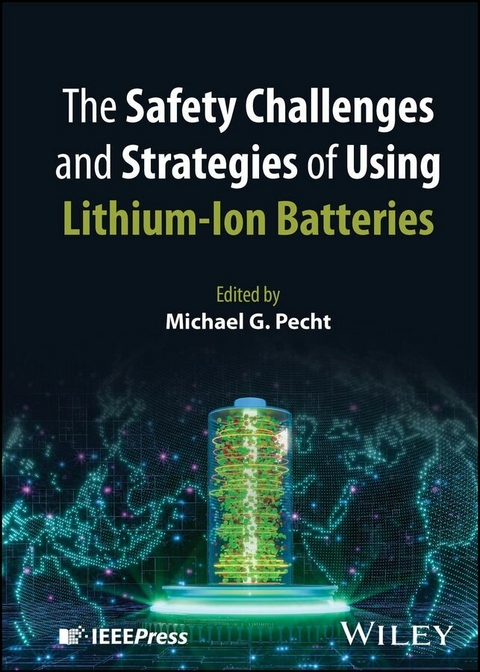
The Safety Challenges and Strategies of Using Lithium-Ion Batteries (eBook)
1034 Seiten
Wiley-IEEE Press (Verlag)
978-1-394-34291-4 (ISBN)
Comprehensive reference detailing the manufacturing, storage, transportation, safety, and regulations of Li-Ion batteries
The Safety Challenges and Strategies of Using Lithium-Ion Batteries presents a comprehensive overview of the safety issues related to lithium-ion batteries. After an introduction explaining the basics of lithium-ion battery technology and the various components used throughout the manufacturing process, the book delves into the design and process of failure models and mechanisms including cell assembly, formation, and electrode preparation processes, discusses the compliance, regulations, and standards of lithium-ion battery transportation, and reviews how environmental factors such as temperature, humidity, and atmospheric pressure can affect the durability, performance, and safety of batteries.
The reader is presented with the range of companies that are producing batteries, the various lithium-ion chemistries being implemented in batteries by these companies, and which chemistries are being used for which applications. Next, the various defects in design and manufacturing that can affect the propensity for fires are presented along with best practices. This section is followed by an overview of the qualification tests, quality assurance methods, and standards needed to ensure safe design.
The Safety Challenges and Strategies of Using Lithium-Ion Batteries includes information on:
- Types of batteries and the trade-off between energy density and safety risks
- Thermal runaway and mitigation strategies such as flame retardants and venting mechanisms
- The reuse, repurposing, and disposal of batteries and how new regulations in the European Union concerning the ability to replace batteries and the right to repair will affect safety risks
- The battery supply chain in the consumer, industrial, electric vehicle, and renewable energy sectors
- Data transparency challenges between manufacturers and end-users/system designers
Written by a team of experts, The Safety Challenges and Strategies of Using Lithium-Ion Batteries is essential reading for professionals working in a wide range of industries including batteries, EV, and energy storage.
Michael G. Pecht is a Chair Professor and the Director of the Center for Advanced Life Cycle Engineering (CALCE) at the University of Maryland, USA. He earned his PhD in Engineering Mechanics from the University of Wisconsin-Madison, USA, and has authored over 30 books and more than 900 technical articles. He is a world-renowned expert in strategic planning, design, testing, and risk assessment of electronics and information systems.
Comprehensive reference detailing the manufacturing, storage, transportation, safety, and regulations of Li-Ion batteries The Safety Challenges and Strategies of Using Lithium-Ion Batteries presents a comprehensive overview of the safety issues related to lithium-ion batteries. After an introduction explaining the basics of lithium-ion battery technology and the various components used throughout the manufacturing process, the book delves into the design and process of failure models and mechanisms including cell assembly, formation, and electrode preparation processes, discusses the compliance, regulations, and standards of lithium-ion battery transportation, and reviews how environmental factors such as temperature, humidity, and atmospheric pressure can affect the durability, performance, and safety of batteries. The reader is presented with the range of companies that are producing batteries, the various lithium-ion chemistries being implemented in batteries by these companies, and which chemistries are being used for which applications. Next, the various defects in design and manufacturing that can affect the propensity for fires are presented along with best practices. This section is followed by an overview of the qualification tests, quality assurance methods, and standards needed to ensure safe design. The Safety Challenges and Strategies of Using Lithium-Ion Batteries includes information on: Types of batteries and the trade-off between energy density and safety risksThermal runaway and mitigation strategies such as flame retardants and venting mechanismsThe reuse, repurposing, and disposal of batteries and how new regulations in the European Union concerning the ability to replace batteries and the right to repair will affect safety risksThe battery supply chain in the consumer, industrial, electric vehicle, and renewable energy sectorsData transparency challenges between manufacturers and end-users/system designers Written by a team of experts, The Safety Challenges and Strategies of Using Lithium-Ion Batteries is essential reading for professionals working in a wide range of industries including batteries, EV, and energy storage.
The Editors, Authors, and Assistants
Michael G. Pecht (60,000+ citations, 105+ H‐index) holds a BS in Physics, an MS in Electrical Engineering, and an MS and PhD in Engineering Mechanics from the University of Wisconsin. He is a Professional Engineer, an IEEE Fellow, an ASME Fellow, an ASM Fellow, and an SAE Fellow. He served on three US National Academy of Science studies, two US Congressional investigations in automotive safety, and as an expert to the US FDA. He is a Distinguished Professor and the Director of the Center for Advanced Life Cycle Engineering (CALCE) at the University of Maryland, which is funded by over 150 of the world's leading electronics companies at more than US$6M/year. He has written more than 30 books on product reliability and supply chain management, and a series of books on the electronics industry in China, Korea, Japan, Taiwan, and India. He has written over 700 technical articles and has 12 patents.
Simin Peng received his PhD degree in electrical engineering from Shanghai Jiao Tong University, Shanghai, China, in 2013. From 2016 to 2017, he was a Visiting Scholar at the University of Maryland, College Park, USA. He is an Associate Professor at Yancheng Institute of Technology, China. His research interests include modeling and control of wind power, microgrids, and battery energy storage systems. He is an IEEE Senior Member and the leader of the Advanced Energy Storage Technology and Applications Research Center at Yancheng Institute of Technology. He is the standing director of the IEEE PES Electric Vehicle Satellite Committee‐China Battery System Subcommittee and IEEE PES Energy Storage Committee‐China Energy Storage System and Equipment Subcommittee. He has authored over 50 academic papers and holds 40 patents.
Rashed A. Islam is a Design for Reliability Lead at Joby Aviation. His group is responsible for the powertrain and electronics reliability for Joby's revolutionary electric vertical takeoff and landing (eVTOL) aircraft. Previously, Rashed was the Head of Product Integrity at Lyft Bikes and Scooters and Technical Lead Manager at Google Devices and Services, where his team managed the Nest home automation products. He also led the Sustainable Materials Reliability efforts for Google's consumer hardware. Rashed has more than 15 years of industry experience in reliability engineering, failure analysis, and materials development (recycled plastics, Pb‐free solder, piezoelectric, and magnetoelectric materials). Before Google, Rashed worked on e‐readers and tablets (at Amazon), LEDs (at Philips), and energy harvesters and dielectric antennas (at Eoplex). Rashed has a PhD in Materials Science and Engineering and has published more than 50 journal and conference publications and book chapters. He has also authored three US patents.
Sanjay Tiku has an MS and PhD in Mechanical Engineering from the University of Maryland, College Park. He currently works as Senior Director of Hardware Engineering at Microsoft. He directs the activities of a team of engineers and researchers to ensure the performance and reliability of complex electromechanical products and to drive product qualification. Previously, he worked at the Research Center of Tata Motors and taught mechanical engineering for a while in India. His research interests include the quality and reliability of electronic products and electronic parts selection and management. He has written several papers and book chapters in this area. He is a member of the IEEE and an invited member of the academic honor society Phi Kappa Phi.
Yan Ning serves as the Battery Performance and Reliability Lead at Dell Technologies, dedicated to delivering reliable and enduring batteries through testing and intelligent health management powered by AI. She collaborates closely with tier‐one, established battery suppliers and emerging technology providers, fostering partnerships to integrate revolutionary battery technologies. Yan's expertise extends to telemetry data analysis and machine learning applications for batteries and computer systems, enabling her to diagnose field failures and extract valuable product insights for business optimization. Yan is the Vice Chair of the IEEE P1624 Working Group, where she contributes to updating the standard for Organizational Reliability Capability. Yan holds a PhD in Mechanical Engineering from the Center for Advanced Life Cycle Engineering (CALCE) at the University of Maryland. Yan has six US patents and six US patent applications pending.
Hassan Abbas Khan is the Director of the Energy and Power Systems Lab, a Lead for the Horizon EU project (LOCEL‐H2), and a founding member of the LUMS Energy Institute. He received his BSc in Electronic Engineering from GIKI, Pakistan, and his MS and PhD in Electrical and Electronic Engineering from the University of Manchester, UK, in 2006 and 2010, respectively. Currently, he is co‐Editor‐in‐Chief for Elsevier's e‐Prime, and a Senior Member of IEEE. He is an expert on batteries and their applications in a spectrum of applications from EVs to grid‐scale storage. Dr. Khan also evaluates drivers changing the conventional grid, focusing on storage‐based systems and EVs to develop evidence‐based policymaking for disruptive technologies in the evolving utility grid. He has contributed to over 100 peer‐reviewed research publications and has advised the Government of Pakistan on a 100 MWp flagship solar project in Pakistan and has also led various energy efficiency‐related projects at LUMS.
Haibo Huo received a PhD degree in Control Theory and Control Engineering from Shanghai Jiao Tong University, Shanghai, China, in 2008. From 2015 to 2016, she was a visiting scholar at the Center for Advanced Life Cycle Engineering, University of Maryland, College Park, USA. She is currently an Associate Professor at Shanghai Engineering Research Center of Marine Renewable Energy, Shanghai Ocean University, China. Her research interests include fuel cell and hydrogen energy storage system integration, modeling, and control and health. She is an IEEE member and the Standing Director of the IEEE PES China Satellite Technical Committee‐Electric Vehicle Committee – Battery System Subcommittee. She has authored over 40 academic papers.
Yulun Zhang is a battery reliability engineer at Microsoft Corporation, where he works extensively on battery‐related reliability analyses, accelerated testing, and root cause investigations for Microsoft Surface products. He has over 10 years of experience in the areas of electrochemistry and lithium‐ion batteries. He has authored and co‐authored more than 10 papers in different journals, such as Nature Energy and Proceedings of the IEEE. Dr. Zhang received a PhD degree in chemistry from the University of Utah, Salt Lake City, UT, USA, in 2018 and a bachelor's degree in chemistry from Xiamen University, Xiamen, China, in 2014. Before joining Microsoft, Dr. Zhang was a postdoctoral fellow at the Idaho National Laboratory (INL), Idaho Falls, ID, USA, from 2019 to 2021.
Kianoush Naeli is a reliability engineer (CRE). He completed his BS, MS, and Ph.D. in Electrical Engineering. His PhD research at the Georgia Institute of Technology was on static and resonant sensors in Micro‐Electro‐Mechanical Systems (MEMS). After his PhD, he worked as a postdoc in the Department of Mechanical Engineering at Georgia Tech. He joined Hewlett‐Packard (now HP Inc.) in 2010 as a process integration engineer, working on inkjet printheads. In 2013, Dr. Naeli shifted his career toward reliability engineering, while still working on inkjet printers. He worked on the reliability of metamaterial antennas at Kymeta Corporation starting in 2016. He joined Microsoft in 2018, where he has been focusing on the reliability of lithium‐ion batteries. Since then, he has been leading the battery reliability of multiple generations of Microsoft Surface products.
Virendra Jadhav received his D.Sc. degree from Washington University in St. Louis. He has been a practicing engineer for over 25 years, in the areas of electronics hardware design, mechanical analysis, and reliability. During his tenure at IBM as a Development Engineer, he worked on stress analysis and testing of electronics and packaging, such as low‐K dielectric materials in high end ICs, solder fatigue of BGA packages, and thermomechanical design of high‐end CPU packages. In his current capacity as a Reliability Engineer at Microsoft, he has been working on the reliability of high‐end personal computers. He is currently the Director of Reliability Engineering at Microsoft in Redmond, WA. Since 2017, he and his team have been actively working on the reliability of lithium‐ion batteries.
Weiping Diao earned her PhD in Mechanical Engineering from the University of Maryland, College Park, USA, in 2021. She also holds a BE and ME in Electrical Engineering from Beijing Jiaotong University, Beijing, China. Currently, she is an Assistant Professor in the Department of Electrical and Computer Engineering at Binghamton University. Before joining academia, she spent three years at Apple Inc. as a Battery Algorithm Engineer in Cupertino, USA. Her research focuses on lithium‐ion battery technologies, including reliability testing, lifetime modeling, degradation mechanisms analysis, battery management...
| Erscheint lt. Verlag | 30.9.2025 |
|---|---|
| Sprache | englisch |
| Themenwelt | Naturwissenschaften ► Physik / Astronomie |
| Technik ► Elektrotechnik / Energietechnik | |
| Schlagworte | lithium ion design • lithium ion environment • lithium ion manufacturing • lithium ion materials • lithium ion recycling • lithium ion regulations • lithium ion research • lithium ion standards • lithium ion storage • lithium ion transportation |
| ISBN-10 | 1-394-34291-8 / 1394342918 |
| ISBN-13 | 978-1-394-34291-4 / 9781394342914 |
| Informationen gemäß Produktsicherheitsverordnung (GPSR) | |
| Haben Sie eine Frage zum Produkt? |
 EPUB (Adobe DRM)
Kopierschutz: Adobe-DRM
Adobe-DRM ist ein Kopierschutz, der das eBook vor Mißbrauch schützen soll. Dabei wird das eBook bereits beim Download auf Ihre persönliche Adobe-ID autorisiert. Lesen können Sie das eBook dann nur auf den Geräten, welche ebenfalls auf Ihre Adobe-ID registriert sind.
Details zum Adobe-DRM
Dateiformat: EPUB (Electronic Publication)
EPUB ist ein offener Standard für eBooks und eignet sich besonders zur Darstellung von Belletristik und Sachbüchern. Der Fließtext wird dynamisch an die Display- und Schriftgröße angepasst. Auch für mobile Lesegeräte ist EPUB daher gut geeignet.
Systemvoraussetzungen:
PC/Mac: Mit einem PC oder Mac können Sie dieses eBook lesen. Sie benötigen eine
eReader: Dieses eBook kann mit (fast) allen eBook-Readern gelesen werden. Mit dem amazon-Kindle ist es aber nicht kompatibel.
Smartphone/Tablet: Egal ob Apple oder Android, dieses eBook können Sie lesen. Sie benötigen eine
Geräteliste und zusätzliche Hinweise
Buying eBooks from abroad
For tax law reasons we can sell eBooks just within Germany and Switzerland. Regrettably we cannot fulfill eBook-orders from other countries.
aus dem Bereich