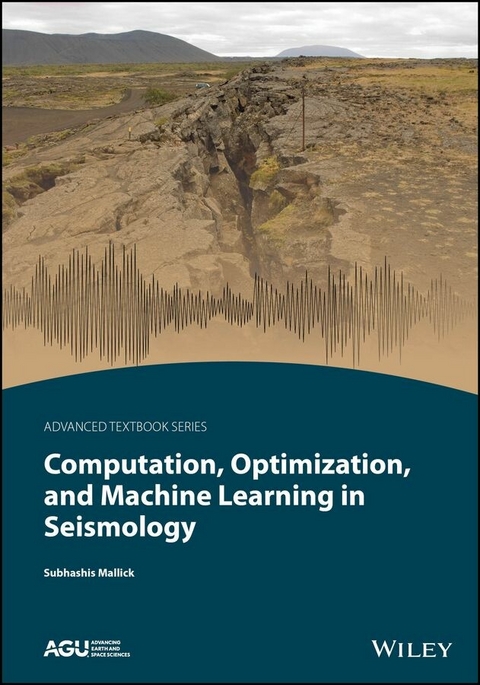
Computation, Optimization, and Machine Learning in Seismology (eBook)
989 Seiten
American Geophysical Union (Verlag)
978-1-119-65448-3 (ISBN)
A textbook applying fundamental seismology theories to the latest computational tools
The goal of computational seismology is to digitally simulate seismic waves, create subsurface models, and match these models with observations to identify subsurface rock properties. With recent advances in computing technology, including machine learning, it is now possible to automate matching procedures and use waveform inversion or optimization to create large-scale models.
Computation, Optimization, and Machine Learning in Seismology provides students with a detailed understanding of seismic wave theory, optimization theory, and how to use machine learning to interpret seismic data.
Volume highlights include:
- Mathematical foundations and key equations for computational seismology
- Essential theories, including wave propagation and elastic wave theory
- Processing, mapping, and interpretation of prestack data
- Model-based optimization and artificial intelligence methods
- Applications for earthquakes, exploration seismology, depth imaging, and multi-objective geophysics problems
- Exercises applying the main concepts of each chapter
Subhashis Mallick, University of Wyoming, USA
A textbook applying fundamental seismology theories to the latest computational tools The goal of computational seismology is to digitally simulate seismic waves, create subsurface models, and match these models with observations to identify subsurface rock properties. With recent advances in computing technology, including machine learning, it is now possible to automate matching procedures and use waveform inversion or optimization to create large-scale models. Computation, Optimization, and Machine Learning in Seismology provides students with a detailed understanding of seismic wave theory, optimization theory, and how to use machine learning to interpret seismic data. Volume highlights include: Mathematical foundations and key equations for computational seismology Essential theories, including wave propagation and elastic wave theory Processing, mapping, and interpretation of prestack data Model-based optimization and artificial intelligence methods Applications for earthquakes, exploration seismology, depth imaging, and multi-objective geophysics problems Exercises applying the main concepts of each chapter
1
Introduction to Key Concepts in Seismic Inversion and Elastic Wave Theory
1.1 Background
Geophysical inversion is a well‐established technique that yields quantitative descriptions of the earth's subsurface. Inversion of measurements of earthquake waves, for example magnetic, electrical, and gravity fields, has long been used to understand the macroscopic structure of the earth. Seismic inversion is routinely used in the oil and gas industry for exploration risk assessment and for reservoir characterization. The purpose of this book is to familiarize readers with the theory behind various approaches to inversion and their common application. Our focus is on seismic applications of inversion, including methods that utilize machine learning (ML) and artificial intelligence (AI) that are now being increasingly applied in all fields of geophysics.
1.2 Seismology—A Historical Perspective
Broadly speaking, seismology is the study of the mechanical vibrations of the earth. These vibrations are generated either from natural sources such as earthquakes or from the artificial (human‐generated) sources such as from the use of explosives or vibrators. Elastic waves associated with these vibrations propagate within the earth and are recorded as seismograms on various measuring devices, the most common of which are “seismometers” or “geophones.” Analyzing these seismograms to estimate the elastic properties of the earth, and relating these to subsurface lithology, fluids, in situ stress fields, etc., is the primary objective of seismology.
Based on the source generating the mechanical vibrations, seismology is broadly classified into (1) earthquake or passive‐source seismology and (2) exploration or active‐source seismology. Irrespective of a passive or an active source, the fundamental mathematical theory for both is the propagation of the elastic waves. This book focuses on elastic wave theory and how it is used to decipher the earth's internal structure and physical properties from recorded seismograms. From a historical perspective, however, it is important to briefly introduce the above two broad categories of seismology and their respective applications.
1.2.1 Earthquake Seismology
The study of earthquakes dates back thousands of years, a comprehensive review of which can be found in Ben‐Menahem (1995). Earthquakes are caused by a sudden release of energy within the subsurface, primarily due to the release of elastic strain. Analysis of the seismograms generated from earthquakes that are recorded by permanent seismometers deployed around the globe enables the determination of their location, magnitude, focal mechanism, and the subsurface structure of the earth. Additionally, earthquake seismology plays a major role in developing our understanding of plate tectonics. In earthquake seismology, the relative distances between the permanent seismic sensors are large (on the order of hundreds of kilometers) and the temporal frequencies of the elastic waves generated from the earthquakes are low (typically less than 1 Hz). Consequently, the vertical and lateral resolution of the earth structure obtained from the analysis of these seismograms is low (tens to hundreds of kilometers). The depth of penetration of these waves is, however, high, and therefore earthquake seismology is useful for studying the structure of earth's deep interior. A very good account of the science of earthquake seismology can be found in Bath (1979), Stein and Wysession (2002), Shearer (2009), among others.
Finding the structure of the earth's deep interior, developing the concepts of plate tectonics, etc., are the fundamental focus of earthquake seismology. In the past few decades, the oil and gas industry has made an interesting adaptation of the concepts of earthquake seismology in a technique known as “microseismic monitoring.” Where hydrocarbon‐bearing reservoirs are impermeable, the reservoir fluids are squeezed out by fracturing under great pressure. In microseismic monitoring, the microearthquakes (microseisms) resulting from such fracturing are recorded by borehole seismic sensors and analyzed to characterize the distribution, extent, size, and nature of the induced fractures. This helps to optimize well placement and design for efficient drainage of the reservoir hydrocarbons (Grechka and Heigl, 2017). Microseismic monitoring is also used in carbon dioxide sequestration and steam injection related applications.
1.2.2 Exploration Seismology
Exploration seismology evolved from earthquake seismology. Here, the source generating elastic waves is artificially excited. Compared with the earthquake seismology, in exploration seismology the seismic sensors (usually geophones on land and hydrophones in marine environments) are placed at relatively short distances apart (50 m or even less), and the temporal frequencies of the elastic waves are high with a dominant frequency between 20 and 50 Hz. The lateral and vertical resolution of the subsurface structures typically resolved from exploration seismology is therefore higher than earthquake seismology. However, because high frequencies rapidly attenuate with depth, the depth of penetration in exploration seismology is much lower than for earthquake seismology, and its use is limited to finding detailed structures at shallow depths, usually less than 10 km.
In exploration seismology, artificial sources are placed at or the near surface of the earth or within a borehole. On land, the seismic sensors (usually geophones) are placed either at the surface or within a borehole. In marine environments on the other hand, these sensors (usually hydrophones) are placed either near the water surface or at the water bottom, or within a borehole below the ocean floor. Irrespective of the land or marine environment, the elastic or acoustic wavefields, excited at the source locations propagate within the earth layers. The propagating wavefield, characterized by a temporal seismic wavelet, is reflected at boundaries between subsurface layers of contrasting elastic or acoustic impedance. The sequence of reflections is recorded as seismograms at the receiver (sensor) locations. Analyzing these recorded seismograms to interpret subsurface structure and rock properties is the focus of exploration seismology (Dobrin and Savit, 1988; Telford et al., 1990). Of all the different types of geophysical exploration methods, exploration seismology is by far the most commonly used and the most successful in terms of accuracy, depth of penetration, and subsurface resolution (Selley and Sonnenberg, 2014).
1.3 Mathematical Foundations of Seismology
Following the discovery of Hooke's law of linearized elasticity in 1660, there have been many advances in the mathematics of elastic wave theory, a comprehensive account of which can be found in the classic textbook written by Love (1892, reprinted 1944), and in more recently published textbooks by Aki and Richards (2002) and Chapman (2004).
Before the digital era, early applications of seismology were limited to the analysis of wave arrival travel times in analog records of seismic data. With the advent of computers these travel‐time‐based analyses gradually evolved into more quantitative analyses of the recorded seismic waveforms (Chapman, 2004).
With current advances in high‐performance computing, seismology has developed into a more mature science. Complex partial differential equations that describe the propagation of seismic wave fields can now be numerically solved in reasonable timeframes. This, in turn, allowed going beyond the travel‐time‐based qualitative analyses into quantitative analyses using sophisticated optimization techniques. More recently, the use of ML methods, a subset of AI, has been introduced in all aspects of seismology for these analyses. The primary focus of this book is to provide an overview of these quantitative methods.
1.4 Seismic Inversion
Seismic optimization is a subset of a broad category, called seismic inversion. Therefore, before understanding the meaning of optimization, it is first necessary to understand the meaning of inversion by explaining some fundamental concepts.
1.4.1 The Meaning of Inversion
Many applications in science, engineering, economics, etc., require finding an optimal model that satisfies a given set or sets of observations. Finding such an optimal model from a set or sets of observations is called inversion. To understand what is meant by inversion, consider the scenario shown in Figure 1.1.
Figure 1.1 Example of a person kicking a soccer ball.
As shown in Figure 1.1, if a person kicks a soccer ball so that it travels with a speed v, the distance d the ball will travel in a time t is given by
To obtain the speed v with which the ball travels, we can measure the distance d that it travels. Additionally, we can also use a stopwatch and measure the time t that the ball takes to travel the distance d. Thus, given the set of observation {d, t}, it is straightforward to find the speed v...
| Erscheint lt. Verlag | 23.9.2025 |
|---|---|
| Reihe/Serie | AGU Advanced Textbooks |
| Sprache | englisch |
| Themenwelt | Naturwissenschaften ► Geowissenschaften ► Geologie |
| Schlagworte | ai seismology • computational seismology • depth imaging • elastic wave theory • Exploration seismology • optimization theory • Seismic Data • seismic machine learning • Seismic wave theory • seismology theory • subsurface models • wave propagation |
| ISBN-10 | 1-119-65448-3 / 1119654483 |
| ISBN-13 | 978-1-119-65448-3 / 9781119654483 |
| Informationen gemäß Produktsicherheitsverordnung (GPSR) | |
| Haben Sie eine Frage zum Produkt? |
 EPUB (Adobe DRM)
Kopierschutz: Adobe-DRM
Adobe-DRM ist ein Kopierschutz, der das eBook vor Mißbrauch schützen soll. Dabei wird das eBook bereits beim Download auf Ihre persönliche Adobe-ID autorisiert. Lesen können Sie das eBook dann nur auf den Geräten, welche ebenfalls auf Ihre Adobe-ID registriert sind.
Details zum Adobe-DRM
Dateiformat: EPUB (Electronic Publication)
EPUB ist ein offener Standard für eBooks und eignet sich besonders zur Darstellung von Belletristik und Sachbüchern. Der Fließtext wird dynamisch an die Display- und Schriftgröße angepasst. Auch für mobile Lesegeräte ist EPUB daher gut geeignet.
Systemvoraussetzungen:
PC/Mac: Mit einem PC oder Mac können Sie dieses eBook lesen. Sie benötigen eine
eReader: Dieses eBook kann mit (fast) allen eBook-Readern gelesen werden. Mit dem amazon-Kindle ist es aber nicht kompatibel.
Smartphone/Tablet: Egal ob Apple oder Android, dieses eBook können Sie lesen. Sie benötigen eine
Geräteliste und zusätzliche Hinweise
Buying eBooks from abroad
For tax law reasons we can sell eBooks just within Germany and Switzerland. Regrettably we cannot fulfill eBook-orders from other countries.
aus dem Bereich