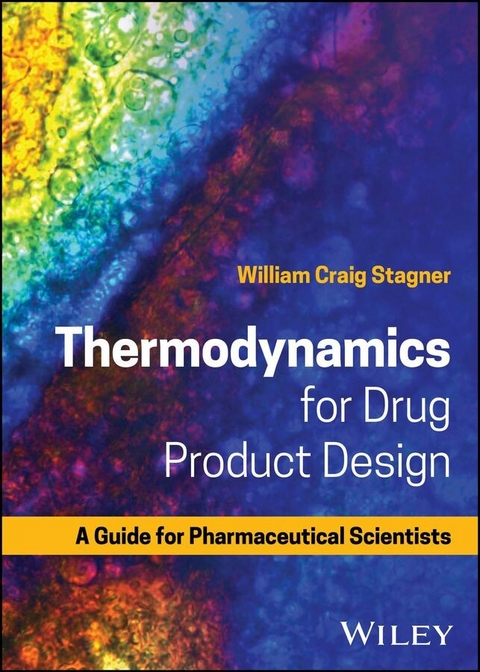
Thermodynamics for Drug Product Design (eBook)
352 Seiten
Wiley (Verlag)
978-1-119-85111-0 (ISBN)
Comprehensive reference reviewing how thermodynamic principles underpin the design of drug products and their applications
Written in an easy-to-read and understand style, Thermodynamics for Drug Product Design offers an abundance of real-life drug product design examples, applications, personal anecdotes, and solved problems that contextualize thermodynamic principles for the drug product design scientist. Advanced undergraduate and beginning graduate students will learn to apply thermodynamic principles to create robust drug products and to predict, prevent, analyze, and evaluate the root cause of product failures. Professionals engaged in drug product design will find this book to be a rich and easy to use reference guide.
The first two chapters address some key basics of data reporting and analysis, math, and thermodynamic properties using simple and accessible language. These chapters also help readers understand fundamental underlying definitions and physical relationships required to use thermodynamic laws in the design of drug products. In later chapters, the book focuses on six industrial pharmacy relevant thermodynamic topics: the laws of thermodynamics, Gibbs free energy, equilibrium, drug solubility equilibrium, surface thermodynamics, and adsorption phenomena.
Thermodynamics for Drug Product Design features chapters including:
- Data Reporting and Analysis
- Underlying Thermodynamic Physical Property Relationships and Definitions
- The Laws of Thermodynamics
- Gibbs Free Energy
- Equilibrium
- Drug Solubility Equilibrium
- Surface Thermodynamics
- Adsorption Phenomena
What others say:
'...comprehensive, rigorous, and logically organized ...the explanations flow effortlessly from the page...'
-BRUNO HANCOCK, PhD, FAAPS, Editor, JPharmSci
'...has a unique style of communicating complex scientific issues...'
-KEN MORRIS, PhD, FAAPS, Professor Emeritus, Founding Director Lachman Institute
'...unusual wide range of subjects...unusual for detail...'
-DALE ERIC WURSTER, PhD, FAAPS, Professor Emeritus, 2019 AAPS President
William Craig Stagner, RPh, MS, PhD is Professor Emeritus and formerly Director of the Campbell University Pharmaceutical Sciences Institute and Director of the Center for Analysis of Pharmaceutical Biomaterials at Campbell University College of Pharmacy & Health Sciences at Buies Creek, NC. Prior to joining the faculty, he founded the Pharmaceutics Department at the Glaxo Research Institute in Research Triangle Park, NC. Among his publications are co-authoring both editions of the Wiley title Integrated Pharmaceutics: Applied Preformulation, Product Design, and Regulatory Science.
Comprehensive reference reviewing how thermodynamic principles underpin the design of drug products and their applications Written in an easy-to-read and understand style, Thermodynamics for Drug Product Design offers an abundance of real-life drug product design examples, applications, personal anecdotes, and solved problems that contextualize thermodynamic principles for the drug product design scientist. Advanced undergraduate and beginning graduate students will learn to apply thermodynamic principles to create robust drug products and to predict, prevent, analyze, and evaluate the root cause of product failures. Professionals engaged in drug product design will find this book to be a rich and easy to use reference guide. The first two chapters address some key basics of data reporting and analysis, math, and thermodynamic properties using simple and accessible language. These chapters also help readers understand fundamental underlying definitions and physical relationships required to use thermodynamic laws in the design of drug products. In later chapters, the book focuses on six industrial pharmacy relevant thermodynamic topics: the laws of thermodynamics, Gibbs free energy, equilibrium, drug solubility equilibrium, surface thermodynamics, and adsorption phenomena. Thermodynamics for Drug Product Design features chapters including: Data Reporting and AnalysisUnderlying Thermodynamic Physical Property Relationships and DefinitionsThe Laws of ThermodynamicsGibbs Free EnergyEquilibriumDrug Solubility EquilibriumSurface ThermodynamicsAdsorption Phenomena What others say: comprehensive, rigorous, and logically organized the explanations flow effortlessly from the page BRUNO HANCOCK, PhD, FAAPS, Editor, JPharmSci has a unique style of communicating complex scientific issues KEN MORRIS, PhD, FAAPS, Professor Emeritus, Founding Director Lachman Institute unusual wide range of subjects unusual for detail DALE ERIC WURSTER, PhD, FAAPS, Professor Emeritus, 2019 AAPS President
| Erscheint lt. Verlag | 18.9.2025 |
|---|---|
| Sprache | englisch |
| Themenwelt | Naturwissenschaften ► Chemie |
| Schlagworte | Dimensional Analysis • drug solubility equilibria • Equilibria • Gibbs energy • interfacial thermodynamics • Isotherms • kinetic energy • laws thermodynamics • pharmaceutical product development • surface tension • Surface Thermodynamics |
| ISBN-10 | 1-119-85111-4 / 1119851114 |
| ISBN-13 | 978-1-119-85111-0 / 9781119851110 |
| Informationen gemäß Produktsicherheitsverordnung (GPSR) | |
| Haben Sie eine Frage zum Produkt? |
 PDF (Adobe DRM)
Kopierschutz: Adobe-DRM
Adobe-DRM ist ein Kopierschutz, der das eBook vor Mißbrauch schützen soll. Dabei wird das eBook bereits beim Download auf Ihre persönliche Adobe-ID autorisiert. Lesen können Sie das eBook dann nur auf den Geräten, welche ebenfalls auf Ihre Adobe-ID registriert sind.
Details zum Adobe-DRM
Dateiformat: PDF (Portable Document Format)
Mit einem festen Seitenlayout eignet sich die PDF besonders für Fachbücher mit Spalten, Tabellen und Abbildungen. Eine PDF kann auf fast allen Geräten angezeigt werden, ist aber für kleine Displays (Smartphone, eReader) nur eingeschränkt geeignet.
Systemvoraussetzungen:
PC/Mac: Mit einem PC oder Mac können Sie dieses eBook lesen. Sie benötigen eine
eReader: Dieses eBook kann mit (fast) allen eBook-Readern gelesen werden. Mit dem amazon-Kindle ist es aber nicht kompatibel.
Smartphone/Tablet: Egal ob Apple oder Android, dieses eBook können Sie lesen. Sie benötigen eine
Geräteliste und zusätzliche Hinweise
Buying eBooks from abroad
For tax law reasons we can sell eBooks just within Germany and Switzerland. Regrettably we cannot fulfill eBook-orders from other countries.
aus dem Bereich