


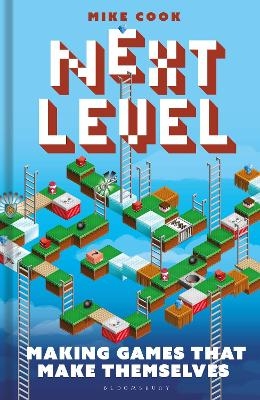
Next Level
Making Games That Make Themselves
Seiten
2026
Bloomsbury Sigma (Verlag)
978-1-3994-2339-7 (ISBN)
Bloomsbury Sigma (Verlag)
978-1-3994-2339-7 (ISBN)
- Noch nicht erschienen (ca. Mai 2026)
- Portofrei ab CHF 40
- Auch auf Rechnung
- Artikel merken
How generative systems are reshaping the way games are made, how we experience them, and what this reveals about creativity itself.
In video games creativity isn’t just seen – it’s played – from exploring endless landscapes, to diving into character details, to immersing ourselves in unpredictable narratives. Yet these elements are often the result of procedural generation – the creative use of algorithms to design game content. Procedural generation is the secret behind some of the biggest hits in video game history, from genre-defying titles in the 1980s, to the most famous blockbusters of today.
Next Level demystifies the collection of algorithms and procedural techniques that are often as mysterious as the things they create. Written by game designer and creative AI researcher Mike Cook, it takes us on a tour of generative systems past and present, exploring how they work, the artistic uses they have in some of our favourite games and how procedural generation didn’t just change how we design games, but how we think about creativity.
In video games creativity isn’t just seen – it’s played – from exploring endless landscapes, to diving into character details, to immersing ourselves in unpredictable narratives. Yet these elements are often the result of procedural generation – the creative use of algorithms to design game content. Procedural generation is the secret behind some of the biggest hits in video game history, from genre-defying titles in the 1980s, to the most famous blockbusters of today.
Next Level demystifies the collection of algorithms and procedural techniques that are often as mysterious as the things they create. Written by game designer and creative AI researcher Mike Cook, it takes us on a tour of generative systems past and present, exploring how they work, the artistic uses they have in some of our favourite games and how procedural generation didn’t just change how we design games, but how we think about creativity.
Mike Cook is an AI researcher, game designer and writer from London, where he is a Senior Lecturer in the Department of Informatics at King’s College London. He is best-known for his research into automated game design – building AI systems that can design games from scratch. His AI systems have won numerous awards.
Prologue: Shuffle and Roll
1: Elite and Rogue
2: Cut and Paste
3: Spelunky's Shifting Walls
4: Noise
5: Minecraft
6. Simulation
7: Dwarf Fortress
8: Caves of Qud
9: Machine Learning and Generative AI
10: Evaluation
11: The Future
Epilogue: Next Level
| Erscheint lt. Verlag | 7.5.2026 |
|---|---|
| Zusatzinfo | Black and white illustrations throughout |
| Verlagsort | London |
| Sprache | englisch |
| Maße | 153 x 234 mm |
| Themenwelt | Informatik ► Software Entwicklung ► Spieleprogrammierung |
| Informatik ► Theorie / Studium ► Künstliche Intelligenz / Robotik | |
| Informatik ► Weitere Themen ► Computerspiele | |
| Naturwissenschaften | |
| ISBN-10 | 1-3994-2339-8 / 1399423398 |
| ISBN-13 | 978-1-3994-2339-7 / 9781399423397 |
| Zustand | Neuware |
| Informationen gemäß Produktsicherheitsverordnung (GPSR) | |
| Haben Sie eine Frage zum Produkt? |
Mehr entdecken
aus dem Bereich


aus dem Bereich
das umfassende Handbuch
Buch | Hardcover (2024)
Rheinwerk (Verlag)
CHF 69,85
Buch | Softcover (2023)
MITP (Verlag)
CHF 34,95


