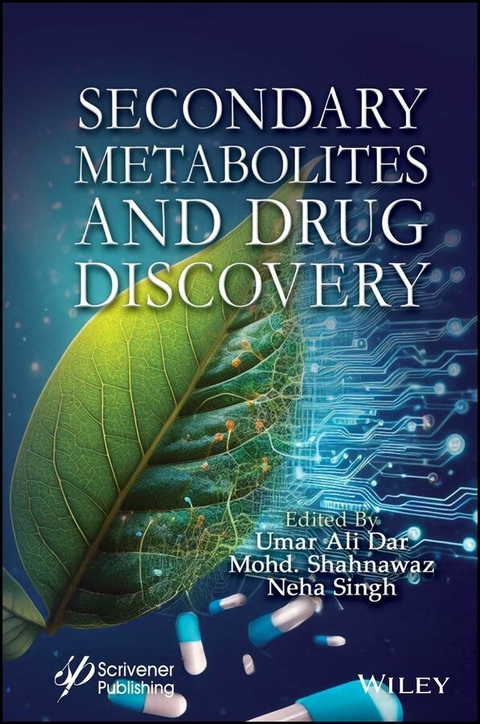
Secondary Metabolites and Drug Discovery (eBook)
566 Seiten
Wiley-Scrivener (Verlag)
978-1-394-20458-8 (ISBN)
This book explores the promising potential of plant and microbe-derived compounds in drug discovery, offering insights into safer alternatives to synthetic drugs and highlighting the vital role of natural products in treating diseases with fewer side effects.
Plants and microbes are a promising source for natural products with the potential to play a major role in drug discovery. Due to advances in the fields of science, technology, engineering, and medicine, the commercial pharmaceutical industry is growing across the globe. Currently, allopathy uses synthetic pharmaceutical drugs for the treatment of diseases, but this practice also exposes patients to significant side effects. Since ancient times, other systems of medicine have been developed that utilize plant-based extracts and molecules to treat various diseases with fewer side effects. While changes in lifestyle, including diet, have had a significant impact on the increased risks of various diseases, there is substantial scientific evidence, both epidemiological and experimental, that vegetables and fruits are key features of diets associated with lower risks of diseases such as cancers and infections. These efforts to identify and create medications from plants are leading to increased manufacturing for larger clinical trials. The continuing scientific research of medicinal plants will undoubtedly provide a wealth of novel, structurally varied, bioactive chemicals. This edited volume provides an overview of various medical systems, with a special focus on microbial and plant-based drug molecules for treating communicable and non-communicable diseases, making it an invaluable resource for researchers, scientists, and practitioners interested in the potential of plant- and microbe-derived secondary metabolites in the ongoing search for innovative, effective, and safer medicines.
Readers will find this book:
- Provides an overview of different types of sources and drug molecules used in allopathic, homeopathic, ayurvedic, Chinese, and Unani systems of medicine;
- Highlights past and current methods of alternative, complementary, folklore, and integrative medicines;
- Discusses the benefits and side effects of the drug molecules used in different systems of medicine at the global level;
- Explores microbial and plant-based drug molecules for treating various communicable and non-communicable diseases.
Audience
Researchers, academics, industry, and governmental experts working in the fields of natural science, natural products, synthetic chemistry, pharmacology, and medicinal chemistry.
Umar Ali Dar, PhD is an assistant professor of Chemistry in the Department of Applied Sciences and Humanities at the Government College of Engineering and Technology in Ganderbal, India. He has authored and co-authored numerous peer-reviewed articles, books, and book chapters, demonstrating his commitment to advancing the understanding of complex chemical systems and their applications. His research interests include crystal engineering, materials science, energy applications, sensors, water treatment, secondary metabolites, pharmaceuticals, and drug discovery.
Mohd. Shahnawaz, PhD is an assistant professor at Government Degree College Drass, University of Ladakh. India. He has published 25 research articles, 19 book chapters, and 15 books of international repute. His research interests are in integrative medicine, ecology, microbiology, plant biotechnology, and bioremediation.
Neha Singh, PhD is a senior scientist at the Virology Lab in the Department of Microbiology at Pt. Jawahar Lal Nehru Memorial Medical College, India with over 11 years of research experience. She has published various research and review articles in reputed national and international journals, as well as books and book chapters related to her specialty. Her areas of interest are antimicrobial compounds, infectious diseases, and molecular virology.
This book explores the promising potential of plant and microbe-derived compounds in drug discovery, offering insights into safer alternatives to synthetic drugs and highlighting the vital role of natural products in treating diseases with fewer side effects. Plants and microbes are a promising source for natural products with the potential to play a major role in drug discovery. Due to advances in the fields of science, technology, engineering, and medicine, the commercial pharmaceutical industry is growing across the globe. Currently, allopathy uses synthetic pharmaceutical drugs for the treatment of diseases, but this practice also exposes patients to significant side effects. Since ancient times, other systems of medicine have been developed that utilize plant-based extracts and molecules to treat various diseases with fewer side effects. While changes in lifestyle, including diet, have had a significant impact on the increased risks of various diseases, there is substantial scientific evidence, both epidemiological and experimental, that vegetables and fruits are key features of diets associated with lower risks of diseases such as cancers and infections. These efforts to identify and create medications from plants are leading to increased manufacturing for larger clinical trials. The continuing scientific research of medicinal plants will undoubtedly provide a wealth of novel, structurally varied, bioactive chemicals. This edited volume provides an overview of various medical systems, with a special focus on microbial and plant-based drug molecules for treating communicable and non-communicable diseases, making it an invaluable resource for researchers, scientists, and practitioners interested in the potential of plant- and microbe-derived secondary metabolites in the ongoing search for innovative, effective, and safer medicines. Readers will find this book: Provides an overview of different types of sources and drug molecules used in allopathic, homeopathic, ayurvedic, Chinese, and Unani systems of medicine; Highlights past and current methods of alternative, complementary, folklore, and integrative medicines; Discusses the benefits and side effects of the drug molecules used in different systems of medicine at the global level; Explores microbial and plant-based drug molecules for treating various communicable and non-communicable diseases. Audience Researchers, academics, industry, and governmental experts working in the fields of natural science, natural products, synthetic chemistry, pharmacology, and medicinal chemistry.
| Erscheint lt. Verlag | 19.8.2025 |
|---|---|
| Sprache | englisch |
| Themenwelt | Naturwissenschaften ► Chemie |
| ISBN-10 | 1-394-20458-2 / 1394204582 |
| ISBN-13 | 978-1-394-20458-8 / 9781394204588 |
| Informationen gemäß Produktsicherheitsverordnung (GPSR) | |
| Haben Sie eine Frage zum Produkt? |
 PDF (Adobe DRM)
Kopierschutz: Adobe-DRM
Adobe-DRM ist ein Kopierschutz, der das eBook vor Mißbrauch schützen soll. Dabei wird das eBook bereits beim Download auf Ihre persönliche Adobe-ID autorisiert. Lesen können Sie das eBook dann nur auf den Geräten, welche ebenfalls auf Ihre Adobe-ID registriert sind.
Details zum Adobe-DRM
Dateiformat: PDF (Portable Document Format)
Mit einem festen Seitenlayout eignet sich die PDF besonders für Fachbücher mit Spalten, Tabellen und Abbildungen. Eine PDF kann auf fast allen Geräten angezeigt werden, ist aber für kleine Displays (Smartphone, eReader) nur eingeschränkt geeignet.
Systemvoraussetzungen:
PC/Mac: Mit einem PC oder Mac können Sie dieses eBook lesen. Sie benötigen eine
eReader: Dieses eBook kann mit (fast) allen eBook-Readern gelesen werden. Mit dem amazon-Kindle ist es aber nicht kompatibel.
Smartphone/Tablet: Egal ob Apple oder Android, dieses eBook können Sie lesen. Sie benötigen eine
Geräteliste und zusätzliche Hinweise
Buying eBooks from abroad
For tax law reasons we can sell eBooks just within Germany and Switzerland. Regrettably we cannot fulfill eBook-orders from other countries.
aus dem Bereich