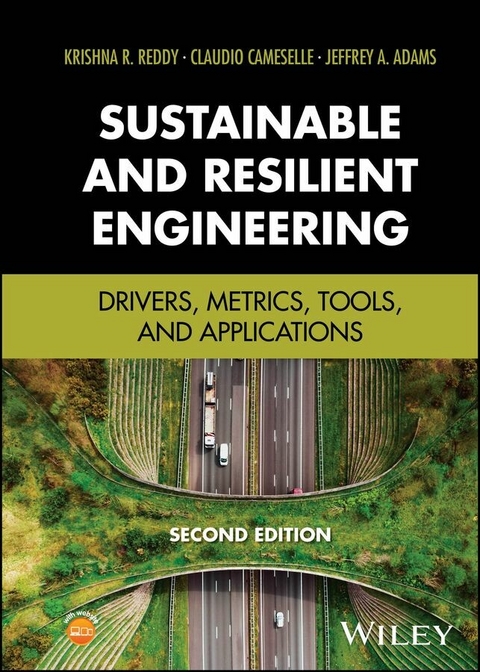
Sustainable and Resilient Engineering (eBook)
1277 Seiten
Wiley (Verlag)
978-1-394-26769-9 (ISBN)
Definitions, methodologies, and current applications of the principles of sustainability and resiliency in all engineering disciplines
Sustainable and Resilient Engineering provides a comprehensive exploration of the scientific basis, methodologies, and practical applications of sustainability and resiliency in engineering. With an emphasis on the tri-sectoral dimensions of the economy, environment, and society, as well as an increased emphasis on resilience across these dimensions, this textbook equips readers with the knowledge and expertise to evaluate, design, and enhance engineering solutions across a wide range of fields spanning from civil infrastructure and energy engineering to waste management and land use planning.
The text also presents a set of case studies across different engineering disciplines such as bio/chemical, environmental, materials, construction, and infrastructure engineering that demonstrate the practical applicability of sustainability and resiliency assessments for a diverse range of projects.
The new edition features updated content on sustainability assessment tools and expands on the critical role of resiliency, emphasizing the interplay between sustainability and resiliency, in engineered systems. The new edition of Sustainable and Resilient Engineering also provides updates on topics including:
- Climate-resilient engineering basics and assessment methodologies
- Role of emerging technologies such as artificial intelligence, remote sensing, robotics, digital twins, and the Internet of Things in achieving sustainability and resiliency
- Sustainable engineered materials, nature-based solutions, and resource recovery
- Wastewater treatment as another source for non-potable water use applications
- Environmental, Social, and Governance (ESG) concepts and environmental justice
Updated pedagogical features include spreadsheet tools, lecture slides, goals/objectives sections, end-of-chapter problem sets, new exercises and examples, and a solutions manual.
Sustainable and Resilient Engineering is an excellent up-to-date textbook for introductory and advanced university courses on sustainability and resiliency. It is also valuable as an advanced manual/reference for practitioners and professionals in their design, review, implementation, advisory, or oversight activities.
Krishna R. Reddy, Ph.D., P.E., F.ASCE, ENV SP is a University Scholar, Distinguished Researcher, Professor of Civil and Environmental Engineering, and the Director of both the Sustainable Engineering Research Laboratory and the Geotechnical and Geoenvironmental Engineering Laboratory in the Department of Civil, Materials and Environmental Engineering at the University of Illinois, Chicago, Illinois, USA.
Claudio Cameselle, Ph.D. is a Professor in the Department of Chemical Engineering at the University of Vigo, Spain.
Jeffrey A. Adams, Ph.D., P.E., ENV SP is a Principal Consultant of ENGEO Incorporated in San Ramon, California, USA.
1
Emerging Challenges, Sustainability, Resiliency, and Sustainable and Resilient Engineering
Chapter Goal and Objectives
This chapter aims to introduce the drivers and concepts of sustainability and resilience, highlighting the importance of integrating them into engineering practice. The specific objectives are to (i) provide examples of emerging challenges that necessitate a focus on sustainability and resilience, (ii) explain the definitions of sustainability and resilience and clarify the differences between these two concepts, and (iii) emphasize the importance of sustainable and resilient engineering in promoting sustainable development.
1.1 Introduction
The concepts of resiliency and sustainability are everywhere. In recent years, ever‐growing numbers of people around the world have become more aware of strains placed on the Earth. These strains have been manifested in a variety of ways – accelerated exploitation of natural resources, increased waste generation, pollution of air, soil, and water, and climate change. Not only have private citizens taken notice, but governments and the business world have also taken steps to address sustainability. Numerous intra‐ and intergovernmental initiatives and agreements have been developed to address the strains on the environment and to identify measures that encourage more sustainable practices. Businesses, too, have realized that sustainability is a good practice for a variety of reasons. New systems and products have been developed that are more protective and less wasteful of resources, and the pursuit of the “triple bottom line” (TBL) of sustainability has been increasingly applied in new projects and products. The TBL is the reference framework in sustainability that accounts for financial as well as social and environmental metrics.
Similarly, the increasing impacts of climate change, along with other uncertainties such as economic instability and social unrest, make it essential for the world to embrace the concept of resilience. In engineering, technical robustness against both expected and unexpected shocks has historically been the primary focus of design and implementation. This approach can be seen as a form of resiliency consideration. However, growing concerns over climate change and other uncertainties necessitate the engineering community to consider other dimensions of resiliency, such as environmental, economic, and social impacts of a failure. Despite the importance of these dimensions of resiliency, they are often overlooked during engineering decision‐making processes.
Several key questions have emerged that necessitate contemplation. What emerging challenges are forcing us to think about sustainability and resiliency? What is sustainability? What is resiliency? How do we take action to further these concepts? What are sustainable engineering (SE), resilient engineering (RE), and integrated sustainable and resilient engineering, and what role can they play in sustainable development? Of equal importance, how do we determine success in pursuit of these initiatives, and how do we measure our progress toward these goals? These evolving and increasingly significant concepts are the focus of this book.
This chapter describes the broader emerging challenges that are forcing us to think about sustainability and resiliency. Next, the general definitions and interpretations of the meaning of sustainability and resiliency are presented. Finally, sustainable and resilient engineering and its role in achieving sustainable development are described.
1.2 Emerging Challenges
Before we delve into the concepts, applications, methods, and measures related to sustainability and resiliency, let us examine several acute problems and related examples that are faced worldwide and are increasingly having a measurable, detrimental effect on the planet.
1.2.1 Increased Consumption and Depletion of Natural Resources
A key consideration of sustainability focuses on our ability to preserve resources for future generations. This is extremely important, as many essential resources (e.g. precious metals, fossil fuels) are non‐renewable and are limited in quantity. For many of these resources, we are on a current trajectory of utilization/exploitation in which near‐total depletion of economically viable reserves is a very realistic possibility. The alarming rates of consumption of a number of resources not only spell trouble for the availability of these resources for future generations but also cause unintended secondary, yet catastrophic, side effects on the environment.
1.2.1.1 Easter Island Example
A classic example of the catastrophic consequences of the primary and secondary effects of natural resource depletion is the collapse of a civilization on Easter Island. Located in the southeastern Pacific Ocean and arguably the most remote habitable region on the planet, Easter Island gained its name from the sighting/discovery of the island on Easter Sunday, 1722, by Dutch sailors. It was subsequently annexed by Chile in 1888. Large stone statuary called moai, created by early Rapa Nui peoples, were important monuments to a sophisticated culture and civilization that had once flourished on Easter Island but had devolved into a small, primitive culture at the time of European discovery (DiNapoli et al. 2021).
Although Easter Island is subject to a cold and dry climate, it was at one time heavily forested with palms, conifers, and sandalwood. The first Polynesians arrived at Easter Island in the fifth century and numbered no more than 20 or 30. The harsh climate and nutrient poor soils restricted agricultural activity to the cultivation of sweet potatoes. Nevertheless, a sophisticated and advanced society flourished among the Rapa Nui. To allow for agricultural activity, much of the land was deforested. Trees were also harvested to provide structural materials for housing and boat fabrication and for use as fuel. However, a significant number of trees were also harvested to create a track system to maneuver the large moai from quarry locations to sites where they were erected. As the population grew upward of 7000 persons, these resources were further utilized to meet increasing demand.
By the 1600s, the entire island had been deforested. The lack of timber resources eliminated the ability to construct fishing boats and wooden structures. The elimination of bark materials prevented the fabrication of cloth materials. Furthermore, the deforestation greatly accelerated soil erosion, and the agricultural capacity of the already nutrient‐poor soils was again severely reduced. Elaborate rituals centered around the moai statuary diminished, placing even greater strain on the social fabric of the declining society, including the breakdown of social and religious conventions. Because boats could no longer be fabricated without timber, the Rapa Nui were trapped on the remote island. Eventually, they were forced to resort to primitive cultural practices where available shelter had been reduced to available caves. Ongoing turbulent conditions fueled conflict/warfare, slavery, and even reports of cannibalism.
Ultimately, the once great civilization had collapsed. At the time of European discovery, the population had declined precipitously. The collapse of island’s agricultural capacity and activity resulted in widespread, ongoing starvation. Subsequent contacts from seafaring groups, such as whalers, introduced sexually transmitted diseases and smallpox. Peruvian slave parties also captured numerous Rapa Nui for use in the slave trade. By 1877, only 111 Rapa Nui remained on Easter Island, and at the time of Chilean annexation, the Chilean government confined the remaining inhabitants to one village.
Rapa Nui remain on Easter Island to this day. Archaeologists brought attention to the island in the mid‐twentieth century, which in turn has stimulated tourism and led to the restoration of some of the moai statuary. Conditions have improved for the Rapa Nui, although unemployment remains high and alcoholism and related social strains are quite prevalent. Additionally, they are still dependent on imported food.
Nevertheless, the story of the Rapa Nui has been repeated with other people – the Mayan and Inca people of Central and South America as well as the ancient Greeks and Romans. All of these people offer a cautionary tale – when a society disregards the health of its environment, places excessive strains on vital resources, such as soil and water, can lead to a collapse of agricultural activity and other aspects of economy and culture. When basic necessities such as food, clothing, and shelter become scarce, a disparity between “haves” and “have‐nots” is often exacerbated, leading to mistrust and resentment between classes. As the problem grows, conflict is inevitable, and collapse of the underlying civilization will occur.
1.2.1.2 Metallic Ores Consumption Example
Several examples can be presented with respect to unsustainable utilization of natural resources. Let us take the example of the usage of metallic ores, and as an example, let us examine the use of zinc (Graedel and Allenby 2010). Consider zinc use over a sustainability design period of 50 years and a global population of 7.5 billion people. Estimated global zinc reserves consist of 330 × 1012 g (330 Tg) of zinc. Considering a 50‐year period (after which all resources will be depleted), 6.6 Tg may be...
| Erscheint lt. Verlag | 5.8.2025 |
|---|---|
| Sprache | englisch |
| Themenwelt | Naturwissenschaften ► Chemie |
| Schlagworte | circular economy • climate change • environmental justice • ESG • GHGs • Life Cycle Analysis • renewable energy • Resilience quantification • resiliency • resilient engineering • SDGs • Sustainability Metrics • sustainable engineering |
| ISBN-10 | 1-394-26769-X / 139426769X |
| ISBN-13 | 978-1-394-26769-9 / 9781394267699 |
| Informationen gemäß Produktsicherheitsverordnung (GPSR) | |
| Haben Sie eine Frage zum Produkt? |
 EPUB (Adobe DRM)
Kopierschutz: Adobe-DRM
Adobe-DRM ist ein Kopierschutz, der das eBook vor Mißbrauch schützen soll. Dabei wird das eBook bereits beim Download auf Ihre persönliche Adobe-ID autorisiert. Lesen können Sie das eBook dann nur auf den Geräten, welche ebenfalls auf Ihre Adobe-ID registriert sind.
Details zum Adobe-DRM
Dateiformat: EPUB (Electronic Publication)
EPUB ist ein offener Standard für eBooks und eignet sich besonders zur Darstellung von Belletristik und Sachbüchern. Der Fließtext wird dynamisch an die Display- und Schriftgröße angepasst. Auch für mobile Lesegeräte ist EPUB daher gut geeignet.
Systemvoraussetzungen:
PC/Mac: Mit einem PC oder Mac können Sie dieses eBook lesen. Sie benötigen eine
eReader: Dieses eBook kann mit (fast) allen eBook-Readern gelesen werden. Mit dem amazon-Kindle ist es aber nicht kompatibel.
Smartphone/Tablet: Egal ob Apple oder Android, dieses eBook können Sie lesen. Sie benötigen eine
Geräteliste und zusätzliche Hinweise
Buying eBooks from abroad
For tax law reasons we can sell eBooks just within Germany and Switzerland. Regrettably we cannot fulfill eBook-orders from other countries.
aus dem Bereich