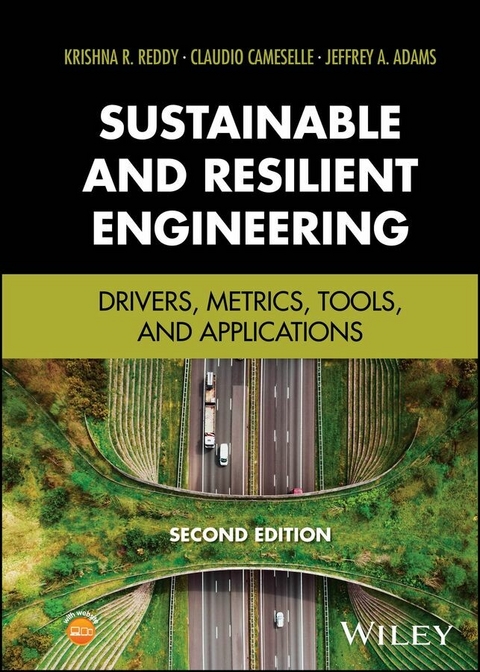
Sustainable and Resilient Engineering (eBook)
673 Seiten
Wiley (Verlag)
978-1-394-26770-5 (ISBN)
Definitions, methodologies, and current applications of the principles of sustainability and resiliency in all engineering disciplines
Sustainable and Resilient Engineering provides a comprehensive exploration of the scientific basis, methodologies, and practical applications of sustainability and resiliency in engineering. With an emphasis on the tri-sectoral dimensions of the economy, environment, and society, as well as an increased emphasis on resilience across these dimensions, this textbook equips readers with the knowledge and expertise to evaluate, design, and enhance engineering solutions across a wide range of fields spanning from civil infrastructure and energy engineering to waste management and land use planning.
The text also presents a set of case studies across different engineering disciplines such as bio/chemical, environmental, materials, construction, and infrastructure engineering that demonstrate the practical applicability of sustainability and resiliency assessments for a diverse range of projects.
The new edition features updated content on sustainability assessment tools and expands on the critical role of resiliency, emphasizing the interplay between sustainability and resiliency, in engineered systems. The new edition of Sustainable and Resilient Engineering also provides updates on topics including:
- Climate-resilient engineering basics and assessment methodologies
- Role of emerging technologies such as artificial intelligence, remote sensing, robotics, digital twins, and the Internet of Things in achieving sustainability and resiliency
- Sustainable engineered materials, nature-based solutions, and resource recovery
- Wastewater treatment as another source for non-potable water use applications
- Environmental, Social, and Governance (ESG) concepts and environmental justice
Updated pedagogical features include spreadsheet tools, lecture slides, goals/objectives sections, end-of-chapter problem sets, new exercises and examples, and a solutions manual.
Sustainable and Resilient Engineering is an excellent up-to-date textbook for introductory and advanced university courses on sustainability and resiliency. It is also valuable as an advanced manual/reference for practitioners and professionals in their design, review, implementation, advisory, or oversight activities.
Krishna R. Reddy, Ph.D., P.E., F.ASCE, ENV SP is a University Scholar, Distinguished Researcher, Professor of Civil and Environmental Engineering, and the Director of both the Sustainable Engineering Research Laboratory and the Geotechnical and Geoenvironmental Engineering Laboratory in the Department of Civil, Materials and Environmental Engineering at the University of Illinois, Chicago, Illinois, USA.
Claudio Cameselle, Ph.D. is a Professor in the Department of Chemical Engineering at the University of Vigo, Spain.
Jeffrey A. Adams, Ph.D., P.E., ENV SP is a Principal Consultant of ENGEO Incorporated in San Ramon, California, USA.
Definitions, methodologies, and current applications of the principles of sustainability and resiliency in all engineering disciplines Sustainable and Resilient Engineering provides a comprehensive exploration of the scientific basis, methodologies, and practical applications of sustainability and resiliency in engineering. With an emphasis on the tri-sectoral dimensions of the economy, environment, and society, as well as an increased emphasis on resilience across these dimensions, this textbook equips readers with the knowledge and expertise to evaluate, design, and enhance engineering solutions across a wide range of fields spanning from civil infrastructure and energy engineering to waste management and land use planning. The text also presents a set of case studies across different engineering disciplines such as bio/chemical, environmental, materials, construction, and infrastructure engineering that demonstrate the practical applicability of sustainability and resiliency assessments for a diverse range of projects. The new edition features updated content on sustainability assessment tools and expands on the critical role of resiliency, emphasizing the interplay between sustainability and resiliency, in engineered systems. The new edition of Sustainable and Resilient Engineering also provides updates on topics including: Climate-resilient engineering basics and assessment methodologiesRole of emerging technologies such as artificial intelligence, remote sensing, robotics, digital twins, and the Internet of Things in achieving sustainability and resiliencySustainable engineered materials, nature-based solutions, and resource recoveryWastewater treatment as another source for non-potable water use applicationsEnvironmental, Social, and Governance (ESG) concepts and environmental justice Updated pedagogical features include spreadsheet tools, lecture slides, goals/objectives sections, end-of-chapter problem sets, new exercises and examples, and a solutions manual. Sustainable and Resilient Engineering is an excellent up-to-date textbook for introductory and advanced university courses on sustainability and resiliency. It is also valuable as an advanced manual/reference for practitioners and professionals in their design, review, implementation, advisory, or oversight activities.
| Erscheint lt. Verlag | 25.7.2025 |
|---|---|
| Sprache | englisch |
| Themenwelt | Naturwissenschaften ► Chemie |
| Schlagworte | circular economy • climate change • environmental justice • ESG • GHGs • Life Cycle Analysis • renewable energy • Resilience quantification • resiliency • resilient engineering • SDGs • Sustainability Metrics • sustainable engineering |
| ISBN-10 | 1-394-26770-3 / 1394267703 |
| ISBN-13 | 978-1-394-26770-5 / 9781394267705 |
| Informationen gemäß Produktsicherheitsverordnung (GPSR) | |
| Haben Sie eine Frage zum Produkt? |
 PDF (Adobe DRM)
Kopierschutz: Adobe-DRM
Adobe-DRM ist ein Kopierschutz, der das eBook vor Mißbrauch schützen soll. Dabei wird das eBook bereits beim Download auf Ihre persönliche Adobe-ID autorisiert. Lesen können Sie das eBook dann nur auf den Geräten, welche ebenfalls auf Ihre Adobe-ID registriert sind.
Details zum Adobe-DRM
Dateiformat: PDF (Portable Document Format)
Mit einem festen Seitenlayout eignet sich die PDF besonders für Fachbücher mit Spalten, Tabellen und Abbildungen. Eine PDF kann auf fast allen Geräten angezeigt werden, ist aber für kleine Displays (Smartphone, eReader) nur eingeschränkt geeignet.
Systemvoraussetzungen:
PC/Mac: Mit einem PC oder Mac können Sie dieses eBook lesen. Sie benötigen eine
eReader: Dieses eBook kann mit (fast) allen eBook-Readern gelesen werden. Mit dem amazon-Kindle ist es aber nicht kompatibel.
Smartphone/Tablet: Egal ob Apple oder Android, dieses eBook können Sie lesen. Sie benötigen eine
Geräteliste und zusätzliche Hinweise
Buying eBooks from abroad
For tax law reasons we can sell eBooks just within Germany and Switzerland. Regrettably we cannot fulfill eBook-orders from other countries.
aus dem Bereich