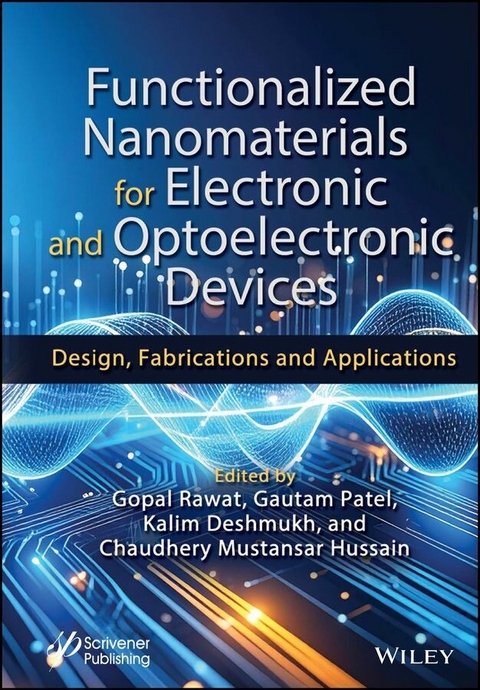
Functionalized Nanomaterials for Electronic and Optoelectronic Devices (eBook)
1296 Seiten
Wiley-Scrivener (Verlag)
978-1-394-21408-2 (ISBN)
The book gives invaluable insights and expertise from leading researchers on the latest advancements, challenges, and applications of functionalized nanomaterials.
Functionalized Nanomaterials for Electronic and Optoelectronic Devices: Design, Fabrications and Applications examines the current state-of-the-art, recent progress, new challenges, and future perspectives of functionalized nanomaterials in high-performance electronic and optoelectronic device applications. The book focuses on the synthesis strategies, functionalization methods, characterizations, properties, and applications of functionalized nanomaterials in various electronic and optoelectronic devices and the essential criteria in each specified field. The physicochemical, optical, electrical, magnetic, electronic, and surface properties of functionalized nanomaterials are also discussed in detail. Additionally, the book discusses reliability, ethical and legal issues, environmental and health impact, and commercialization aspects of functionalized nanomaterials, as well as essential criteria in each specified field. This curated selection of topics and expert contributions from across the globe make this book an outstanding reference source for anyone involved in the field of functionalized nanomaterials-based electronic and optoelectronic devices. The book gives a comprehensive summary of recent advancements and key technical research accomplishments in the area of electronic/optoelectronic device applications of functionalized nanomaterials. Functionalized Nanomaterials for Electronic and Optoelectronic Devices serves as a one-stop reference for important research in this innovative research field.
Readers will find this volume:
- Explores technological advances, recent trends, and various applications of functionalized nanomaterials;
- Provides state-of-the-art knowledge on synthesis, processing, properties, and characterization of functionalized nanomaterials;
- Presents fundamental knowledge and an extensive review on functionalized nanomaterials, especially those designed for electronic device applications;
- Summarizes key challenges, future perspectives, reliability, and commercialization aspects of functionalized nanomaterials in various electronic devices.
Audience
This book will be a very valuable reference source for research scholars, graduate students (primarily in the field of materials science and engineering, nanomaterials and nanotechnology) and industry engineers working in the field of functionalized nanomaterials for electronic applications.
Gopal Rawat, PhD is an assistant professor in the School of Computing and Electrical Engineering at the Indian Institute of Technology Mandi, Himachal Pradesh, India. He has published over 50 research articles in leading peer-reviewed international journals and conferences, one book chapter, and four patents. His research interests include semiconducting materials, device design and development, novel materials, and semiconductor devices.
Gautam Patel, PhD works in the Department of Industrial Chemistry at the Institute of Science and Technology for Advanced Studies and Research, CVM University, Nagar, Gujarat, India, with over seven years of experience. He has published one book, six chapters, three patents, and five research papers in international journals. His research interests include organic synthesis, green chemistry, nanosciences, and nanotechnology.
Kalim Deshmukh, PhD is a senior researcher at the New Technologies Research Centre at the University of West Bohemia, Plzen, Czech Republic, with over 15 years of research experience. He has published over 110 research articles in peer-reviewed journals and 36 book chapters and edited several books. His research interests include synthesis, characterization, and property investigations of polymer nanocomposites reinforced with different nanofillers, including various nanoparticles and carbon allotropes such as carbon black, carbon nanotubes, graphene, and its derivatives for energy storage, energy harvesting, gas sensing, EMI shielding, and high-k dielectric applications.
Chaudhery Mustansar Hussain, PhD is an adjunct professor, academic advisor, and Lab Director in the Department of Chemistry and Environmental Sciences at the New Jersey Institute of Technology, USA. He is the author of numerous papers in peer-reviewed journals as well as author and editor of over 100 scientific monographs and books. His research focuses on the application of nanotechnology and advanced materials in environmental and analytical chemistry.
The book gives invaluable insights and expertise from leading researchers on the latest advancements, challenges, and applications of functionalized nanomaterials. Functionalized Nanomaterials for Electronic and Optoelectronic Devices: Design, Fabrications and Applications examines the current state-of-the-art, recent progress, new challenges, and future perspectives of functionalized nanomaterials in high-performance electronic and optoelectronic device applications. The book focuses on the synthesis strategies, functionalization methods, characterizations, properties, and applications of functionalized nanomaterials in various electronic and optoelectronic devices and the essential criteria in each specified field. The physicochemical, optical, electrical, magnetic, electronic, and surface properties of functionalized nanomaterials are also discussed in detail. Additionally, the book discusses reliability, ethical and legal issues, environmental and health impact, and commercialization aspects of functionalized nanomaterials, as well as essential criteria in each specified field. This curated selection of topics and expert contributions from across the globe make this book an outstanding reference source for anyone involved in the field of functionalized nanomaterials-based electronic and optoelectronic devices. The book gives a comprehensive summary of recent advancements and key technical research accomplishments in the area of electronic/optoelectronic device applications of functionalized nanomaterials. Functionalized Nanomaterials for Electronic and Optoelectronic Devices serves as a one-stop reference for important research in this innovative research field. Readers will find this volume: Explores technological advances, recent trends, and various applications of functionalized nanomaterials; Provides state-of-the-art knowledge on synthesis, processing, properties, and characterization of functionalized nanomaterials; Presents fundamental knowledge and an extensive review on functionalized nanomaterials, especially those designed for electronic device applications; Summarizes key challenges, future perspectives, reliability, and commercialization aspects of functionalized nanomaterials in various electronic devices. Audience This book will be a very valuable reference source for research scholars, graduate students (primarily in the field of materials science and engineering, nanomaterials and nanotechnology) and industry engineers working in the field of functionalized nanomaterials for electronic applications.
1
Functionalized Nanomaterials: Fundamentals, New Perspectives, and Emerging Research Trends in Electronic and Optoelectronic Device Fabrications, Challenges, and Future Perspectives
Sunil Kumar Baburao Mane1, Naghma Shaishta1* and G. Manjunatha2
1Department of Chemistry, Khaja Bandanawaz University, Kalaburagi, Karnataka, India
2Department of Chemistry, Shri Siddhartha Institute of Technology, Tumkur, Karnataka, India
Abstract
Nanomaterials (NMs) (particles with a size between 1 and 100 nm) are the fundamental units of nanostructured materials. When materials grow to be in the nanoscale range owing to quantum entrapment, both their chemical and physical characteristics are significantly altered. Owing to advancements in efficiency and the shrinking of equipment, there is a nanotechnology boom using these NMs, and NM need in the marketplace has surged. Although NMs provide many benefits, they also have certain drawbacks. Agglomeration, interaction with substrate and reaction media, and poor solubility in many solvents are a few of the drawbacks. The constraints can be reduced by surface functionalizing NMs with the appropriate functional groups. Comparatively speaking, functionalized NMs (FNMs) exhibit superior mechanical, chemical, and physical characteristics.
The creation of novel FNMs with potential uses in the optoelectronic fields has recently attracted a lot of attention. The opportunity for many cutting-edge devices to be revolutionized by FNMs is exceptional. The study of FNMs’ manufacture, characterization, and applications, however, is still in its infancy. Information regarding this great material is required. Major characteristics including the kind of FNMs, the fabrication processes, the applications, the tasks, the advantages and limitations, and the marketable characteristics are explored in depth.
This book chapter will be helpful for those studying, seeking information, and employed in the fields of FNMs because it gives a clear understanding of the numerous uses of these FNMs in the field of electronic and optoelectronic devices.
Keywords: Functionalized nanomaterials, electronic, optoelectronic, device fabrications
1.1 Introduction
Nanomaterials (NMs) or particles with a size between 1 and 100 nm are the fundamental units of materials engineering. When materials grow to be in the nanometer scale as a result of quantum confinement, both their physical and chemical characteristics are significantly altered. Due to enhanced efficiency and the miniaturization of equipment, there is a nanotechnology breakthrough using these NMs, and their popularity in the marketplace has expanded. Even though NMs have several benefits, they additionally come with certain drawbacks. Assemblage, interaction with material and interaction surfaces, and poor solubility in several solvents are a few of the restrictions. The restrictions could be reduced by surface functionalizing NMs with the appropriate functional communities [1–4].
Comparatively speaking, functionalized NMs (FNMs) exhibit superior mechanical, chemical, and physical characteristics. Due to their distinctive topography, nanostructure components have awhile back become an increasing focus to be utilized in photocatalysis, bioprobes, nanosensors, nanopatterning, and nanofabrication and in an optoelectronics like solar cells, laser diodes, light-emitting diodes (LEDs), and photodetectors due to the particular surface places for preferential molecular bonding [5, 6]. Small-scale NMs can be seamlessly incorporated into a wide variety of scientific portals, delivering exceptional optoelectronic devices with novel chemical and physical characteristics. For their emerging functional technological applications, innovative nanostructures’ electrical as well as optical characteristics must be utilized. Therefore, the possibility for many cutting-edge innovations to be revolutionized by multifunctional NMs is special. The study of their preparation, identification, characteristics, and uses, even so, is still in its beginnings, and also the documentation about this marvelous material is needed further.
Additionally, they are beneficial in a variety of uses, such as optoelectronics, thanks to their distinctive optical, electrical, and mechanical characteristics. Screens, detectors, and information technology are just a few of the innovations that are using optoelectronic devices, which use light to perform or transmit data. NMs may serve as photoactive layer in solar cells and LEDs and display in optoelectronics to increase their efficiency and efficacy [7, 8]. To increase the product’s accountability and conductivity, they may be employed as transparent conductive layers and also be incorporated into sensors to enhance their detection and selection abilities. Graphene, titanium dioxide, and zinc oxide (ZnO) are a few typical NMs used in optoelectronics [9–11].
NM-based technologies like circuits, optoelectronics, quantum optics, and nanophotonics are thought to be the main forces behind research on innovative, valuable product as well as their nanoscale for a variety of uses. It is widely known that research into these materials and structures has, indeed, been crucial for the creation and improvement of both optical and electrical instruments [12–14]. Greater yields are not the only thing that can be anticipated from such gadgets; one can also connect directly to the creation of brand-new ideas, which are urgently needed by today’s information, quantum, or medicinal innovations, as well as optical sensors [15].
This perspective provides an overview of a broad range of topics, including the physics of innovative materials, fabrication techniques, evaluation, and implementations. Innovative resources that may be employed, for example, for power generation or light production in addition to prospective logic circuits; material engineering that can enhance the operation and efficiency of optoelectronics; material physics that can provide understanding into the electrical and optical characteristics of nanostructured frameworks and quantum materials; and developments that discuss advancements on the user end of complex materials.
Among the most productive areas of science and technology right now is nano-optics and nano-optoelectronics [16]. These become crucial to technological advancement and science by fusing photonics and nanotechnology breakthroughs to realize utterly novel optical, electronic, and optoelectronic operations. After enormous efforts, these fields have, indeed, left their beginning and entered a fascinating period in which scientific ideas and relevant theories are strenuously translated into practical gadgets and uses. Furthermore, these technologies have received a lot of attention recently, and the developments show promising future uses in fields such as fiber optics, optical connectivity, optical recollection, detecting and image processing, test equipment, display and illumination, pharmaceutics, safety, and renewable technology [17, 18]. There is more and more study being done in this area.
Additionally, with the growing demands for the incorporation of modern electronics in the areas of aircraft industry, healthcare, electronic components, ecology, and artificial intelligence, the feature size of optoelectronics has already been steadily decreasing in current history. Nevertheless, as feature size is decreased, the variation, quantum influence, short-channel impact, and thermal consequence in optoelectronics would, therefore, cause a decline in system efficiency or even collapse. As a result, conventional superconductors used in silicon-based modern electronics have hit their boundaries. Ongoing expansion will increasingly focus on acquiring the skills to produce useful gadgets that have superior levels of integration and efficiency. The growth of NMs offers fresh perspectives on how to surpass conventional silicon-based electronics [19]. The creation of workable nanostructures premised on NMs would then help advance the use of NMs in electronic components, intelligent detecting, communication system, bioengineering, environmental recognition, and defense safety while also removing the specialized barrier that currently exists in the creation of practical equipment [14–17]. On the other hand, investigation is still being done on the effectiveness and use of functional products created of low-dimensional materials. Equipment creation and production, material and instrument efficiency management, and commercialization are still insufficient. As a result, there is a pressing requirement for additional study on low-dimensional material device applications in the modern world.
This chapter has a detailed discussion of the fundamentals of multifunctional NMs using various methods with particular emphasis on their features, as well as their forms, assets, and implementations. The material-specific characteristics are revealed to be size dependent at the nanoscale. As a result, based on the formation mechanism used, the sample’s structural, electrical, optical, and morphological features exhibit distinct behavior, which may be extremely tailored for the gadget characteristics. The special optoelectronics’ relevance of FNMs, in particular, the zero-dimensional (0D), one-dimensional (1D), two-dimensional (2D), and three-dimensional (3D), was discussed in with their latest condition and capability to meet the criteria for next-generation optoelectronics. Finally, the challenges and future perspectives...
| Erscheint lt. Verlag | 28.7.2025 |
|---|---|
| Sprache | englisch |
| Themenwelt | Naturwissenschaften ► Physik / Astronomie |
| ISBN-10 | 1-394-21408-1 / 1394214081 |
| ISBN-13 | 978-1-394-21408-2 / 9781394214082 |
| Informationen gemäß Produktsicherheitsverordnung (GPSR) | |
| Haben Sie eine Frage zum Produkt? |
 EPUB (Adobe DRM)
Kopierschutz: Adobe-DRM
Adobe-DRM ist ein Kopierschutz, der das eBook vor Mißbrauch schützen soll. Dabei wird das eBook bereits beim Download auf Ihre persönliche Adobe-ID autorisiert. Lesen können Sie das eBook dann nur auf den Geräten, welche ebenfalls auf Ihre Adobe-ID registriert sind.
Details zum Adobe-DRM
Dateiformat: EPUB (Electronic Publication)
EPUB ist ein offener Standard für eBooks und eignet sich besonders zur Darstellung von Belletristik und Sachbüchern. Der Fließtext wird dynamisch an die Display- und Schriftgröße angepasst. Auch für mobile Lesegeräte ist EPUB daher gut geeignet.
Systemvoraussetzungen:
PC/Mac: Mit einem PC oder Mac können Sie dieses eBook lesen. Sie benötigen eine
eReader: Dieses eBook kann mit (fast) allen eBook-Readern gelesen werden. Mit dem amazon-Kindle ist es aber nicht kompatibel.
Smartphone/Tablet: Egal ob Apple oder Android, dieses eBook können Sie lesen. Sie benötigen eine
Geräteliste und zusätzliche Hinweise
Buying eBooks from abroad
For tax law reasons we can sell eBooks just within Germany and Switzerland. Regrettably we cannot fulfill eBook-orders from other countries.
aus dem Bereich