


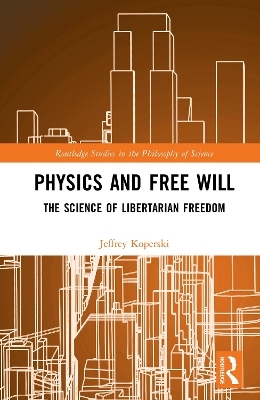
Physics and Free Will
The Science of Libertarian Freedom
Seiten
2025
Routledge (Verlag)
978-1-041-15791-5 (ISBN)
Routledge (Verlag)
978-1-041-15791-5 (ISBN)
Can libertarian free will survive our best physical theories? While prominent physicists argue that genuine agency contradicts science, this book demonstrates that contemporary physics actually provides robust foundations for human freedom.
Physics and Free Will rigorously navigates the complex intersection of physical theory and the free will debate. Koperski begins by clarifying determinism’s scientific foundations before systematically addressing challenges from special relativity and refuting physics-based arguments against mind-body dualism. Drawing on insights from continuum mechanics and condensed matter physics, he reveals how multiscale systems exhibit the emergence of causally efficacious properties irreducible to their micro-constituents. Using these insights, Koperski develops a framework that preserves libertarian intuitions about genuine choice while remaining consistent with physical theory. Through meticulous examination of determinism, reductionism, and the causal closure of physics, this comprehensive work reveals how contemporary science’s recognition of emergent causation provides ample space for genuine human agency.
This book will be essential for researchers and graduate students in metaphysics, philosophy of physics, philosophy of science, and philosophy of mind, and for anyone seeking to understand how contemporary science reshapes rather than eliminates the possibility of free will.
Physics and Free Will rigorously navigates the complex intersection of physical theory and the free will debate. Koperski begins by clarifying determinism’s scientific foundations before systematically addressing challenges from special relativity and refuting physics-based arguments against mind-body dualism. Drawing on insights from continuum mechanics and condensed matter physics, he reveals how multiscale systems exhibit the emergence of causally efficacious properties irreducible to their micro-constituents. Using these insights, Koperski develops a framework that preserves libertarian intuitions about genuine choice while remaining consistent with physical theory. Through meticulous examination of determinism, reductionism, and the causal closure of physics, this comprehensive work reveals how contemporary science’s recognition of emergent causation provides ample space for genuine human agency.
This book will be essential for researchers and graduate students in metaphysics, philosophy of physics, philosophy of science, and philosophy of mind, and for anyone seeking to understand how contemporary science reshapes rather than eliminates the possibility of free will.
Jeffrey Koperski is Professor of Philosophy at Saginaw Valley State University. His two previous books are The Physics of Theism: God, Physics, and the Philosophy of Science (2015) and Divine Action, Determinism, and the Laws of Nature (Routledge, 2020).
1. Physics and the Problem of Free Will 2. What is Free Will? 3. The Challenge of Determinism 4. Relativity and the Block Universe 5. Physics vs. Dualism 6. Reductions 7. Emergence 8. Micro, Macro, and Meso 9. Compatibilist Libertarianism 10. The Big Picture
| Erscheinungsdatum | 14.11.2025 |
|---|---|
| Reihe/Serie | Routledge Studies in the Philosophy of Science |
| Zusatzinfo | 4 Line drawings, black and white; 4 Halftones, black and white; 8 Illustrations, black and white |
| Verlagsort | London |
| Sprache | englisch |
| Maße | 152 x 229 mm |
| Gewicht | 570 g |
| Themenwelt | Geisteswissenschaften ► Philosophie ► Metaphysik / Ontologie |
| Naturwissenschaften ► Physik / Astronomie | |
| ISBN-10 | 1-041-15791-6 / 1041157916 |
| ISBN-13 | 978-1-041-15791-5 / 9781041157915 |
| Zustand | Neuware |
| Informationen gemäß Produktsicherheitsverordnung (GPSR) | |
| Haben Sie eine Frage zum Produkt? |
Mehr entdecken
aus dem Bereich


aus dem Bereich
eine philosophische Reise
Buch | Softcover (2024)
Goldmann (Verlag)
CHF 21,90


