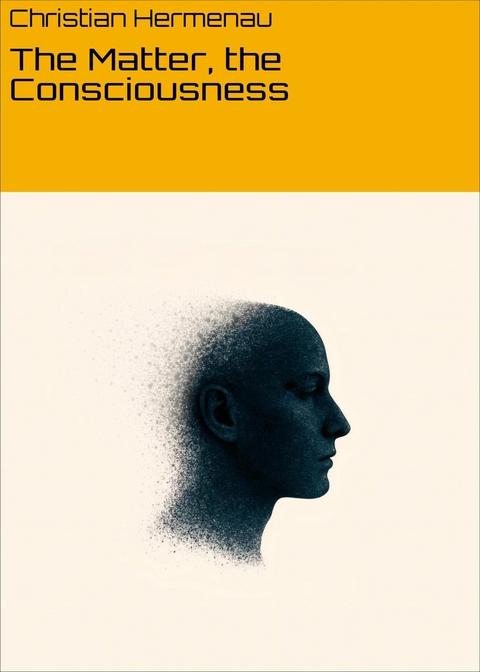
The Matter, the Consciousness (eBook)
599 Seiten
neobooks Self-Publishing (Verlag)
978-3-7575-9689-7 (ISBN)
Christian Hermenau has a doctorate in physics and works as a freelance lecturer
Christian Hermenau has a doctorate in physics and works as a freelance lecturer
18. Consciousness, a powerful instrument
Our consciousness is not just a small ray of light, but a powerful instrument. There are an incredible number of networks involved and we can clearly feel how deep this awake realisation goes. What's more, we don't stay in this state for long. Although we have the feeling that we are constantly aware of our surroundings, it is similar to seeing or tasting, the brain quickly switches to economy mode and only tells us that the coffee tastes great as always or that what we see is hot. It's just a good illusion. It's the same with consciousness, so of course it's only similar and it's just a guess. Here, too, we think we are wide awake and in control, but this is not the case.
So we believe that much more is needed. Especially if all of this is supposed to have arisen by itself. But what we want to say with these long explanations is that the mathematical analytical approach is definitely too simple. Not so much because we are failing at maths and we still have to wait for the development of the quantum computer or a super AI, but because physics describes something that is only approximately related to nature. Actually, this should always be crystal clear. It is strange and puzzling how we have come to have such faith in an imaginary world of logic, and it is probably related to our human nature. We wish there was more to the equations than what they were created for. It gives people so much meaning, esteem and respect. The fact that it's actually about truths doesn't really matter that much. The truth of a formula, together with its numbers and the rules of operations, is always true, even independently of this universe, even if it makes no sense without the matter. Such formulae are also quite symmetrical, surprising, elegant and certainly simple and beautiful for initiates. Just how far we seem to have got as masters of formulae is shown by our overwhelming dominance on Earth. But perhaps it is not really us who have achieved this, not us and not a god, and then there is certainly something so much more important that our formulae look ridiculous next to it.
Even if physicists might still smile at this, because after the experiments and the theory, there is nothing else that could be there and, as modern people, we have all grown up so mathematised and literate that we have become extremely rational thinkers. That's why we tend to look at the world pragmatically. We continue to feel the exhilaration within us, but think rationally in material terms. Regardless of whether we are religious, esoteric or scientific thinkers. If this were not the case, it would be much clearer to us that something crucial is missing. And for all our humanity's successes, our superiority is based on just one small difference. And regardless of this, all life could never have been created with such simple equations and approaches. Not even the simplest of them. If you want to put it in a nutshell, the superiority of being able to count not just one and two, but from one to a hundred, is almost the only thing that is actually special. We can count something, no matter what it is, and it tells us something. We have a feeling for these abstract numbers, like dogs for odours in the air. We can transfer this ability to letters and see the meaning in simple formulae, some even in very complex formulae. This is important, we need to see the rudimentary but meaningful in the simple equation or numbers. For example, we need to be able to walk through a shop and match prices. Pure numerical values with meaningful objects of any kind. In addition, we need to be able to put the 24 letters of the alphabet together to form meaningful words and use them to develop stories that come to life within us.
In a way, it is almost funny that we feel so safe and comfortable in the letter range up to one hundred and in the number range up to 100, it is familiar to us and gives us so much freedom for our imagination, but the periodic table of elements only has around one hundred elements. Not that there is any deeper meaning in this, but it remains the case that only about a hundred elements are enough to fully construct all the complicated life here on earth.
We need three particles to construct the elements and hundreds of stable elements to develop life. So, with relatively few special ones, there are almost infinite possibilities, and not just in theory. Of course, we can easily count things beyond a hundred, but then the numbers quickly become blurred, as with animals. Then the brain tells us: Yes, everything is correct, everything is clear, but the feeling for it is vague when you get to the bottom of it. We can't immediately grasp 1536 and 14712, like 65 and 32. We first have to break down larger numbers into smaller graspable areas, how many digits do they have, what would the next rounded numbers be, is it worth using a thousand point?
Or physicists turn 0.00000001327 m into 1.327 10-9 m or, even better, 1.3 nm. You can work well with 1.3 nanometres, estimate them and insert them quite well. A decimal number with lots of zeros, on the other hand, tells us nothing. But because the detection range goes up to one hundred, we have a lot of possibilities to organise a fantastically large, confusing world.
19. Higgs boson or matter exchange
But let's come back to the fact that we believe that there were not even simple small structures and that we would have noticed the error in the structure better than people who were not trained in mathematics. We place a lot of trust in maths, physics and technology.
Trust simplifies the complexity.
For many technical areas and our modern way of life, this trust is justified. In fact, we know much more today than early man. It is our factual knowledge that makes us so superior, but it seems to come at a price. Intuitively, or rather with our intuition, little has changed. Of course, Neanderthals knew very little about the world, but if you had asked them, they probably wouldn't have felt at all stupid. We believe that conscious perception also gave him the feeling of knowing everything, of understanding everything, of feeling his great superiority.
Suppose an uneducated person hears that there was a big bang and that all energy was once concentrated in almost one point. Who would think who was stupid? Would such an early human trust us when we tell such strange stories?
Perhaps, as many people imagine, you could impress such early humans with a mobile phone and thereby gain respect?
Many people imagine that this would be a simple way of gaining a lot of respect without having to do much. But would it really work that easily?
If we hardly show how we move, how we hunt or what we know about plants, respect would quickly dwindle and the people of early times would hardly be afraid of us. Of course, if we were to draw a weapon, a trial of strength would look very different. As we can see, the price of our modernity is that we have outsourced our skills and knowledge. And if we wanted to convince people of our knowledge in the long term, we would have to go to great lengths and be able to tell a really good story. That of the Big Bang, dark matter or black holes is not one of them and we would do well not to mention any of them. Funnily enough, with all these stories we would only then realise that we can describe much of what exists, but have almost no explanation as to why it is the way it is. Our finely knitted world view, which works so well for us with our school education all over the world, would collapse in the face of such a primitive man. And not so much because what we know is wrong, but more because we cannot convincingly explain why things are the way they are.
And this is exactly what we fail to do when explaining the early galaxies, which should not have existed at all according to the Big Bang model. The fact that there must therefore be dark matter or, even worse, that only 5% of our familiar form of matter is known from the perspective of energy or converted matter, can only be so unconvincingly simplified if we all have so much faith in scientists. Because, of course, this does not explain anything and the researchers or those in the know should actually be ridiculed. Nevertheless, society has been prepared to invest a lot of money in the search for dark matter for almost 80 years now and the researchers involved are recognised and respected. But as I said, for this to work so well, we have to go through the same literacy and mathematisation. Mathematisation is even independent of the country you live in, as it is almost universal.
So we still maintain that structures, let alone large structures like those that shine so brightly that they can still be seen up to us, cannot be explained by any Big Bang model, even if dark matter really existed.
We now claim that the universe was thinking and knowing from the beginning. But, to distinguish it from a god, this knowledge is only fragmented in tiny pieces and not centralised as a coherent complexity, as it would have to be with a god. We also go and say that this fragmented knowledge is space, timeless and material-less. We are therefore initially no better than the physicists with their dark energy or dark matter, but our explanation for this is different and our structure of matter is also completely different. Firstly, we start from gravity itself and claim that this is where the real speciality lies and then we place much more emphasis on the virtual but significant information that must not disappear completely.
But let's start with the structure of matter, which consists of two planes. In the case of the electron, the distance of the planes is equal to an RE ...
| Erscheint lt. Verlag | 2.7.2025 |
|---|---|
| Verlagsort | Berlin |
| Sprache | deutsch |
| Themenwelt | Naturwissenschaften ► Physik / Astronomie |
| Schlagworte | Consciousness • Entanglement • Gravitation • Life • Networks • quantenphysics • Space-time |
| ISBN-10 | 3-7575-9689-7 / 3757596897 |
| ISBN-13 | 978-3-7575-9689-7 / 9783757596897 |
| Informationen gemäß Produktsicherheitsverordnung (GPSR) | |
| Haben Sie eine Frage zum Produkt? |
 EPUB (Wasserzeichen)
E-Book Endkundennutzungsbedinungen des Verlages
DRM: Digitales Wasserzeichen
Dieses eBook enthält ein digitales Wasserzeichen und ist damit für Sie personalisiert. Bei einer missbräuchlichen Weitergabe des eBooks an Dritte ist eine Rückverfolgung an die Quelle möglich.
Dateiformat: EPUB (Electronic Publication)
EPUB ist ein offener Standard für eBooks und eignet sich besonders zur Darstellung von Belletristik und Sachbüchern. Der Fließtext wird dynamisch an die Display- und Schriftgröße angepasst. Auch für mobile Lesegeräte ist EPUB daher gut geeignet.
Systemvoraussetzungen:
PC/Mac: Mit einem PC oder Mac können Sie dieses eBook lesen. Sie benötigen dafür die kostenlose Software Adobe Digital Editions.
eReader: Dieses eBook kann mit (fast) allen eBook-Readern gelesen werden. Mit dem amazon-Kindle ist es aber nicht kompatibel.
Smartphone/Tablet: Egal ob Apple oder Android, dieses eBook können Sie lesen. Sie benötigen dafür eine kostenlose App.
Geräteliste und zusätzliche Hinweise
Buying eBooks from abroad
For tax law reasons we can sell eBooks just within Germany and Switzerland. Regrettably we cannot fulfill eBook-orders from other countries.
aus dem Bereich