Increase your understanding of molecular properties and reactions with this accessible textbook
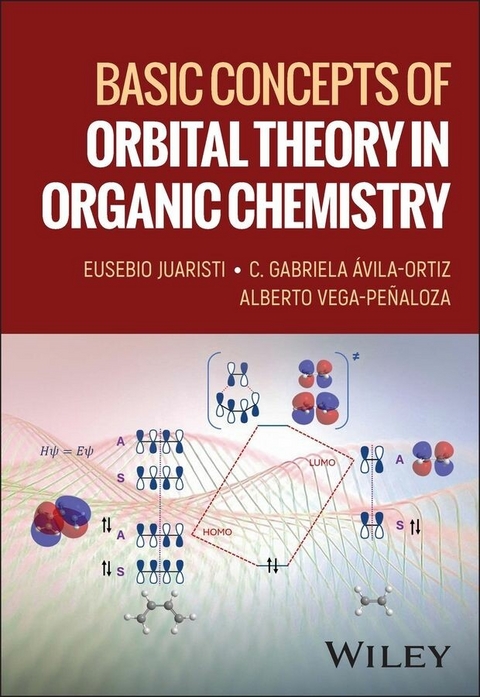
The study of organic chemistry hinges on an understanding and capacity to predict molecular properties and reactions. Molecular Orbital Theory is a model grounded in quantum mechanics deployed by chemists to describe electron organization within a chemical structure. It unlocks some of the most prevalent reactions in organic chemistry.
Basic Concepts of Orbital Theory in Organic Chemistry provides a concise, accessible overview of this theory and its applications. Beginning with fundamental concepts such as the shape and relative energy of atomic orbitals, it proceeds to describe the way these orbitals combine to form molecular orbitals, with important ramifications for molecular properties. The result is a work which helps students and readers move beyond localized bonding models and achieve a greater understanding of organic chemical interactions.
In Basic Concepts of Orbital Theory in Organic Chemistry readers will also find:
- Comprehensive explorations of stereoelectronic interactions and sigmatropic, cheletropic, and electrocyclic reactions,
- Detailed discussions of hybrid orbitals, bond formation in atomic orbitals, the Hückel Molecular Orbital Method, and the conservation of molecular orbital symmetry
- Sample exercises for organic chemistry students to help reinforce and retain essential concepts
Basic Concepts of Orbital Theory in Organic Chemistry is ideal for advanced undergraduate and graduate students in chemistry, particularly organic chemistry.
Eusebio Juaristi, PhD, is Professor at Centro de Investigacion de Estudios Avanzados del Instituto Politecnico Nacional, Mexico City, Mexico.He has produced influential research in numerous areas of physical organic chemistry, particularly conformational analysis and stereochemistry, as well as computational chemistry, asymmetric organocatalysis, and sustainable chemistry.
C. Gabriela Ávila-Ortiz, PhD, is a Research Assistant at Centro de Investigacion de Estudios Avanzados del Instituto Politecnico Nacional, Mexico City, Mexico. She works in Professor Juaristi's research group studying the asymmetric synthesis of organic compounds, organocatalysis, and green chemistry.
Alberto Vega-Peñaloza, PhD, is Serra Hunter Lecturer in the Section of Organic Chemistry at the University of Barcelona, Spain. He has worked as Senior Scientist I at Selvita S.A., Poland, as a postdoctoral fellow at the Faculty of Chemistry of the National Autonomous University of Mexico (UNAM), as a postdoctoral researcher at ICIQ in Spain, and at the University of Padova, Italy, where he was awarded the Seal of Excellence UniPD grant to work on the development of photocatalytic systems for sustainable synthetic methods.
Increase your understanding of molecular properties and reactions with this accessible textbook The study of organic chemistry hinges on an understanding and capacity to predict molecular properties and reactions. Molecular Orbital Theory is a model grounded in quantum mechanics deployed by chemists to describe electron organization within a chemical structure. It unlocks some of the most prevalent reactions in organic chemistry. Basic Concepts of Orbital Theory in Organic Chemistry provides a concise, accessible overview of this theory and its applications. Beginning with fundamental concepts such as the shape and relative energy of atomic orbitals, it proceeds to describe the way these orbitals combine to form molecular orbitals, with important ramifications for molecular properties. The result is a work which helps students and readers move beyond localized bonding models and achieve a greater understanding of organic chemical interactions. In Basic Concepts of Orbital Theory in Organic Chemistry readers will also find: Comprehensive explorations of stereoelectronic interactions and sigmatropic, cheletropic, and electrocyclic reactions,Detailed discussions of hybrid orbitals, bond formation in atomic orbitals, the H ckel Molecular Orbital Method, and the conservation of molecular orbital symmetrySample exercises for organic chemistry students to help reinforce and retain essential concepts Basic Concepts of Orbital Theory in Organic Chemistry is ideal for advanced undergraduate and graduate students in chemistry, particularly organic chemistry.
| Erscheint lt. Verlag | 27.6.2025 |
|---|---|
| Sprache | englisch |
| Themenwelt | Naturwissenschaften ► Chemie ► Organische Chemie |
| Schlagworte | atomic orbitals • Hybridization • Molecular Orbitals • Molecular orbital theory • Molecular Properties • Molecular Reactivity • orbital interactions • Physical Organic Chemistry • quantum mechanics • Quantum numbers • wave-particle duality |
| ISBN-13 | 9781394253869 / 9781394253869 |
| Informationen gemäß Produktsicherheitsverordnung (GPSR) | |
| Haben Sie eine Frage zum Produkt? |
 PDF (Adobe DRM)
Kopierschutz: Adobe-DRM
Adobe-DRM ist ein Kopierschutz, der das eBook vor Mißbrauch schützen soll. Dabei wird das eBook bereits beim Download auf Ihre persönliche Adobe-ID autorisiert. Lesen können Sie das eBook dann nur auf den Geräten, welche ebenfalls auf Ihre Adobe-ID registriert sind.
Details zum Adobe-DRM
Dateiformat: PDF (Portable Document Format)
Mit einem festen Seitenlayout eignet sich die PDF besonders für Fachbücher mit Spalten, Tabellen und Abbildungen. Eine PDF kann auf fast allen Geräten angezeigt werden, ist aber für kleine Displays (Smartphone, eReader) nur eingeschränkt geeignet.
Systemvoraussetzungen:
PC/Mac: Mit einem PC oder Mac können Sie dieses eBook lesen. Sie benötigen eine
eReader: Dieses eBook kann mit (fast) allen eBook-Readern gelesen werden. Mit dem amazon-Kindle ist es aber nicht kompatibel.
Smartphone/Tablet: Egal ob Apple oder Android, dieses eBook können Sie lesen. Sie benötigen eine
Geräteliste und zusätzliche Hinweise
Buying eBooks from abroad
For tax law reasons we can sell eBooks just within Germany and Switzerland. Regrettably we cannot fulfill eBook-orders from other countries.
aus dem Bereich