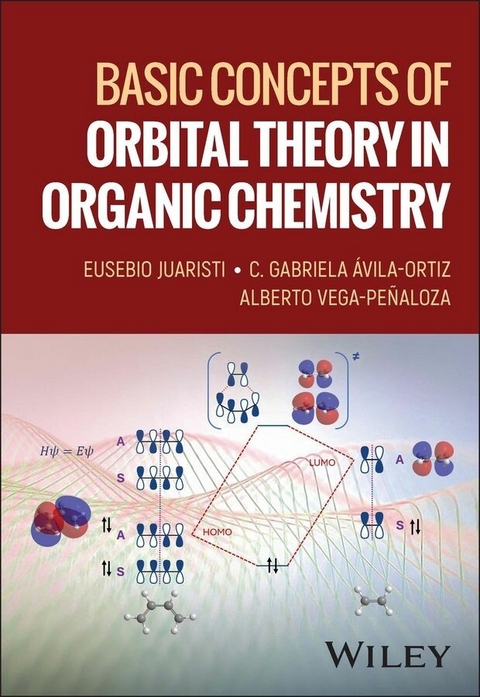
Increase your understanding of molecular properties and reactions with this accessible textbook
The study of organic chemistry hinges on an understanding and capacity to predict molecular properties and reactions. Molecular Orbital Theory is a model grounded in quantum mechanics deployed by chemists to describe electron organization within a chemical structure. It unlocks some of the most prevalent reactions in organic chemistry.
Basic Concepts of Orbital Theory in Organic Chemistry provides a concise, accessible overview of this theory and its applications. Beginning with fundamental concepts such as the shape and relative energy of atomic orbitals, it proceeds to describe the way these orbitals combine to form molecular orbitals, with important ramifications for molecular properties. The result is a work which helps students and readers move beyond localized bonding models and achieve a greater understanding of organic chemical interactions.
In Basic Concepts of Orbital Theory in Organic Chemistry readers will also find:
- Comprehensive explorations of stereoelectronic interactions and sigmatropic, cheletropic, and electrocyclic reactions,
- Detailed discussions of hybrid orbitals, bond formation in atomic orbitals, the Hückel Molecular Orbital Method, and the conservation of molecular orbital symmetry
- Sample exercises for organic chemistry students to help reinforce and retain essential concepts
Basic Concepts of Orbital Theory in Organic Chemistry is ideal for advanced undergraduate and graduate students in chemistry, particularly organic chemistry.
Eusebio Juaristi, PhD, is Professor at Centro de Investigacion de Estudios Avanzados del Instituto Politecnico Nacional, Mexico City, Mexico.He has produced influential research in numerous areas of physical organic chemistry, particularly conformational analysis and stereochemistry, as well as computational chemistry, asymmetric organocatalysis, and sustainable chemistry.
C. Gabriela Ávila-Ortiz, PhD, is a Research Assistant at Centro de Investigacion de Estudios Avanzados del Instituto Politecnico Nacional, Mexico City, Mexico. She works in Professor Juaristi's research group studying the asymmetric synthesis of organic compounds, organocatalysis, and green chemistry.
Alberto Vega-Peñaloza, PhD, is Serra Hunter Lecturer in the Section of Organic Chemistry at the University of Barcelona, Spain. He has worked as Senior Scientist I at Selvita S.A., Poland, as a postdoctoral fellow at the Faculty of Chemistry of the National Autonomous University of Mexico (UNAM), as a postdoctoral researcher at ICIQ in Spain, and at the University of Padova, Italy, where he was awarded the Seal of Excellence UniPD grant to work on the development of photocatalytic systems for sustainable synthetic methods.
Chapter 1
Introduction and History of the Molecular Orbital Theory
INTRODUCTION
Chemistry is the science that studies the composition, structure and transformations of matter. As soon as it was established that virtually all the matter that surrounds us and builds us up is the result of combinations of atoms forming molecules, it became necessary to understand how the bonds between these atoms are formed and broken. To do this, it became essential to understand the models that describe the arrangement of electrons in atoms and molecules (chemical bonding theories).
A fundamental breakthrough was made in the early twentieth century by G.N. Lewis, who observed the special stability of inert gases. He proposed that the constituent atoms of molecules tend to present the same electronic configuration of such inert gases, which is eight electrons in their valence shell (Figure 1.1). Indeed, Lewis’ bonding theory was the only general description of bond formation in chemical compounds until the mid-1920s. Lewis’ bonding theory made it possible to interpret and predict important properties of molecules in a simple manner. In fact, this model still provides a good qualitative description of the nature of bonds in organic compounds and is therefore still in use.
FIGURE 1.1 Some examples of Lewis’ molecular structures.
However, Lewis’ bonding theory has serious limitations and, for example, cannot accurately describe or predict the geometry and reactivity of certain types of compounds. Some of these limitations were alleviated by extending Lewis’ theory to include resonance theory. However, this model was still an intuitive and imprecise approximation. Quantum mechanics, a new branch of physics that revolutionised science by allowing a better understanding of various physical, chemical and biological processes, was developed in the 1920s and 1930s. The application of quantum mechanics to distinct issues in chemistry has been in the form of valence bond theory and molecular orbital (MO) theory. The basic idea of valence bond theory is that covalent bonds can be formed by the overlapping of localised half-occupied atomic orbitals. This model provides a simple rationalisation of some molecular aspects, such as the geometries of molecules. However, valence bond theory cannot explain other important aspects of bonding and reactivity, such as those originating from the excited states of molecules. In other words, not all chemical bonding phenomena and not all molecular properties can be satisfactorily explained by localised bonding models.
Some properties of chemical bonds are best explained by a more complex quantum model, MO theory. The MO theory allows description of the electronic arrangement of molecules in terms of MOs, whose role is analogous to that of atomic orbitals in atoms. The fundamental characteristic of MOs is that they are distributed over all the atoms in a molecule; that is, the MOs comprise the whole molecule, rather than being associated with just one atom or being localised in a particular region between a pair of atoms.
In order to explain MO theory (and valence bond theory, discussed later in Chapters 3 and 4), it is necessary to understand the basic concepts of quantum mechanics. These concepts and their historical development are discussed in this chapter. In particular, the study of light absorbed or emitted by chemical species, such as atoms and molecules, has provided much of the basic knowledge of quantum mechanics. Therefore, we will begin by studying the properties of light. We will then go on to analyse concepts such as quantised energy, wave-particle duality, the uncertainty principle and others.
NATURE OF ELECTROMAGNETIC RADIATION
As mentioned earlier, different approaches to understanding the nature of electromagnetic radiation and its interaction with matter led to the development of quantum mechanics. To understand current atomic theory, it is necessary to comprehend the properties of electromagnetic radiation. Visible light, X-rays, radio waves and microwaves are some of the types of electromagnetic radiation. They all consist of energy propagated by electric and magnetic fields that increase and decrease in intensity as they move through space. The nature of light was debated as early as the seventeenth century. For the Dutch astronomer and physicist Christiaan Huygens (1678), light had to be a wave, such as the waves in water. By contrast, Englishman Isaac Newton (1704) suggested that light had to consist of small luminous ‘corpuscles’ (particles) travelling in a straight line at a finite speed and with an associated momentum. Scientific debate on this subject continued for many years later and culminated in the realisation of the dual behaviour of electromagnetic radiation. Before entering a more detailed discussion, let us first describe the properties of electromagnetic radiation in its wave-like behaviour.
THE WAVE NATURE OF LIGHT
Light is a form of electromagnetic radiation, consisting of electric and magnetic fields oscillating as a wave and travelling through empty space at about (Figure 1.2). The wave properties of electromagnetic radiation are described by three variables and a constant.
FIGURE 1.2 Light as both electric and magnetic fields.
Frequency (, Greek nu). The frequency of electromagnetic radiation, expressed in the unit 1/second (s−1; also called Hertz [Hz]), is the number of complete waves or cycles passing through a given point per second. For example, a 960 kHz AM radio station transmits waves with a frequency of 960 000 cycles per second.
Wavelength (, Greek lambda). The wavelength is the distance between any one point of a wave and the corresponding point of the next oscillation (Figure 1.3). For example, the distance from one peak to another, or valley-to-valley. In other words, it is the distance the wave travels in one cycle. The wavelength can have units of length as large as metres or, for very short wavelengths, nanometres (nm, 10−9 m) or picometres (pm, 10−12 m). An alternative unit is angstroms (Å, 10−10 m).
Figure 1.3 Wavelength concept.
Velocity . The speed of a wave is the distance travelled per unit of time, which is the product of its frequency in cycles second−1 and its wavelength in meters cycle−1:
In vacuum, the speed of electromagnetic radiation is 2.99792458 × 10⁸ m s−1, which can be rounded to 3.0 × 10⁸ m s−1 with three significant figures (i.e. 300 000 km s−1). This is a physical constant called the speed of light expressed in the formula
Since the product of and is a constant, and have an inverse relationship. Take the waves shown in Figure 1.4, which travel at the speed of light . If the wavelength of the light is very short, a large number of complete oscillations will pass through a given point in one second. If, on the other hand, the wavelength is long, a smaller number of complete oscillations will pass through the point in one second. Therefore, a short wavelength corresponds to high-frequency (high energy) radiation and a long wavelength corresponds to low-frequency (low energy) radiation.
FIGURE 1.4 The relationship between frequency and wavelength : Longer corresponds to a reduced frequency (lower energy, left side) and smaller corresponds to an increased frequency (higher energy, right side).
The amplitude is the wave height above the centreline (Figure 1.5). For an electromagnetic wave, amplitude is related to radiation intensity, or brightness in the case of visible light. Light of a given colour presents a specific frequency (and therefore wavelength), but its amplitude can vary. The light can be softer (lower amplitude, less intense) or brighter (higher amplitude, more intense).
FIGURE 1.5 The concept of amplitude of a wave.
ELECTROMAGNETIC SPECTRUM
In a vacuum, all electromagnetic waves travel at the same speed and differ in frequency and therefore wavelength. The electromagnetic spectrum (Figure 1.6) is the classification of electromagnetic waves by frequency or wavelength. The types of radiation vary in the order of increasing wavelength (decrease in frequency). Visible light represents only a tiny region of the spectrum, between about 750 and 400 nm, corresponding to red and violet light, respectively. This represents less than one-millionth of one percent of the measured electromagnetic spectrum. At frequencies lower than red, we have infrared radiation, microwaves and radio waves (in the kilohertz and megahertz range). At frequencies above violet, we have ultraviolet radiation (these higher frequency waves cause sunburn), X-rays and finally gamma rays. These present frequencies above 10 exahertz (1019 Hz).
FIGURE 1.6 The electromagnetic spectrum.
THE DISTINCTION BETWEEN ENERGY AND MATTER
Understanding the difference between the properties of energy waves and particles (matter) is essential to grasping the dual behaviour of light. In a world where we are used to observing objects moving, it is more complex to understand the nature of radiant energy, which does not contain matter and travels in diffuse waves. The differences between the behaviour of particles and that of energy waves will be the subject of discussion in the following.
Light travels at different speeds in...
| Erscheint lt. Verlag | 27.6.2025 |
|---|---|
| Sprache | englisch |
| Themenwelt | Naturwissenschaften ► Chemie ► Organische Chemie |
| Schlagworte | atomic orbitals • Hybridization • Molecular Orbitals • Molecular orbital theory • Molecular Properties • Molecular Reactivity • orbital interactions • Physical Organic Chemistry • quantum mechanics • Quantum numbers • wave-particle duality |
| ISBN-13 | 9781394253852 / 9781394253852 |
| Informationen gemäß Produktsicherheitsverordnung (GPSR) | |
| Haben Sie eine Frage zum Produkt? |
 EPUB (Adobe DRM)
Kopierschutz: Adobe-DRM
Adobe-DRM ist ein Kopierschutz, der das eBook vor Mißbrauch schützen soll. Dabei wird das eBook bereits beim Download auf Ihre persönliche Adobe-ID autorisiert. Lesen können Sie das eBook dann nur auf den Geräten, welche ebenfalls auf Ihre Adobe-ID registriert sind.
Details zum Adobe-DRM
Dateiformat: EPUB (Electronic Publication)
EPUB ist ein offener Standard für eBooks und eignet sich besonders zur Darstellung von Belletristik und Sachbüchern. Der Fließtext wird dynamisch an die Display- und Schriftgröße angepasst. Auch für mobile Lesegeräte ist EPUB daher gut geeignet.
Systemvoraussetzungen:
PC/Mac: Mit einem PC oder Mac können Sie dieses eBook lesen. Sie benötigen eine
eReader: Dieses eBook kann mit (fast) allen eBook-Readern gelesen werden. Mit dem amazon-Kindle ist es aber nicht kompatibel.
Smartphone/Tablet: Egal ob Apple oder Android, dieses eBook können Sie lesen. Sie benötigen eine
Geräteliste und zusätzliche Hinweise
Buying eBooks from abroad
For tax law reasons we can sell eBooks just within Germany and Switzerland. Regrettably we cannot fulfill eBook-orders from other countries.
aus dem Bereich