


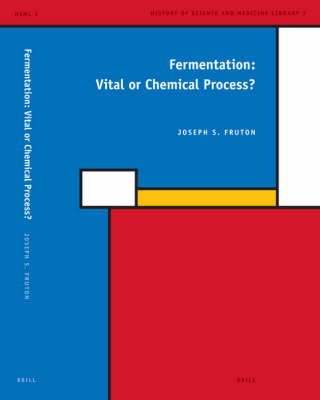
Fermentation: Vital or Chemical Process?
Seiten
2006
Brill (Verlag)
978-90-04-15268-7 (ISBN)
Brill (Verlag)
978-90-04-15268-7 (ISBN)
This book is a brief history of the centuries-old fascination with the process of alcoholic fermentation, the debates about its nature, and its elucidation during the early twentieth century.
Human knowledge of the conversion of grape must into wine and of cereal dough into bread is as old as agriculture. This book is a study of the ways this phenomenon (fermentation) has been considered since Aristotle to be analogous to natural processes such as human digestion. During 1200–1600 A.D., alchemists wrote “ferments” or “elixirs” that could turn lead into gold. A century later, in Newton’s time, many physicians and natural philosophers considered fermentation to be an important natural process. The 18th century was marked by Lavoisier’s celebrated experiment on alcoholic fermentation. The 19th-century debate about the nature of this process was concluded by Buchner’s preparation of an active cell-free yeast extract. From 1910–1940 many researchers participated in the identification of the chemical intermediates and catalysts in the multi-enzyme pathway of alcoholic fermentation.
Human knowledge of the conversion of grape must into wine and of cereal dough into bread is as old as agriculture. This book is a study of the ways this phenomenon (fermentation) has been considered since Aristotle to be analogous to natural processes such as human digestion. During 1200–1600 A.D., alchemists wrote “ferments” or “elixirs” that could turn lead into gold. A century later, in Newton’s time, many physicians and natural philosophers considered fermentation to be an important natural process. The 18th century was marked by Lavoisier’s celebrated experiment on alcoholic fermentation. The 19th-century debate about the nature of this process was concluded by Buchner’s preparation of an active cell-free yeast extract. From 1910–1940 many researchers participated in the identification of the chemical intermediates and catalysts in the multi-enzyme pathway of alcoholic fermentation.
Joseph S. Fruton, Ph.D. (1934) Biochemistry, Columbia University, is Eugene Higgins Professor Emeritus, Yale University. His latest publication is Methods and Styles in the Development of Chemistry (2002).
Acknowledgements
Introduction
1. Aristotle to Paracelsus
2. Van Helmont to Black
3. Lavoisier to Fischer
4. The Buchners to the Warburg Group
Conclusion
Bibliography
Index
| Reihe/Serie | History of Science and Medicine Library ; 1 |
|---|---|
| Verlagsort | Leiden |
| Sprache | englisch |
| Maße | 155 x 235 mm |
| Gewicht | 396 g |
| Themenwelt | Naturwissenschaften |
| Technik ► Lebensmitteltechnologie | |
| ISBN-10 | 90-04-15268-7 / 9004152687 |
| ISBN-13 | 978-90-04-15268-7 / 9789004152687 |
| Zustand | Neuware |
| Informationen gemäß Produktsicherheitsverordnung (GPSR) | |
| Haben Sie eine Frage zum Produkt? |
Mehr entdecken
aus dem Bereich

aus dem Bereich
Technologie, Chemie, Mikrobiologie, Analytik, Bedeutung, Recht
Buch | Hardcover (2023)
Verlag Eugen Ulmer
CHF 169,00
A Laboratory Manual
Buch | Softcover (2022)
John Wiley & Sons Inc (Verlag)
CHF 103,00


