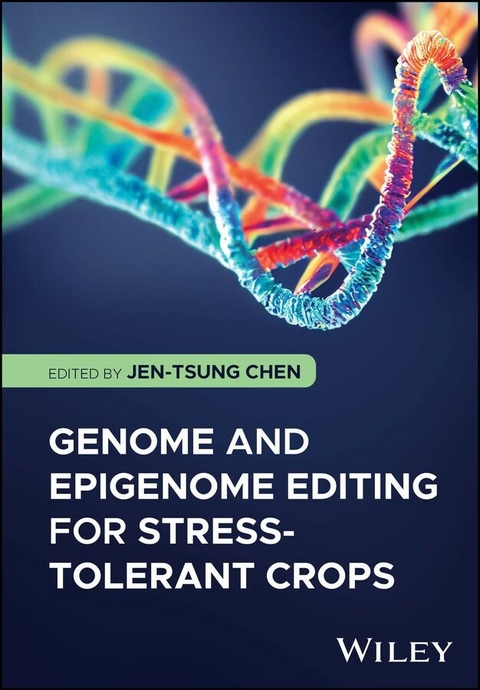
Genome and Epigenome Editing for Stress-Tolerant Crops (eBook)
367 Seiten
Wiley (Verlag)
978-1-394-28003-2 (ISBN)
Provides a timely overview of the use of CRISPR and non-coding RNA technologies to develop climate-resilient crops
With mounting challenges from climate change, expanding populations, and resource limitations, the need for resilient and sustainable agricultural systems has never been greater. Genome and Epigenome Editing for Stress-Tolerant Crops summarizes advanced techniques for creating crops that can withstand both biotic and abiotic stressors. Edited by renowned biologist Jen-Tsung Chen, this authoritative volume discusses the coordination of CRISPR/Cas technology with ncRNA-based epigenetics to enhance stress tolerance and improve crop quality.
In addition to offering insights into genetic and molecular advances, contributions by experts in the field present key methodologies and applications that bridge multiple omics technologies with genome editing for impactful agricultural outcomes. Addressing emerging tools and strategies that could be instrumental in achieving the United Nations Sustainable Development Goals (SDGs) and advancing sustainable agriculture, Genome and Epigenome Editing for Stress-Tolerant Crops:
- Provides an in-depth overview of CRISPR/Cas and non-coding RNA strategies to develop stress-tolerant crops.
- Integrates multiple omics approaches, including genomics, transcriptomics, and metabolomics for comprehensive crop improvement.
- Discusses strategies for resilience against both abiotic and biotic stressors, such as drought, salinity, pests, and pathogens.
- Offers practical applications of CRISPR and RNA technologies for high-yield, high-quality crop development.
- Presents recent research advancements in epigenetic regulation to fine-tune plant stress responses.
- Discusses future directions in plant science to inspire new research and experimental designs.
Genome and Epigenome Editing for Stress-Tolerant Crops is essential reading for advanced undergraduate and graduate courses in plant biology, molecular genetics, and agricultural biotechnology. It is also a valuable reference for researchers, plant breeders, and scientists working on crop improvement and climate-resilient agriculture initiatives.
Jen-Tsung Chen is Professor of Cell Biology at the Department of Life Sciences, National University of Kaohsiung, Taiwan, where he teaches courses on cell biology, genomics, proteomics, plant physiology, and plant biotechnology. His research focuses on bioactive compounds, plant molecular biology, bioinformatics, and systems pharmacology. Dr. Chen is an editorial board member for several prestigious journals, including Plant Methods and GM Crops & Food. He has authored multiple books on drug discovery, nanotechnology, plant functional genomics, and CRISPR-based plant genome editing. Dr. Chen was included in the 'World's Top 2% Scientists' by Stanford University and Elsevier in 2023 and 2024.
Provides a timely overview of the use of CRISPR and non-coding RNA technologies to develop climate-resilient crops With mounting challenges from climate change, expanding populations, and resource limitations, the need for resilient and sustainable agricultural systems has never been greater. Genome and Epigenome Editing for Stress-Tolerant Crops summarizes advanced techniques for creating crops that can withstand both biotic and abiotic stressors. Edited by renowned biologist Jen-Tsung Chen, this authoritative volume discusses the coordination of CRISPR/Cas technology with ncRNA-based epigenetics to enhance stress tolerance and improve crop quality. In addition to offering insights into genetic and molecular advances, contributions by experts in the field present key methodologies and applications that bridge multiple omics technologies with genome editing for impactful agricultural outcomes. Addressing emerging tools and strategies that could be instrumental in achieving the United Nations Sustainable Development Goals (SDGs) and advancing sustainable agriculture, Genome and Epigenome Editing for Stress-Tolerant Crops: Provides an in-depth overview of CRISPR/Cas and non-coding RNA strategies to develop stress-tolerant crops.Integrates multiple omics approaches, including genomics, transcriptomics, and metabolomics for comprehensive crop improvement.Discusses strategies for resilience against both abiotic and biotic stressors, such as drought, salinity, pests, and pathogens.Offers practical applications of CRISPR and RNA technologies for high-yield, high-quality crop development.Presents recent research advancements in epigenetic regulation to fine-tune plant stress responses.Discusses future directions in plant science to inspire new research and experimental designs. Genome and Epigenome Editing for Stress-Tolerant Crops is essential reading for advanced undergraduate and graduate courses in plant biology, molecular genetics, and agricultural biotechnology. It is also a valuable reference for researchers, plant breeders, and scientists working on crop improvement and climate-resilient agriculture initiatives.
| Erscheint lt. Verlag | 1.5.2025 |
|---|---|
| Sprache | englisch |
| Themenwelt | Naturwissenschaften ► Biologie ► Genetik / Molekularbiologie |
| Schlagworte | abiotic stress • biotic stress • Climate-resilient agriculture • CRISPR • Crop improvement • epigenetics • Genome editing • Non-coding RNA • omics technologies • Plant Biotechnology • Plant Breeding • plant genomics • Plant Molecular Biology • RNA technology • stress-tolerant crops • sustainable agriculture |
| ISBN-10 | 1-394-28003-3 / 1394280033 |
| ISBN-13 | 978-1-394-28003-2 / 9781394280032 |
| Informationen gemäß Produktsicherheitsverordnung (GPSR) | |
| Haben Sie eine Frage zum Produkt? |
 PDF (Adobe DRM)
Kopierschutz: Adobe-DRM
Adobe-DRM ist ein Kopierschutz, der das eBook vor Mißbrauch schützen soll. Dabei wird das eBook bereits beim Download auf Ihre persönliche Adobe-ID autorisiert. Lesen können Sie das eBook dann nur auf den Geräten, welche ebenfalls auf Ihre Adobe-ID registriert sind.
Details zum Adobe-DRM
Dateiformat: PDF (Portable Document Format)
Mit einem festen Seitenlayout eignet sich die PDF besonders für Fachbücher mit Spalten, Tabellen und Abbildungen. Eine PDF kann auf fast allen Geräten angezeigt werden, ist aber für kleine Displays (Smartphone, eReader) nur eingeschränkt geeignet.
Systemvoraussetzungen:
PC/Mac: Mit einem PC oder Mac können Sie dieses eBook lesen. Sie benötigen eine
eReader: Dieses eBook kann mit (fast) allen eBook-Readern gelesen werden. Mit dem amazon-Kindle ist es aber nicht kompatibel.
Smartphone/Tablet: Egal ob Apple oder Android, dieses eBook können Sie lesen. Sie benötigen eine
Geräteliste und zusätzliche Hinweise
Buying eBooks from abroad
For tax law reasons we can sell eBooks just within Germany and Switzerland. Regrettably we cannot fulfill eBook-orders from other countries.
aus dem Bereich