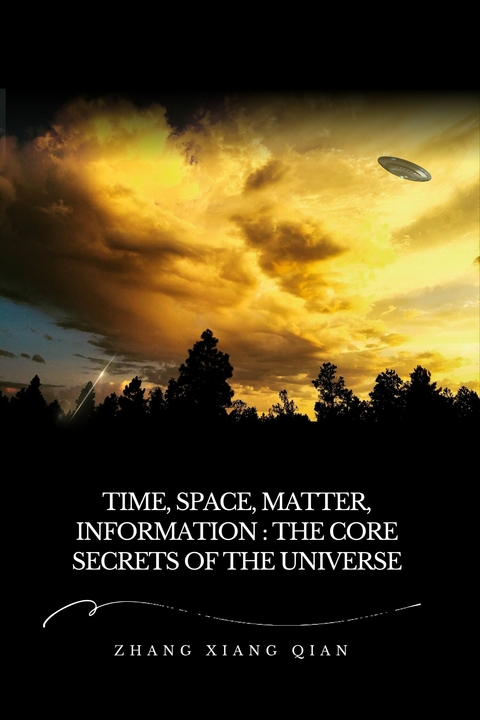
Time, Space, Matter, Information: The Core Secrets of the Universe (eBook)
246 Seiten
Shiyi (Verlag)
978-3-69111-135-4 (ISBN)
The author presents himself as a Chinese farmer who claims to have visited an advanced extraterrestrial civilization in 1985, where he was exposed to advanced scientific knowledge about the fundamental nature of the universe. He combines traditional Eastern philosophical concepts with modern physics to create a unique theoretical framework that challenges conventional scientific understanding. His work attempts to bridge the gap between observable phenomena and theoretical physics, offering explanations for both scientific mysteries and seemingly paranormal experiences. Through his writings, he aims to share knowledge that he believes could transform human understanding of reality and consciousness.
The author presents himself as a Chinese farmer who claims to have visited an advanced extraterrestrial civilization in 1985, where he was exposed to advanced scientific knowledge about the fundamental nature of the universe. He combines traditional Eastern philosophical concepts with modern physics to create a unique theoretical framework that challenges conventional scientific understanding. His work attempts to bridge the gap between observable phenomena and theoretical physics, offering explanations for both scientific mysteries and seemingly paranormal experiences. Through his writings, he aims to share knowledge that he believes could transform human understanding of reality and consciousness.
Part One: Time, Space, and the Core Secrets of the Universe
1.What are the most fundamental elements of the universe?
Western philosopher Thales believed that the origin of all things in the universe is water.
Among the four major schools of ancient Greek philosophy, there was one called Parmenides, who proposed:
The world we perceive through our five senses—eyes, ears, nose, tongue, and skin—is not truly real. Instead, there exists another realm, an ontological world, which is the true origin of the world and the fundamental substance constituting the universe.
Democritus believed that all things in the universe are composed of indivisible atoms and the surrounding space.
In ancient China, we believed that the universe is made up of metal, wood, water, fire, and earth.
Before the advent of relativity, people generally thought the universe consisted of space, objects, time, ether, energy, and light.
Faraday’s research on fields led people to believe that the universe is composed of space, objects, time, ether, energy, light, and fields.
Starting in the 19th century, with the West’s growing emphasis on and study of information, people began to think the universe consisted of space, objects, time, ether, energy, fields, and information.
During this period, heat was considered the degree of random motion of molecules within an object, while mass and charge were seen as properties inherent to an object’s particles. Fields were regarded as a special substance emitted by an object’s particles into the surrounding space.
Force and energy were properties that an object’s particles possessed due to motion.
Magnetic fields were formed by the motion of charges.
Accelerating charges also produced electromagnetic waves. Maxwell’s brilliant work led humanity to realize that light is, in fact, a type of electromagnetic wave.
The birth of Maxwell’s electromagnetism allowed humans to recognize that electricity, magnetism, and light are unified by a single underlying phenomenon, marking the first time humanity unified electricity, magnetism, electromagnetic waves, and light.
After the advent of relativity, the existence of ether was negated, and time and space were unified, suggesting that time and space are constituted by a more fundamental entity.
Relativity also unified mass and energy, proposing that mass and energy are manifestations of a more fundamental underlying substance. Building on Maxwell’s electromagnetism, relativity further unified electricity and magnetism.
Relativity streamlined the components of the universe, leading humans to recognize that the universe is made up of objects, spacetime, energy, fields, and information.
However, general relativity introduced dark matter and dark energy, so according to general relativity, the universe consists of objects, spacetime, energy, fields, photons, dark matter, dark energy, and information.
Modern physics, particularly the Standard Model, built upon general relativity by adding quarks, leptons, gluons, gravitons, strings from string theory, and the Higgs boson to the elements constituting the universe.
So, what exactly is the universe made of?
In 1985, I visited a technologically advanced alien planet, where they believed that quarks, leptons, gravitons, strings from string theory, dark matter, dark energy, and the Higgs boson do not exist at all.
They had completed a unified field theory, and their theory proposed:
The universe is composed of space and objects, with nothing else existing alongside them—no third coexisting entity. Everything else is merely our description, as observers, of the motion of objects in space and the motion of the space surrounding those objects.
Space and objects cannot transform into one another; the universe has a dual structure, not a singular one.
A field is the space surrounding an object, moving outward in a cylindrical spiral pattern.
Electric fields, magnetic fields, gravitational fields, and nuclear force fields are merely segments of this cylindrical spiral motion.
Time is the sensation we, as observers, experience due to the space around us moving outward in a cylindrical spiral pattern at the speed of light.
Mass is the number of spatial displacement lines radiating outward at the speed of light within a unit solid angle around an object. Charge is the solid angle swept by a single spatial displacement line around an object in a unit of time.
Force is the degree of change in the motion of an object in space or the motion of the space surrounding an object.
Energy is the degree of motion of an object relative to us as observers in space, or the degree of motion of the space surrounding the object.
The interactions of electricity, magnetism, gravity, and nuclear forces all occur through space.
Photons are produced when an accelerating negative charge generates an anti-gravitational field, causing the electron’s mass and charge to disappear, entering an excited state and moving at the speed of light.
The wave-like nature of photons is the fluctuation of space itself, which constantly fluctuates at the speed of light, with the fluctuation speed being the speed of light.
Information is the form of motion of objects and space relative to us as observers.
What we call "matter" in the material world is composed of space and objects. Why do we say this?
Because even without us as observers, objects and space still exist. Space and objects are objectively real, independent of whether we observe them or not.
Anything that continues to exist without observers is what we define as matter.
Beyond objects and space, everything else is a description we create as observers; without us, those things clearly do not exist.
The so-called "God particle" of the Standard Model—the Higgs boson—has indeed been discovered, but it has absolutely nothing to do with the essence of an object’s mass or charge.
2. The Illusory Universe Before Our Eyes and the True Universe Behind It
When you dedicate your entire life to exploring the mysteries of the universe, tirelessly seeking the root of the real world, you may discover that the world isn’t real—it’s merely your own description.
Recent scientific research has revealed that the vast world seen through the eyes of cats, dogs, and flies differs from what we humans perceive.
Even among humans, many people see the same object differently—some perceive colors that others do not.
A dog’s eyes, unlike human eyes, lack the same abundance of light-sensitive cells, making them less sensitive to color.
In a dog’s eyes, the world appears as a gray, hazy blur. Compared to the vivid images we see, dogs perceive something closer to black and white.
Dogs could never imagine that humans can see a vibrant world of red, orange, yellow, green, blue, indigo, and violet!
This image is what we humans see.
This is what a dog sees.
On the left is what humans see; on the right is what a dog sees.
So, which world—the one in a dog’s eyes or a human’s—is the real one?
The correct answer is that there is no absolute reality.
Modern physics has discovered that no one’s eyes can represent the true colors of the world—there is no definitive standard!
The color an object appears to have been simply the result of it reflecting electromagnetic waves of different wavelengths, which stimulate our eyes and are processed by our brains.
Electromagnetic waves of the same wavelength might appear as different colors in the eyes of different animals! If we strip away electromagnetic waves and the perceiver, asking what color an object truly is at its core becomes meaningless.
The color an object presents to us is determined collectively by the object, the electromagnetic waves, our eyes, and our brain.
Without humans or other observers, there is no such thing as color in the universe!
The vibrant, colorful world we see through our eyes isn’t the inherent nature of the material world—it’s the result of our brain processing the electromagnetic signals received by our eyes.
The reason you see it that way is precisely because your brain calculated it to be so.
Delving into the logic behind this can feel mind-boggling—could it be that the world we see isn’t real?
Some argue that the world we live in is an illusion created by humans, not something...
| Erscheint lt. Verlag | 26.4.2025 |
|---|---|
| Verlagsort | Vachendorf |
| Sprache | englisch |
| Themenwelt | Naturwissenschaften ► Physik / Astronomie |
| Schlagworte | consciousness theory • Cosmology • extraterrestrial knowledge • Holographic Universe • information field • Metaphysics • Quantum Physics • reality nature • space-time secrets • Unified Field Theory |
| ISBN-10 | 3-69111-135-1 / 3691111351 |
| ISBN-13 | 978-3-69111-135-4 / 9783691111354 |
| Informationen gemäß Produktsicherheitsverordnung (GPSR) | |
| Haben Sie eine Frage zum Produkt? |
 EPUB (Wasserzeichen)
DRM: Digitales Wasserzeichen
Dieses eBook enthält ein digitales Wasserzeichen und ist damit für Sie personalisiert. Bei einer missbräuchlichen Weitergabe des eBooks an Dritte ist eine Rückverfolgung an die Quelle möglich.
Dateiformat: EPUB (Electronic Publication)
EPUB ist ein offener Standard für eBooks und eignet sich besonders zur Darstellung von Belletristik und Sachbüchern. Der Fließtext wird dynamisch an die Display- und Schriftgröße angepasst. Auch für mobile Lesegeräte ist EPUB daher gut geeignet.
Systemvoraussetzungen:
PC/Mac: Mit einem PC oder Mac können Sie dieses eBook lesen. Sie benötigen dafür die kostenlose Software Adobe Digital Editions.
eReader: Dieses eBook kann mit (fast) allen eBook-Readern gelesen werden. Mit dem amazon-Kindle ist es aber nicht kompatibel.
Smartphone/Tablet: Egal ob Apple oder Android, dieses eBook können Sie lesen. Sie benötigen dafür eine kostenlose App.
Geräteliste und zusätzliche Hinweise
Buying eBooks from abroad
For tax law reasons we can sell eBooks just within Germany and Switzerland. Regrettably we cannot fulfill eBook-orders from other countries.
aus dem Bereich