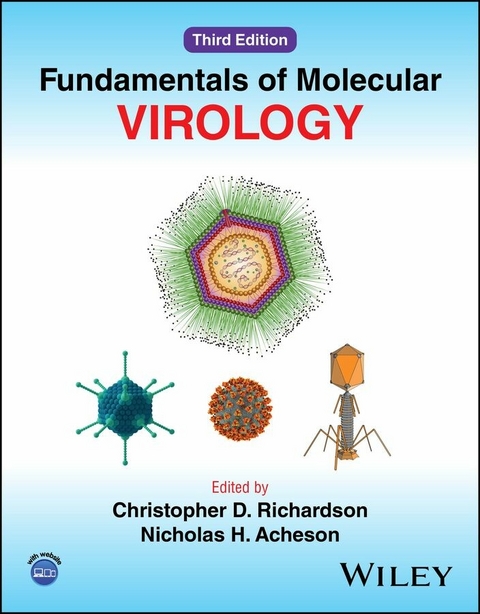
Fundamentals of Molecular Virology (eBook)
1942 Seiten
Wiley (Verlag)
978-1-119-88588-7 (ISBN)
Comprehensive coverage of major families of viruses, including human pathogens and viruses of organisms from bacteria to plants, with updated information on antiviral drugs, vaccines, antiviral immunity, and gene therapy
Fundamentals of Molecular Virology is a textbook designed for university students learning about viruses at the undergraduate or graduate levels. Chapters contributed by prominent virologists cover many of the major virus families. Each chapter is designed to tell a story about the viruses covered, including information on discovery, diseases and pathogenesis, virus structure, steps in replication, and interaction with cellular signaling pathways. This approach portrays the 'personality' of each virus, helping students to learn the material and build up their knowledge of virology starting with smaller and simpler viruses and proceeding to more complex viruses.
Major importance is given to viruses that infect humans and cause disease, but coverage is broad, including viruses of bacteria, Archaea, algae, invertebrates, and plants. Information boxes highlight applications and research directions of particular significance. Chapters conclude with sections presenting fundamental concepts, review questions, and lists of key terms, which are defined in a glossary at the end of the book.
This 3rd edition of Fundamentals of Molecular Virology includes detailed information on the recent COVID-19 pandemic and mRNA vaccine technology, additional sections on pathogenic herpesviruses, and updates on recent outbreaks of Zika virus, Ebola virus and mpox diseases. New chapters describe hepatitis C virus, rhabdoviruses, viruses of invertebrates, oncolytic viruses, and virus-mediated gene therapy. All chapters, including those on innate and adaptive immune responses to virus infections, virus vaccines, and antiviral agents, were revised and updated.
Christopher D. Richardson is Professor, Department of Microbiology & Immunology, Department of Pediatrics, Dalhousie University, Canada. Dr. Chris Richardson is a molecular virologist with 35 years of experience working with a variety of viruses. He earned his PhD at the University of British Columbia and did postdoctoral work at The Rockefeller University and the National Institutes of Health (Bethesda, USA). He previously held faculty positions at the National Research Council of Canada, McGill University, and the University of Toronto.
Nicholas H. Acheson is Emeritus Professor of Microbiology & Immunology at McGill University, Quebec, Canada. He earned his PhD from The Rockefeller University and was a postdoctoral fellow at the Swiss Institute for Experimental Cancer Research (Lausanne) and Institut Pasteur (Paris). He carried out research on Semliki Forest virus and mouse polyomavirus, and taught a virology course for advanced undergraduate students at McGill University.
PREFACE
This book is written for students who are learning about viruses for the first time in a university course at the undergraduate or graduate level. As the title implies, it concentrates on the molecular mechanisms of virus replication and on the interactions between viruses and the cells in which they replicate. The book approaches learning about virology by presenting chapters, many of which cover a specific virus family, using one or two well‐studied viruses as examples. Several other chapters discuss a variety of the many viruses that infect Archaea, algae, or invertebrates. These chapters are each designed to tell a story about the viruses being considered and to portray their “personality”, with the idea that this will help students learn about and remember each virus group.
This organizational scheme has been used in a number of successful virology textbooks, including Salvador Luria’s classic 1953 book, General Virology. Luria was one of the founding members of the “phage group,” a coalition of physicists, biologists, and chemists who, during the 1940s, chose to study bacteriophages in order to understand the molecular basis of life and, in doing so, invented the field of molecular biology. Their approach was to study how the proteins and nucleic acids of viruses interact with cellular molecules and organelles, transforming the cell into a factory that can produce many new progeny virus particles. Their underlying hope, which was largely achieved, was to use viruses as a tool to help understand how cells work.
The amount of knowledge that has accumulated about viruses has expanded enormously in recent years, as in many other areas of biomedical sciences. Fields Virology has become the classic reference book for knowledge about human and animal viruses during the past 40 years; that book is also organized in chapters that cover specific virus families. Our own teaching experience and conversations with numerous colleagues have convinced us that there is a real need for a concise, up‐to‐date textbook organized around the concept of virus families and designed specifically for teaching university students.
The problem was to make such a book accessible to beginning students without oversimplifying the material. Our approach was to ask a number of prominent virology researchers and teachers to write chapters on viruses that they knew well, using a set of criteria that we provided. We then edited and sometimes rewrote these chapters into a common style, and, in many cases, we created or redesigned the illustrations.
No individual could possibly write knowledgeably about the large spectrum of viruses that a virology course should cover, so a collaborative approach was necessary. However, a textbook that is an effective learning tool must have a coherent organization and a clear, consistent style of writing and illustration. Our job has been to craft the original chapters that we received into what we hope are readable and easily understood units.
This textbook emphasizes virus replication strategies; it is directed toward university students studying microbiology, cell and molecular biology, and the biomedical sciences. It does not go deeply into pathogenesis, epidemiology, or disease symptoms. However, substantial information and stories about medical and historical aspects of virology are included, particularly in the introductory sections of each chapter. Students who understand the diseases caused by particular viruses, and their importance in human history, may be motivated to learn more about those viruses.
What is New in the Third Edition
The second edition of this book, published in 2011, expanded coverage to include additional viruses and chapters on innate and adaptive immune responses to virus infection. New full‐color figures were introduced. It was well‐received and was adopted as a text for many university‐based virology courses in North America and overseas. Work on the current third edition began shortly before the COVID‐19 pandemic, when Christopher Richardson accepted the job of planning and coordinating this revision. Chris began to recruit virology researchers and educators to update and revise existing chapters, as well as soliciting several additional chapters. The COVID‐19 pandemic inevitably slowed down work on this revision but also gave us the chance to include detailed descriptions of the pandemic and its life‐changing effects on the entire planet, in the chapter on coronaviruses.
All chapters in this book were reviewed and updated, some in depth. However, the organization and content of each chapter were retained in most cases. We have therefore cited on the title page of each chapter the names of the original contributors as well as those of the individuals who revised or rewrote the chapter.
This third edition includes five new chapters: (1) “Bacteriophage T4,” one of the best‐studied and most complex phages; (2) “Hepatitis C Virus,” the story about a relatively recent viral disease for which efficient antiviral agents that cure infected individuals have been developed; (3) “Viruses of Invertebrates,” a growing field with many diverse viruses, which has developed through the efforts of high‐throughput sequencing, resulting in the discovery of thousands of viral genomes derived from environmental samples; (4) “Oncolytic Viral Agents,” a field that is starting to show some promise for treatment of certain human cancers; and (5) “Virus‐Mediated Gene Therapy,” a field under development for decades that has now progressed from its infancy to adolescence. This last chapter discusses how viral vectors have been harnessed to yield clinical successes in treating inherited human diseases and some cancers. The field has embraced CRISPR/Cas gene editing, which evolved from studying defense mechanisms in phage infections of bacteria. The merging of these technologies shows promise in treating debilitating diseases such as sickle cell disease, thalassemia, Parkinson’s disease, congenital blindness, amyloidosis, and cancer, to name a few.
How to Use this Book
This textbook is designed to be used in a modular fashion. No course would be expected to use all chapters in the book, nor necessarily in the same order in which they appear. The organization of the book gives wide latitude to course coordinators to make their own choices of which virus groups will be covered. Chapters are designed to accompany a 50‐minute lecture on the subject, or, in some cases, two or three such lectures. It should be possible to read each chapter in 30–60 minutes, including examination of figures and tables. Lecturers might want to supplement material given in the text with experimental methods or results, which are not covered because of lack of space.
The book is organized into 11 sections and 42 chapters. Four introductory chapters in Section I cover the history of virology and the virus life cycle, virus structure, virus classification, and the entry of viruses into animal cells. Five chapters in Section II cover well‐studied bacteriophages. These are included because bacteriophages are among the best‐known viruses, and because much of our knowledge of molecular biology and virology began with their study. Furthermore, bacteriophages are the source of many tools commonly used in modern molecular and cell biology laboratories. A final chapter in Section II covers exciting new knowledge about the sometimes‐bizarre viruses that infect archaea, members of the third domain of life, alongside bacteria and eukaryotes.
Sections III through VII cover viruses of eukaryotes, with an emphasis on viruses that infect humans and other vertebrates. The division into sections is based on the nature of the viral genome and viral replication strategies: positive‐strand RNA viruses (Section III), negative‐strand and double‐stranded RNA viruses (Section IV), DNA viruses (Sections V and VI), and viruses that use reverse transcriptase (Section VII). Within a section, smaller and simpler viruses are discussed first, followed by larger and more complex viruses. In this way, concepts that are learned about simpler viruses can be applied when more complex viruses are encountered.
Section VIII covers small infectious entities that are not viruses: viroids, which are virus‐like nucleic acids that replicate but code for no proteins; and prions, which are infectious proteins that contain no detectable nucleic acid. Section IX includes chapters on viruses that infect algae, invertebrates, and plants. The “giant” viruses are discussed in the chapter on viruses of algae. Section X covers host defenses against virus infection, and Section XI has been expanded to include not only chapters on vaccines and antiviral chemotherapy but also two new chapters on oncolytic viruses and viral gene therapy.
Each chapter begins with an outline. For chapters that cover virus families, these outlines are “thumbnail sketches” that contain some basic information about virion structure, genome organization, replication strategies, diseases caused, and distinctive characteristics shared by viruses in that family. These outlines are designed to serve as study aids that will help students understand and remember common features of the viruses they study.
Subheadings within each chapter are explanatory phrases, telling the reader what will be discussed in the next several paragraphs. These subheadings (collected in the Table of Contents) can also be read...
| Erscheint lt. Verlag | 22.4.2025 |
|---|---|
| Sprache | englisch |
| Themenwelt | Naturwissenschaften ► Biologie ► Mikrobiologie / Immunologie |
| Schlagworte | Cancer Therapy • electron microscopy • emerging viruses • miRNAs • monoclonal antibodies • new antivirals • new vaccines • old viruses • Oncolytic viruses • PCR • Proteomics • vaccination lapses • Viral infections • virus-mediated gene therapy |
| ISBN-10 | 1-119-88588-4 / 1119885884 |
| ISBN-13 | 978-1-119-88588-7 / 9781119885887 |
| Informationen gemäß Produktsicherheitsverordnung (GPSR) | |
| Haben Sie eine Frage zum Produkt? |
 EPUB (Adobe DRM)
Kopierschutz: Adobe-DRM
Adobe-DRM ist ein Kopierschutz, der das eBook vor Mißbrauch schützen soll. Dabei wird das eBook bereits beim Download auf Ihre persönliche Adobe-ID autorisiert. Lesen können Sie das eBook dann nur auf den Geräten, welche ebenfalls auf Ihre Adobe-ID registriert sind.
Details zum Adobe-DRM
Dateiformat: EPUB (Electronic Publication)
EPUB ist ein offener Standard für eBooks und eignet sich besonders zur Darstellung von Belletristik und Sachbüchern. Der Fließtext wird dynamisch an die Display- und Schriftgröße angepasst. Auch für mobile Lesegeräte ist EPUB daher gut geeignet.
Systemvoraussetzungen:
PC/Mac: Mit einem PC oder Mac können Sie dieses eBook lesen. Sie benötigen eine
eReader: Dieses eBook kann mit (fast) allen eBook-Readern gelesen werden. Mit dem amazon-Kindle ist es aber nicht kompatibel.
Smartphone/Tablet: Egal ob Apple oder Android, dieses eBook können Sie lesen. Sie benötigen eine
Geräteliste und zusätzliche Hinweise
Buying eBooks from abroad
For tax law reasons we can sell eBooks just within Germany and Switzerland. Regrettably we cannot fulfill eBook-orders from other countries.
aus dem Bereich