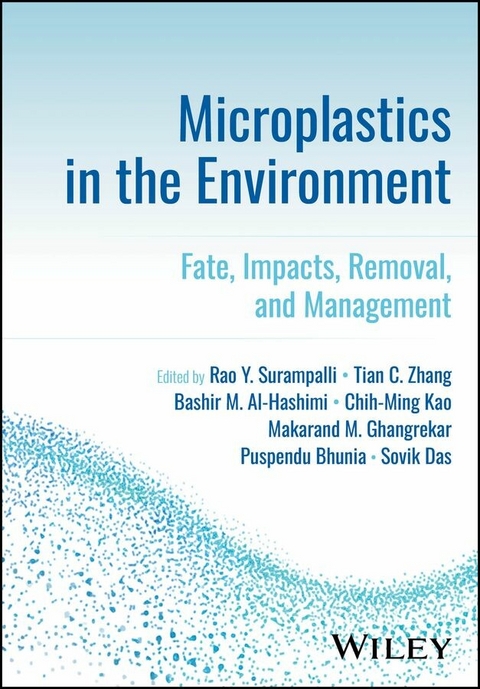
Microplastics in the Environment (eBook)
1214 Seiten
Wiley (Verlag)
978-1-394-25108-7 (ISBN)
Enables readers to assess, manage and prevent damage from the environment's biggest enemy: microplastics
Microplastics in the Environment addresses the biggest unresolved pollution issue: microplastics accumulating in the environment at a rapidly growing rate, giving rise to severe ecological stress and novel diseases in both aquatic and terrestrial organisms. This book is a one-stop resource that ties together the latest developments in this fast-moving field, including analytical techniques, risk assessment methods and predictive approaches, and evaluates different strategies that make it possible to minimize and redress microplastics pollution in the near and distant future.
The book is organized into three main parts. Part one explains the fundamental ideas underlying microplastics, including their classification, major sources, detection and characterisation, as well as risk assessment methods. The second part covers the fate and transport of microplastics in various environmental domains, their interaction with ecosystems and the exposure of humans to environment-borne microplastics. The final part surveys current and future approaches to limit and remove the environmental effects of microplastics, from replacement of plastics with biodegradable substitutes to more efficient recycling of plastics to their active removal and remediation.
Microplastics in the Environment includes information on:
- Microplastics' interaction with agricultural crops, the food and construction industries and water and solid waste pollution control systems
- Microplastics in microbial communities, crops and soil and the subsequent impacts on microbial metabolism, plant growth and geo-chemical properties of soil, respectively
- Consumption of microplastics by aquatic life and consequent effects of microplastics on the development of aquatic organisms including corals, invertebrates and marine and freshwater biota
- Global strategies, existing regulations and policies focused on microplastics management
With its emphasis on management and remediation, Microplastics in the Environment is a valuable resource for environmental scientists, government agencies and researchers working in the field of microplastics pollution.
Rao Y. Surampalli is President and Chief Executive Officer of the Global Institute for Energy, Environment and Sustainability (GIEES) in Lenexa, USA.
Tian C. Zhang is Professor in the department of Civil Engineering at the University of Nebraska-Lincoln (UNL), USA.
Bashir M. Al-Hashimi is Vice-President for Research and Innovation at King's College London, UK.
Chih-Ming Kao is Professor in the Institute of Environmental Engineering at the National Sun Yat-sen University in Kaohsiung, Taiwan.
Makarand M. Ghangrekar is Institute Chair Professor in the Department of Civil Engineering at the Indian Institute of Technology Kharagpur, India.
Puspendu Bhunia is Professor at the School of Infrastructure, Indian Institute of Technology Bhubaneswar, India.
Sovik Das is Assistant Professor at the Department of Civil and Environmental Engineering, Indian Institute of Technology Delhi, India.
Enables readers to assess, manage and prevent damage from the environment s biggest enemy: microplastics Microplastics in the Environment addresses the biggest unresolved pollution issue: microplastics accumulating in the environment at a rapidly growing rate, giving rise to severe ecological stress and novel diseases in both aquatic and terrestrial organisms. This book is a one-stop resource that ties together the latest developments in this fast-moving field, including analytical techniques, risk assessment methods and predictive approaches, and evaluates different strategies that make it possible to minimize and redress microplastics pollution in the near and distant future. The book is organized into three main parts. Part one explains the fundamental ideas underlying microplastics, including their classification, major sources, detection and characterisation, as well as risk assessment methods. The second part covers the fate and transport of microplastics in various environmental domains, their interaction with ecosystems and the exposure of humans to environment-borne microplastics. The final part surveys current and future approaches to limit and remove the environmental effects of microplastics, from replacement of plastics with biodegradable substitutes to more efficient recycling of plastics to their active removal and remediation. Microplastics in the Environment includes information on: Microplastics interaction with agricultural crops, the food and construction industries and water and solid waste pollution control systemsMicroplastics in microbial communities, crops and soil and the subsequent impacts on microbial metabolism, plant growth and geo-chemical properties of soil, respectivelyConsumption of microplastics by aquatic life and consequent effects of microplastics on the development of aquatic organisms including corals, invertebrates and marine and freshwater biotaGlobal strategies, existing regulations and policies focused on microplastics management With its emphasis on management and remediation, Microplastics in the Environment is a valuable resource for environmental scientists, government agencies and researchers working in the field of microplastics pollution.
Notes on Editors
Dr. Rao Y. Surampalli, PhD, PE, BCEE, Hon BC.WRE, F.WEF, F.AAAS, Dist.F.IWA, M.EASA, Dist.M.ASCE, NAC, is President and Chief Executive Officer of the Global Institute for Energy, Environment and Sustainability (GIEES). He was with the U.S. Environmental Protection Agency (USEPA) for 30 years and retired as an engineer director. He received MS and PhD degrees in environmental engineering from Oklahoma State University and Iowa State University, respectively. He is a registered professional engineer in the branches of civil and environmental engineering, and also a Board Certified Environmental Engineer (BCEE) and Water Resources Engineer (BC.WRE) of the American Academy of Environmental Engineers (AAEE) and the American Academy of Water Resources Engineers (AAWRE). He is an adjunct professor in seven universities and Distinguished/Honorary Visiting Professor in six (6) well‐known universities abroad. Currently, he serves, or has served on over 85 national and international committees, review panels, or advisory boards including the ASCE National Committee on Energy, Environment and Water Policy. He also served as President of Civil Engineering Certification (CEC), Inc., an entity of ASCE for board certification of various specialties within civil engineering. He is a Distinguished Engineering Alumnus of both the Oklahoma State and Iowa State universities, and an elected member of the European Academy of Sciences and Arts (EASA), an elected member of the U.S. National Academy of Construction (NAC), an elected fellow of the Water Environment Federation and Distinguished Fellow of International Water Association, an elected fellow of the American Association for the Advancement of Science (F.AAAS), and a Distinguished Member of the American Society of Civil Engineers. He also is Editor‐in‐Chief of the ASCE Journal of Hazardous, Toxic, and Radioactive Waste, past Vice‐Chair of Editorial Board of Water Environment Research Journal and Editor‐in‐Chief of Nanotechnology for Environmental Engineering Journal (Springer Nature), and serves on the editorial boards of 8 other refereed environmental journals. He has authored over 400 articles in refereed journals, 22 approved patents, 27 refereed books and 183 refereed book chapters, 250 national and international conference presentations and proceedings, and presented over 160 plenary/keynote or invited presentations worldwide. He has received over 30 national awards/honors.
Dr. Tian C. Zhang, PhD, PE, BCEE, BC.WRE, F.ASCE, F.AAAS, Dist.M.ASCE, is a professor in the Department of Civil Engineering at the University of Nebraska‐Lincoln (UNL), USA. He received his BS degree in civil engineering from Wuhan University of Technology, China, in 1982, his MS degree in environmental engineering from Tsinghua University, China, in 1985, and his PhD in environmental engineering from the University of Cincinnati in 1994. He joined the UNL faculty in August 1994. Professor Zhang teaches courses related to water/wastewater treatment, remediation of hazardous wastes, and nonpoint pollution control. Professor Zhang's research involves fundamentals and applications of nanotechnology and conventional technology for water, wastewater, and storm water treatment and management, remediation of contaminated environments, and detection/control of emerging contaminants in the environment. Professor Zhang has published more than 250 peer‐reviewed journal papers, 80 book chapters, and 16 books since 1994. Professor Zhang is a member of the Water Environmental Federation (WEF), and Association of Environmental Engineering and Science Professors (AEESP). Professor Zhang is a Diplomate of Water Resources Engineer (BC.WRE) of the American Academy of Water Resources Engineers, Board Certified Environmental Engineers (BCEE) of the American Academy of Environmental Engineers, Distinguished Member of American Society of Civil Engineers (Dist.M.ASCE), and Fellow of American Association for the Advancement of Science (F.AAAS), and Member of the European Academy of Sciences and Arts (EASA). Professor Zhang is the associate editor of Journal of Environmental Engineering (since 2007), Journal of Hazardous, Toxic, and Radioactive Waste (since 2006), and the managing editor of Water Environment Research (since 2008). He has been a registered professional engineer in Nebraska, USA, since 2000.
Bashir M. Al‐Hashimi, CBE, FREng, FRS, FIEEE, FIET, FBCS, is the Vice President (Research & Innovation) and ARM Professor of Computer Engineering at King's College London in the United Kingdom. He is internationally recognized for his sustained and pioneering research contributions to advanced semiconductor chips test, energy‐efficient embedded systems and the emerging research field of energy harvesting computing. His research has led to substantive innovations in enabling hardware and software technologies with application in mobile and digital electronic devices. A highly cited researcher, he has published more than 350 technical papers, with eight best paper awards at international conferences and has authored/coauthored and edited five books and eight book chapters, with his most recent as Many‐core Computing: Hardware and Software, IET press (2019). He has overseen the successful supervision of 45 PhD students and has secured over £25m in external research funding from UK research funders and industry. The impact of his computer engineering research and technology transfer has been significant in both academia and industry across the world and it has led to numerous distinctions. He was cofounder (2008) and codirector of the ARM‐Southampton Research Centre, which is an industry‐university collaborative center involving the University of Southampton and ARM, recognized as an exemplar in the UK for industry‐academia collaboration. Bashir has led successfully a number of large EPSRC‐funded multidisciplinary and interdisciplinary research consortia, including the Holistic battery‐free electronics project and the recently completed £5.6m EPSRC PRiME Programme Grant, which included four universities and five industrial partners. He was awarded in 2020 the UK Institution of Engineering and Technology's Faraday Medal for contributions to manufacturing test of electronics systems (the Institution's highest honor and one of the most world's most prestigious international awards for engineers and scientists). In 2018, he received one of the highest national UK honors when he was appointed Commander of the Order of the British Empire (CBE) by Her Majesty Queen Elizabeth II for sustained services to industry and engineering. He was appointed to the Research Excellence Framework (REF) for research impact evaluation of British Higher Education in both 2014 and 2021 and has contributed to numerous government research and education consultations through his active participation in the UK National Engineering Academy ‐ the Royal Academy of Engineering (RAEng) since election to the fellowship in 2013, where he has also been an elected member of the trustee board since 2021. In 2014, he received the Royal Society Wolfson Fellowship for scientific contributions to energy‐efficient and reliable computing systems, and in 2012, he received the Design and Test in European Conference Fellowship in recognition of contributions to electronic design and technical leadership. He was an elected fellow of the IEEE in 2009 for contributions to low‐power integrated circuits and systems and was recently elected to the Fellowship of the Royal Society and the membership of the European Academy of Sciences and Arts in the same year, 2023. He has an undergraduate degree in electrical engineering and a PhD from University of York (1989).
Dr. Chih‐Ming Kao, PhD, PE, BCEE, BC.WRE, F.IWA, F.WEF, F.AAAS, Dist.M.ASCE is a Distinguished Chair Professor in the Institute of Environmental Engineering at National Sun Yat‐Sen University, Taiwan. Professor Kao is also the coordinator of Environmental Engineering Program at Ministry of Science and Technology, past president of The Chinese Institute of Environmental Engineering, and former president of The Taiwan Association of Soil and Groundwater Environmental Protection. Professor Kao received his MS and PhD degrees in civil and environmental engineering from North Carolina State University in 1989 and 1993, respectively. He is a fellow member of International Water Association (IWA), Distinguished Member of American Society of Civil Engineers (ASCE), a member of the European Academy of Sciences and Arts (EASA), a fellow member of American Association for the Advancement of Science (AAAS), a fellow member of Environment and Water Resource Institute (EWRI), a registered professional engineer in the branch of civil engineering, a certified ground water professional, and a professional hydrologist in the United States. He is also a Diplomate of the American Academy of Environmental Engineers and Diplomate of American Academy of Water Resources Engineers. Professor Kao received the “Distinguished Researcher Award” from Taiwan Ministry of Science and Technology in 2011 and 2015. He is also the receiver of the “Distinguished Engineer Professor Award” from Chinese Institute of Engineers in 2012, and receiver of the “Distinguished Honor Award” from C.T. Ho Foundation in 2013. He also received several awards from ASCE including the State‐of‐the‐Art of Civil Engineering Award in 2013, Hering Medal, Samuel Arnold Greeley Award in 2012, and distinguished theory‐oriented paper award in 2008 and...
| Erscheint lt. Verlag | 7.4.2025 |
|---|---|
| Sprache | englisch |
| Themenwelt | Naturwissenschaften ► Biologie ► Ökologie / Naturschutz |
| Schlagworte | Microplastics characterization • microplastics classification • Microplastics detection • microplastics ecosystem • microplastics remediation • microplastics risk assessment methods • microplastics sources • remove microplastics |
| ISBN-10 | 1-394-25108-4 / 1394251084 |
| ISBN-13 | 978-1-394-25108-7 / 9781394251087 |
| Informationen gemäß Produktsicherheitsverordnung (GPSR) | |
| Haben Sie eine Frage zum Produkt? |
 EPUB (Adobe DRM)
Kopierschutz: Adobe-DRM
Adobe-DRM ist ein Kopierschutz, der das eBook vor Mißbrauch schützen soll. Dabei wird das eBook bereits beim Download auf Ihre persönliche Adobe-ID autorisiert. Lesen können Sie das eBook dann nur auf den Geräten, welche ebenfalls auf Ihre Adobe-ID registriert sind.
Details zum Adobe-DRM
Dateiformat: EPUB (Electronic Publication)
EPUB ist ein offener Standard für eBooks und eignet sich besonders zur Darstellung von Belletristik und Sachbüchern. Der Fließtext wird dynamisch an die Display- und Schriftgröße angepasst. Auch für mobile Lesegeräte ist EPUB daher gut geeignet.
Systemvoraussetzungen:
PC/Mac: Mit einem PC oder Mac können Sie dieses eBook lesen. Sie benötigen eine
eReader: Dieses eBook kann mit (fast) allen eBook-Readern gelesen werden. Mit dem amazon-Kindle ist es aber nicht kompatibel.
Smartphone/Tablet: Egal ob Apple oder Android, dieses eBook können Sie lesen. Sie benötigen eine
Geräteliste und zusätzliche Hinweise
Buying eBooks from abroad
For tax law reasons we can sell eBooks just within Germany and Switzerland. Regrettably we cannot fulfill eBook-orders from other countries.
aus dem Bereich