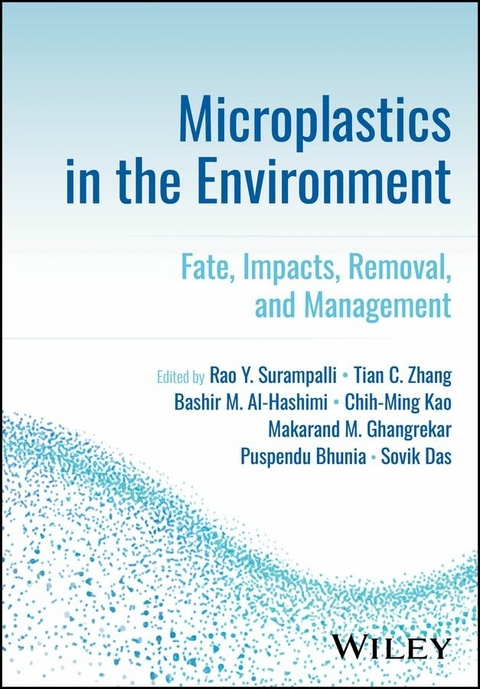
Microplastics in the Environment (eBook)
658 Seiten
Wiley (Verlag)
978-1-394-25109-4 (ISBN)
Enables readers to assess, manage and prevent damage from the environment's biggest enemy: microplastics
Microplastics in the Environment addresses the biggest unresolved pollution issue: microplastics accumulating in the environment at a rapidly growing rate, giving rise to severe ecological stress and novel diseases in both aquatic and terrestrial organisms. This book is a one-stop resource that ties together the latest developments in this fast-moving field, including analytical techniques, risk assessment methods and predictive approaches, and evaluates different strategies that make it possible to minimize and redress microplastics pollution in the near and distant future.
The book is organized into three main parts. Part one explains the fundamental ideas underlying microplastics, including their classification, major sources, detection and characterisation, as well as risk assessment methods. The second part covers the fate and transport of microplastics in various environmental domains, their interaction with ecosystems and the exposure of humans to environment-borne microplastics. The final part surveys current and future approaches to limit and remove the environmental effects of microplastics, from replacement of plastics with biodegradable substitutes to more efficient recycling of plastics to their active removal and remediation.
Microplastics in the Environment includes information on:
- Microplastics' interaction with agricultural crops, the food and construction industries and water and solid waste pollution control systems
- Microplastics in microbial communities, crops and soil and the subsequent impacts on microbial metabolism, plant growth and geo-chemical properties of soil, respectively
- Consumption of microplastics by aquatic life and consequent effects of microplastics on the development of aquatic organisms including corals, invertebrates and marine and freshwater biota
- Global strategies, existing regulations and policies focused on microplastics management
With its emphasis on management and remediation, Microplastics in the Environment is a valuable resource for environmental scientists, government agencies and researchers working in the field of microplastics pollution.
Rao Y. Surampalli is President and Chief Executive Officer of the Global Institute for Energy, Environment and Sustainability (GIEES) in Lenexa, USA.
Tian C. Zhang is Professor in the department of Civil Engineering at the University of Nebraska-Lincoln (UNL), USA.
Bashir M. Al-Hashimi is Vice-President for Research and Innovation at King's College London, UK.
Chih-Ming Kao is Professor in the Institute of Environmental Engineering at the National Sun Yat-sen University in Kaohsiung, Taiwan.
Makarand M. Ghangrekar is Institute Chair Professor in the Department of Civil Engineering at the Indian Institute of Technology Kharagpur, India.
Puspendu Bhunia is Professor at the School of Infrastructure, Indian Institute of Technology Bhubaneswar, India.
Sovik Das is Assistant Professor at the Department of Civil and Environmental Engineering, Indian Institute of Technology Delhi, India.
Enables readers to assess, manage and prevent damage from the environment s biggest enemy: microplastics Microplastics in the Environment addresses the biggest unresolved pollution issue: microplastics accumulating in the environment at a rapidly growing rate, giving rise to severe ecological stress and novel diseases in both aquatic and terrestrial organisms. This book is a one-stop resource that ties together the latest developments in this fast-moving field, including analytical techniques, risk assessment methods and predictive approaches, and evaluates different strategies that make it possible to minimize and redress microplastics pollution in the near and distant future. The book is organized into three main parts. Part one explains the fundamental ideas underlying microplastics, including their classification, major sources, detection and characterisation, as well as risk assessment methods. The second part covers the fate and transport of microplastics in various environmental domains, their interaction with ecosystems and the exposure of humans to environment-borne microplastics. The final part surveys current and future approaches to limit and remove the environmental effects of microplastics, from replacement of plastics with biodegradable substitutes to more efficient recycling of plastics to their active removal and remediation. Microplastics in the Environment includes information on: Microplastics interaction with agricultural crops, the food and construction industries and water and solid waste pollution control systemsMicroplastics in microbial communities, crops and soil and the subsequent impacts on microbial metabolism, plant growth and geo-chemical properties of soil, respectivelyConsumption of microplastics by aquatic life and consequent effects of microplastics on the development of aquatic organisms including corals, invertebrates and marine and freshwater biotaGlobal strategies, existing regulations and policies focused on microplastics management With its emphasis on management and remediation, Microplastics in the Environment is a valuable resource for environmental scientists, government agencies and researchers working in the field of microplastics pollution.
| Erscheint lt. Verlag | 28.3.2025 |
|---|---|
| Sprache | englisch |
| Themenwelt | Naturwissenschaften ► Biologie ► Ökologie / Naturschutz |
| Schlagworte | Microplastics characterization • microplastics classification • Microplastics detection • microplastics ecosystem • microplastics remediation • microplastics risk assessment methods • microplastics sources • remove microplastics |
| ISBN-10 | 1-394-25109-2 / 1394251092 |
| ISBN-13 | 978-1-394-25109-4 / 9781394251094 |
| Informationen gemäß Produktsicherheitsverordnung (GPSR) | |
| Haben Sie eine Frage zum Produkt? |
 PDF (Adobe DRM)
Kopierschutz: Adobe-DRM
Adobe-DRM ist ein Kopierschutz, der das eBook vor Mißbrauch schützen soll. Dabei wird das eBook bereits beim Download auf Ihre persönliche Adobe-ID autorisiert. Lesen können Sie das eBook dann nur auf den Geräten, welche ebenfalls auf Ihre Adobe-ID registriert sind.
Details zum Adobe-DRM
Dateiformat: PDF (Portable Document Format)
Mit einem festen Seitenlayout eignet sich die PDF besonders für Fachbücher mit Spalten, Tabellen und Abbildungen. Eine PDF kann auf fast allen Geräten angezeigt werden, ist aber für kleine Displays (Smartphone, eReader) nur eingeschränkt geeignet.
Systemvoraussetzungen:
PC/Mac: Mit einem PC oder Mac können Sie dieses eBook lesen. Sie benötigen eine
eReader: Dieses eBook kann mit (fast) allen eBook-Readern gelesen werden. Mit dem amazon-Kindle ist es aber nicht kompatibel.
Smartphone/Tablet: Egal ob Apple oder Android, dieses eBook können Sie lesen. Sie benötigen eine
Geräteliste und zusätzliche Hinweise
Buying eBooks from abroad
For tax law reasons we can sell eBooks just within Germany and Switzerland. Regrettably we cannot fulfill eBook-orders from other countries.
aus dem Bereich