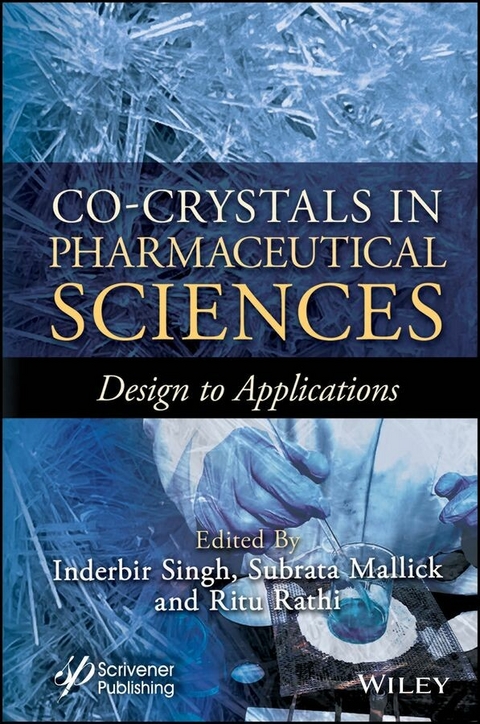
Co-Crystals in Pharmaceutical Sciences (eBook)
566 Seiten
Wiley-Scrivener (Verlag)
978-1-394-30248-2 (ISBN)
The book is essential for anyone in the pharmaceutical field, as it offers invaluable insights into the innovative world of cocrystals, their design principles, experimental techniques, and practical applications that can significantly enhance drug development and address critical industry challenges.
Co-Crystals in Pharmaceutical Sciences: Design to Applications is a comprehensive exploration of pharmaceutical cocrystals that introduces their scope and potential impact on drug development. This volume highlights the structural characteristics influencing cocrystals and delves into design principles and molecular interactions. Focus is placed on the advantages and challenges of integrating in-silico techniques for screening, which accelerates cocrystal discovery. Detailed coverage of experimental techniques, validation, and process optimization provides a solid foundation for readers. The book uniquely explores herbal and drug-drug cocrystals, showcasing synergies between traditional herbal medicine and modern pharmaceuticals. Scaling up cocrystal synthesis and potential commercial opportunities are examined in depth. Chapters on pharmaceutical applications emphasize how cocrystals address solubility, stability, and therapeutic challenges, with real-world examples illustrating their impact. The role of cocrystals in enhancing mechanical properties for more efficient formulations is discussed, and insights into the patent landscape and regulatory considerations round out the book, making it an indispensable resource for researchers and industry professionals alike.
Audience
Botanists, biologists, pharmaceutical professionals, drug delivery experts, and materials scientists studying pharmaceutical sciences.
Inderbir Singh, PhD, is a professor and the Assistant Dean of Research at Chitkara College of Pharmacy, Chitkara University, India. He has published eight books, 25 book chapters, and 180 papers in peer-reviewed journals. He also has 11 utility patents and 15 design registrations under review and has been granted three patents. His research interests include gastroretentive drug delivery systems, biopolymers, biomaterials, modified polymers in drug delivery, pharmaceutical cocrystals, the SeDeM expert system, and 3D printing technology.
Subrata Mallick, PhD, is a professor and the Head of the Department of Pharmaceutics in the School of Pharmaceutical Sciences, Siksha 'O' Anusandhan University, Odisha, India, with 26 years of teaching, research, and industry experience. He has published over 100 papers in international journals, six books, over 130 conference abstract proceedings, and five scientific articles, in addition to serving as an editorial board member for several international journals. His areas of interest include transdermal drug delivery systems, transmucosal drug delivery systems, powder compaction, drug degradation kinetics and stabilization, and drug-drug and drug-excipient interactions.
Ritu Rathi, PhD, is a PhD research scholar at Chitkara College of Pharmacy, Chitkara University, India, with five years of research experience in the field of pharmaceutical sciences. In addition to her active pharmaceutical research, she has published 17 articles and book chapters in various national and international journals, applied for three utility patents, and been granted two design registrations. Her research interests include pharmaceutical cocrystals, solubility enhancement techniques, herbal bioactives, and in-silico modeling techniques.
The book is essential for anyone in the pharmaceutical field, as it offers invaluable insights into the innovative world of cocrystals, their design principles, experimental techniques, and practical applications that can significantly enhance drug development and address critical industry challenges. Co-Crystals in Pharmaceutical Sciences: Design to Applications is a comprehensive exploration of pharmaceutical cocrystals that introduces their scope and potential impact on drug development. This volume highlights the structural characteristics influencing cocrystals and delves into design principles and molecular interactions. Focus is placed on the advantages and challenges of integrating in-silico techniques for screening, which accelerates cocrystal discovery. Detailed coverage of experimental techniques, validation, and process optimization provides a solid foundation for readers. The book uniquely explores herbal and drug-drug cocrystals, showcasing synergies between traditional herbal medicine and modern pharmaceuticals. Scaling up cocrystal synthesis and potential commercial opportunities are examined in depth. Chapters on pharmaceutical applications emphasize how cocrystals address solubility, stability, and therapeutic challenges, with real-world examples illustrating their impact. The role of cocrystals in enhancing mechanical properties for more efficient formulations is discussed, and insights into the patent landscape and regulatory considerations round out the book, making it an indispensable resource for researchers and industry professionals alike. Audience Botanists, biologists, pharmaceutical professionals, drug delivery experts, and materials scientists studying pharmaceutical sciences.
1
Pharmaceutical Cocrystals: Introduction, History and Applications
Oluwatoyin A. Odeku* and Olufunke D. Akin-Ajani
Department of Pharmaceutics and Industrial Pharmacy, University of Ibadan, Ibadan, Nigeria
Abstract
Cocrystals represent an expanding field of pharmaceutical sciences that offers an innovative approach to improving the physicochemical properties of active pharmaceutical ingredients (APIs). Cocrystals are a unique type of solid-state crystalline substance created by the interaction of two or more molecular species, usually an API and a coformer, joined together by noncovalent interactions, without forming chemical bonds. Unlike traditional drug formulations, cocrystals use purposeful molecular design to manufacture precise interactions between components, resulting in distinct crystal shapes and characteristics. Cocrystals offer the potential to increase drug solubility, bioavailability, and stability, mask taste, boost flavor, and control the release of drugs from formulations. In addition, cocrystals can facilitate the co-formulation of multiple drugs with complementary pharmacological activities, and they serve as versatile carriers or excipients in drug delivery systems such as nanoparticles, liposomes, or microspheres, enabling drug targeting. This chapter gives a background of cocrystals and their application in various aspects of drug development and delivery, as well as some marketed cocrystal formulations.
Keywords: Cocrystals, bioavailability, solubility, stability, marketed cocrystal formulations
1.1 Introduction
Cocrystal is a supramolecular chemistry idea that is gaining popularity among pharmaceutical and chemical researchers, as well as drug regulatory bodies. The primary reason for this is its capacity to affect the physicochemical characteristics of active medicinal components [1]. During pharmaceutical product development, formulators must maximize the physicochemical qualities of active medicinal components.
The European Medicines Agency (EMA) has defined cocrystals as “homogenous (single phase) crystalline structures made up of two or more components in a definite stoichiometric ratio where the arrangement in the crystal lattice is not based on ionic bonds (as with salts) and the components of a cocrystal may nevertheless be neutral as well as ionized” [2]. Cocrystals have been defined by the United States Food and Drug Administration (USFDA) as “Crystalline materials composed of two or more different molecules, typically API and cocrystal formers (coformers), in the same crystal lattice in a defined stoichiometric ratio” [3]. They were characterized as a discrete category of innovative, crystalline compounds that may affect the physicochemical properties of APIs, signifying the start of a new era in the domains of crystal engineering and manufacture [4]. Cocrystals consist of an active pharmaceutical ingredient and one or more distinct coformers that are solid at ambient temperature [5]. They are preferred over amorphous API forms or solid dispersions because they offer the solubility benefits of high-energy solids and a crystalline structure with strong thermal stability [6].
A coformer is described as “a component that interacts non-ionically with the active medicinal substance in the crystal lattice, which is typically non-solvent and is not volatile” [7]. The coformer selection has a significant impact on the final cocrystal properties. When synthesized as a cocrystal, the coformers can alter the API’s stability and solubility by causing modifications to the structure of its crystals [8]. Unlike traditional drug formulations, cocrystals use purposeful molecular design to manufacture precise interactions between components, resulting in distinct crystal shapes and characteristics. Cocrystals can be formed by interactions, including van der Waals forces, p-stacking, and hydrogen bonding. This excludes API solvates and hydrates from the category of cocrystals. However, cocrystals may comprise one or more water molecules or solvents in the crystal lattice [9]. Cocrystals frequently rely on hydrogen-bonded assemblies formed by neutral drug molecules and additional components [4]. For nonionizable substances, cocrystals increase medicinal qualities by modifying their mechanical behavior, solubility, water absorption, dissolution rate, bioavailability, and stability [10–12].
The major distinction between solvates and cocrystals rests in the physical condition of their constituents [13]. Crystals are known as solvates if one of the constituents is liquid at ambient temperature and cocrystals if both constituents are solid at ambient temperature. Solvates are prevalent because they develop as an accidental outcome of crystallization from solution and can boost the medicine dissolution rate, as demonstrated by spironolactone solvate [14]. Cocrystals have a more stable crystalline form without having to make or break covalent bonds, and both weakly ionizable and nonionizable drug molecules can be combined to form cocrystals. They have several potential commercial pharmaceutical and food applications [15]. Cocrystals have the potential to improve medication solubility, stability, bioavailability, and other essential properties important for medicinal efficacy [16].
1.2 History
Cocrystals have a history dating back to the early nineteenth century, yet their notion and understanding have developed greatly over time (Figure 1.1). The development of cocrystals may be traced back to 1844 when Friedrich Wöhler mixed quinone and hydroquinone solutions to create quinhydrone, a green solid with a 1:1 stoichiometry between the reactants [17, 18]. For several decades, there remained debate regarding the actual nature of the chemical composition of Wöhler’s product, and it took more than a century to verify the content and structure of this crystalline substance using single-crystal X-ray diffraction [19]. The introduction of X-ray crystallography in the early 20th century transformed the study of crystal structures, revealing insights into the molecular configurations inside cocrystals.
Figure 1.1 The evolution of cocrystals over the years.
A close evaluation of the literature from the latter part of the 19th and early 20th centuries reveals the existence of practically hundreds of cocrystals (even though they would continually appear under various names). The concept of cocrystals evolved in the later part of the 20th century when researchers defined them as “solid-state structures made up of two or more components held together by noncovalent interactions.” The area of crystal engineering sprang to prominence, with an emphasis on designing and manipulating crystal formations to attain certain qualities and functionality. Researchers investigated the use of cocrystals in medicines, noting their capacity to increase medication solubility, stability, and other characteristics. Stahly has published an excellent comprehensive summary of cocrystals reported before the year 2000 [18].
The 21st century saw an increase in research on cocrystals, notably in the pharmaceutical business. The emphasis on cocrystals as an easily recognized research owes a great deal to Etter’s foundational work in the late 1980s and early 1990s [20, 21]. In 1984, Desiraju and Steiner presented a systematic definition of hydrogen-bonded molecular complexes, which helped to formalize cocrystal notions in a book on “crystal engineering” [22].
Cocrystals attracted attention for their capacity to handle issues such as medication solubility, bioavailability, polymorphism, and intellectual property protection [15]. Several successful examples of cocrystal-based pharmaceuticals hit the market, emphasizing the practical applicability of cocrystals in pharmaceutical sciences.
1.3 Applications of Cocrystals in Pharmaceutical Sciences
Cocrystals have a wide range of pharmaceutical uses, providing answers to difficulties in standard medication formulations. Some important pharmaceutical uses of cocrystals include the following.
1.3.1 Enhanced Solubility
Many drugs have been revealed to have low solubility, which can reduce their bioavailability and therapeutic effectiveness. Approximately 70% of new drugs belong to the class II Biopharmaceutical Classification System (BCS; low solubility/high permeability) or class IV BCS (poor solubility/low permeability) [23, 24]. Since the gastrointestinal (GI) system has varied pH in different parts, drugs taken orally exhibit varying solubility in GI fluids at different pH, resulting in unpredictable and variable absorption and the inability to evaluate the drug’s efficacy and safety appropriately. Hence, restricted drug solubility is a key challenge in developing oral drug delivery systems [25].
Cocrystallization with proper coformers can improve API solubility by changing the crystal lattice structure, resulting in faster dissolution and greater absorption in the body [26]. Synthesizing salts and cocrystals boosted the solubility of ketoconazole, an antifungal medication, by 53 and 100 times, respectively, compared to ketoconazole [27]. Thus, cocrystals resulted in better drug solubility than the salt form.
The formulation of pterostilbene cocrystals with piperazine resulted in a sixfold increase in solubility,...
| Erscheint lt. Verlag | 2.4.2025 |
|---|---|
| Sprache | englisch |
| Themenwelt | Naturwissenschaften ► Chemie |
| Schlagworte | co-crystals • Co-Crystals Characterization • crystallization • Dissolution • Drug-Drug Co-Crystals • Herbal Co-Crystals • hot melt extrusion • hygroscopicity • regulatory aspects • Solubility enhancement • Solvent-Based Co-Crystallizations • Solvent evaporation • Solvent-Free Co-Crystallization • Spring and Parachute Mechanism • stability |
| ISBN-10 | 1-394-30248-7 / 1394302487 |
| ISBN-13 | 978-1-394-30248-2 / 9781394302482 |
| Informationen gemäß Produktsicherheitsverordnung (GPSR) | |
| Haben Sie eine Frage zum Produkt? |
 EPUB (Adobe DRM)
Kopierschutz: Adobe-DRM
Adobe-DRM ist ein Kopierschutz, der das eBook vor Mißbrauch schützen soll. Dabei wird das eBook bereits beim Download auf Ihre persönliche Adobe-ID autorisiert. Lesen können Sie das eBook dann nur auf den Geräten, welche ebenfalls auf Ihre Adobe-ID registriert sind.
Details zum Adobe-DRM
Dateiformat: EPUB (Electronic Publication)
EPUB ist ein offener Standard für eBooks und eignet sich besonders zur Darstellung von Belletristik und Sachbüchern. Der Fließtext wird dynamisch an die Display- und Schriftgröße angepasst. Auch für mobile Lesegeräte ist EPUB daher gut geeignet.
Systemvoraussetzungen:
PC/Mac: Mit einem PC oder Mac können Sie dieses eBook lesen. Sie benötigen eine
eReader: Dieses eBook kann mit (fast) allen eBook-Readern gelesen werden. Mit dem amazon-Kindle ist es aber nicht kompatibel.
Smartphone/Tablet: Egal ob Apple oder Android, dieses eBook können Sie lesen. Sie benötigen eine
Geräteliste und zusätzliche Hinweise
Buying eBooks from abroad
For tax law reasons we can sell eBooks just within Germany and Switzerland. Regrettably we cannot fulfill eBook-orders from other countries.
aus dem Bereich