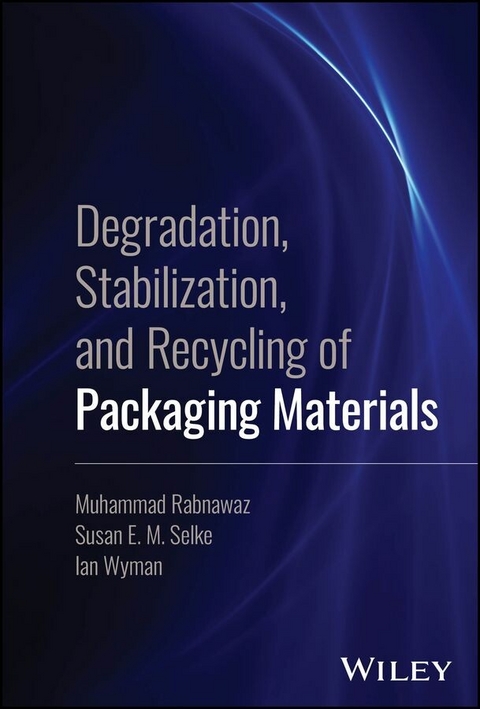
Degradation, Stabilization, and Recycling of Packaging Materials (eBook)
614 Seiten
Wiley (Verlag)
978-1-394-29427-5 (ISBN)
Practical guidance to sustainable packaging and its challenges with analysis of various packaging materials and their interactions with different environments
Degradation, Stabilization, and Recycling of Packaging Materials analyzes packaging materials and their interactions with different environments, discussing the degradation processes of different materials like plastics, wood, paper, glass, and metal, providing specific strategies to address these degradation processes, and exploring solid waste management, recent developments in recycling, and the principles of eco-friendly packaging design.
Organized into two parts, the first section of this book provides a comprehensive examination of how environmental factors such as heat, shear, light, air, packaged products, and stress affect packaging materials, focusing on the chemistry of their deterioration and stabilization methods. The second section explores solid waste management, recent developments in recycling, and key principles of eco-friendly packaging design, culminating in an extensive discussion of legal and regulatory aspects.
The book includes case studies and problem sets in each chapter, with solutions to the problems in an appendix in the back of the book.
Written by a team of highly qualified authors, Degradation, Stabilization, and Recycling of Packaging Materials includes discussion on:
- Structure of tinplate and tin-free steel, corrosion in lacquered cans, and effects of producing, processing, and storing metals
- Recyclable versus repulpable paper, uses of recycled papers, wet-strength papers, non-wood fibers as paper sources, and contamination issues with paper recycling
- Plastic recycling rates, plastic scrap exports in the US and abroad, chemical versus mechanical plastic recycling, hydrocracking of plastics, and PE and PET recycling
- Lightweight glass bottles, strategies to modify or strengthen glass, and the real recyclability of glass
Presenting advanced technical knowledge that demystifies the sustainable packaging landscape Degradation, Stabilization, and Recycling of Packaging Materials is a critical resource for researchers, students, and industry professionals in the field of materials science and packaging to evaluate challenges related to solid waste and devise effective disposal strategies.
Muhammad Rabnawaz, PhD is an Associate Professor for the Michigan State University (MSU) School of Packaging.
Susan E. M. Selke, PhD is Professor Emeritus in the Michigan State University (MSU) School of Packaging.
Ian Wyman, PhD is a Professional Aide in the Michigan State University (MSU) School of Packaging.
Practical guidance to sustainable packaging and its challenges with analysis of various packaging materials and their interactions with different environments Degradation, Stabilization, and Recycling of Packaging Materials analyzes packaging materials and their interactions with different environments, discussing the degradation processes of different materials like plastics, wood, paper, glass, and metal, providing specific strategies to address these degradation processes, and exploring solid waste management, recent developments in recycling, and the principles of eco-friendly packaging design. Organized into two parts, the first section of this book provides a comprehensive examination of how environmental factors such as heat, shear, light, air, packaged products, and stress affect packaging materials, focusing on the chemistry of their deterioration and stabilization methods. The second section explores solid waste management, recent developments in recycling, and key principles of eco-friendly packaging design, culminating in an extensive discussion of legal and regulatory aspects. The book includes case studies and problem sets in each chapter, with solutions to the problems in an appendix in the back of the book. Written by a team of highly qualified authors, Degradation, Stabilization, and Recycling of Packaging Materials includes discussion on: Structure of tinplate and tin-free steel, corrosion in lacquered cans, and effects of producing, processing, and storing metalsRecyclable versus repulpable paper, uses of recycled papers, wet-strength papers, non-wood fibers as paper sources, and contamination issues with paper recyclingPlastic recycling rates, plastic scrap exports in the US and abroad, chemical versus mechanical plastic recycling, hydrocracking of plastics, and PE and PET recyclingLightweight glass bottles, strategies to modify or strengthen glass, and the real recyclability of glass Presenting advanced technical knowledge that demystifies the sustainable packaging landscape Degradation, Stabilization, and Recycling of Packaging Materials is a critical resource for researchers, students, and industry professionals in the field of materials science and packaging to evaluate challenges related to solid waste and devise effective disposal strategies.
1
Introduction
This book is the only book that offers comprehensive insights into all packaging materials, how packaging materials interact with their surroundings, and how they are affected by their environments, such as packaged products, heat, light, air, stress, and so on. The book also covers strategies used to stabilize these materials against their environment. In addition, the impact of stabilizing strategies on recycling is also discussed. Other topics include solid waste management, recycling, and strategies for reducing waste. The book concludes with a focus on advancements in plastic recycling, packaging‐related laws, and principles of eco‐friendly packaging design.
In this chapter, we will provide a brief introduction to packaging sustainability issues. Subsequently, Chapters 2–6 will take a deeper look at individual packaging materials, their advantages and disadvantages, as well as the sustainability issues that should be considered for each. In particular, packaging materials that will be discussed in these chapters will include plastics (Chapter 2), wood (Chapter 3), paper (Chapter 4), glass (Chapter 5), and metals (Chapter 6). The degradation pathways and stabilization strategies of some of these materials will also be discussed. Issues relating to packaging’s impact on municipal solid waste systems and how this waste is handled, and how issues are addressed will be discussed in Chapter 7. Subsequently, the recycling of packaging materials will be discussed in Chapters 8–10, with the recycling of metals and glass being covered in Chapter 8, paper and paperboard recycling being the focus of Chapter 9, and plastics recycling being discussed in Chapter 10. Last, Chapter 11 will discuss packaging policies, extended producer responsibility (EPR), legal frameworks, and other policies, as well as green design principles and how they are being used to strengthen, incentivize, mandate, and promote packaging sustainability. It is hoped that this book will provide valuable insight into the landscape, challenges, and opportunities in sustainable packaging.
1.1 General Introduction
The packaging sector has a market value of 1.1 trillion USD globally as of 2023, which is projected to increase [1]. Therefore, it is evident that the packaging sector has a key influence on the economy and the environment. The vast majority of retail items sold today come in some form of packaging, whether these goods be food, medicines, cosmetics, consumer electronics, or other merchandise. Given the consumable nature of many of these products (especially food), it becomes readily apparent why packaging has such an impact on our everyday life, the economy, and the environment. In this chapter, we will briefly introduce some general concepts relating to packaging, which will be followed by a more detailed discussion in the subsequent chapters.
As we begin to look into packaging, it will be helpful to discuss some general concepts as well as some terms that are relevant to this topic.
1.2 What Are Some Ideal Properties of Packaging?
There are a number of roles that packaging fulfils, such as protecting goods against damage (including impacts in some cases), helping to maintain freshness, preventing contamination and spoilage of the product, conveying information about the product to consumers (this is usually done through labels, which can either be added onto the package or are printed directly on the package), as well as attracting the attention of consumers to help promote sales.
Depending on the application and the goods being packaged, a number of properties can be desirable and should be considered before a new package is selected. One of these properties includes its ability to prevent the passage of water vapor, oxygen, or other gases into the product (these are often referred to as barrier properties). Another consideration to take into account is the water or grease resistance of a packaging material, mainly if the product is susceptible to damage or contamination by water or oils. The weight of the packaging material is another important consideration, especially if the goods are likely to be shipped over long distances. The mechanical properties of a particular format can also be an important consideration, as in some cases, flexibility may be desirable, while rigidity may be preferable in other circumstances. The raw materials required to produce the packaging will also be an important factor in many cases. Ideally, these raw materials should be inexpensive and readily available. Due to environmental concerns, there is a trend toward seeking renewable biobased materials rather than those that are derived from nonrenewable petroleum. Alternatively, it is also highly desirable from a sustainability perspective to utilize recycled materials as feedstocks or raw materials to produce new packaging. Another consideration is the recyclability of the packaging at the end of its service lifetime, as some materials are easier to recycle than others.
A given material will have certain inherent advantages and drawbacks, depending on the intended packaging application. For example, plastics are relatively lightweight and tend to have good barrier properties. On the other hand, plastics are often derived from petroleum‐based resources (although biobased plastics are also available), and they tend to break down into microplastics, which can proliferate in the environment. Meanwhile, paper and paperboard packaging is highly desirable from a sustainability perspective but has poor water and grease resistance and offers only very limited barrier protection in the absence of coatings. These are a few examples of packaging materials, but we will discuss all this in greater depth in Chapters 2–5.
1.3 Liquid Resistance and Barrier Properties
As noted above, the barrier properties, as well as the oil and grease resistance of a packaging material, are often an important consideration when one is designing or selecting a new packaging material or format. Although these properties may not seem to directly impact the sustainability of packaging material, they are key criteria that are often required in order for the packaging to effectively fulfill its purpose of protecting the packaged goods. In addition, these properties do have some implications toward sustainability as the packaging with good liquid resistance and barrier properties can help to prevent food spoilage or damage to the packaged goods, thereby helping to minimize waste. Meanwhile, materials that do not meet these criteria will not be suitable candidates for new packaging, even if they are highly sustainable.
Some tests that are performed to evaluate liquid resistance include Cobb tests [2], kit rating tests, as well as contact angle measurements. Cobb tests are employed to measure the amount of water that has been absorbed by paper and paperboard over a certain timespan (typically 60, 180, or 1800 seconds) in units of g/m2. Meanwhile, kit rating tests are typically employed to evaluate the oil resistance of a given surface and have ratings in the range of 0–12, with a kit rating of 12 corresponding to the highest kit rating on this scale [3]. These tests are performed with a series of liquids with different viscosities and surface tensions (or “aggressiveness”), which have kit ratings in the range of 1–12, with the liquid with the kit number of 1 being the least aggressive (least likely to stain the paper) and the liquid with the kit number of 12 being the most aggressive. The kit rating of a paper substrate is assigned to the kit number of the liquid with the highest kit number that did not leave a stain. There may seem to be a slight discrepancy between the kit ratings of a sample (0–12) and the kit numbers of the test liquids [1–11]. This situation exists because a sample with a kit rating of 0 would have become stained by the least aggressive test liquid with a kit number of 1 and thus would be considered to have “failed” the kit rating test with that liquid, thus resulting in the sample being assigned a kit rating of 0. Meanwhile, a high contact angle can suggest that the liquid has resistance against that particular liquid. The contact angle can be influenced by various properties of an underlying solid, such as its surface energy and roughness. Some ways through which gas barrier properties are measured include the water vapor transmission rate, oxygen transmission rate, as well as carbon dioxide transmission rate (CO2TR) [4], which are the respective rates at which water vapor, oxygen, and carbon dioxide permeate through a material. Lower transmission rates would correspond to higher gas barrier properties. While high‐barrier properties are often desirable, in some cases a certain degree of breathability may be desired, such as with the packaging of produce.
1.4 End‐of‐Life (EoL) Outcomes
The scenario or outcome refers to the eventual fate of a product. In the context of this book, the EoL outcomes being focused on are packaging materials, or used packaging. Before environmental issues became a focus of concern, there were fewer EoL scenarios for packaging than there are today. In the past, some of the main outcomes for used packaging were disposal at landfills,...
| Erscheint lt. Verlag | 27.3.2025 |
|---|---|
| Sprache | englisch |
| Themenwelt | Naturwissenschaften ► Chemie |
| Schlagworte | bottle recycling • green recycling • Metal recycling • packaging recycling • Paper recycling • pet recycling • Plastic recycling • recycling challenges • recycling regulations • waste management • Waste reduction • wood recycling |
| ISBN-10 | 1-394-29427-1 / 1394294271 |
| ISBN-13 | 978-1-394-29427-5 / 9781394294275 |
| Informationen gemäß Produktsicherheitsverordnung (GPSR) | |
| Haben Sie eine Frage zum Produkt? |
 EPUB (Adobe DRM)
Kopierschutz: Adobe-DRM
Adobe-DRM ist ein Kopierschutz, der das eBook vor Mißbrauch schützen soll. Dabei wird das eBook bereits beim Download auf Ihre persönliche Adobe-ID autorisiert. Lesen können Sie das eBook dann nur auf den Geräten, welche ebenfalls auf Ihre Adobe-ID registriert sind.
Details zum Adobe-DRM
Dateiformat: EPUB (Electronic Publication)
EPUB ist ein offener Standard für eBooks und eignet sich besonders zur Darstellung von Belletristik und Sachbüchern. Der Fließtext wird dynamisch an die Display- und Schriftgröße angepasst. Auch für mobile Lesegeräte ist EPUB daher gut geeignet.
Systemvoraussetzungen:
PC/Mac: Mit einem PC oder Mac können Sie dieses eBook lesen. Sie benötigen eine
eReader: Dieses eBook kann mit (fast) allen eBook-Readern gelesen werden. Mit dem amazon-Kindle ist es aber nicht kompatibel.
Smartphone/Tablet: Egal ob Apple oder Android, dieses eBook können Sie lesen. Sie benötigen eine
Geräteliste und zusätzliche Hinweise
Buying eBooks from abroad
For tax law reasons we can sell eBooks just within Germany and Switzerland. Regrettably we cannot fulfill eBook-orders from other countries.
aus dem Bereich