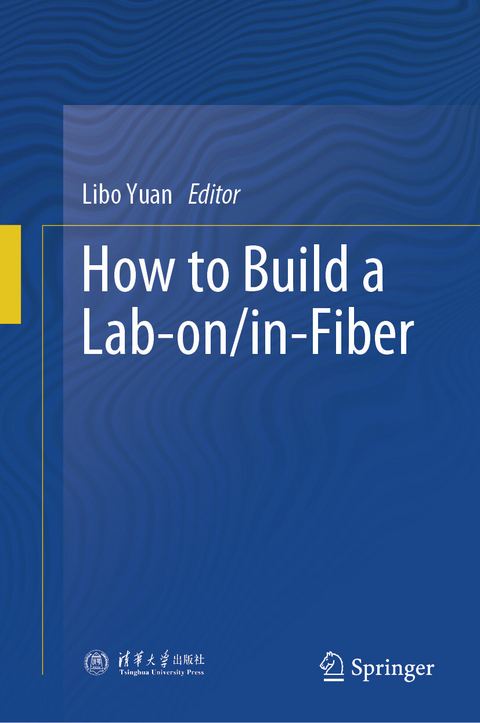
How to Build a Lab-on/in-Fiber (eBook)
VI, 626 Seiten
Springer Nature Singapore (Verlag)
978-981-97-9869-8 (ISBN)
This book explores the technical foundations of constructing diverse laboratories on optical fiber. In recent years, microstructured-based optical fiber devices and sensors have emerged as a rapidly advancing area within the field of optical fiber sensing technology. The concept of creating a laboratory on optical fiber has been inspired by advances in micro-structured fiber optics. Given the natural existence of optical waveguide channels within fibers, it is feasible to integrate a wide range of materials such as inorganic, organic, biological, and nonlinear optical substances-into or onto the fiber's end face or side. This integration facilitates the interaction between light and matter, leading to measurable optical outcomes through the fiber's optical channel. The rapid evolution of this concept is driven by the ease with which strong interactions can be achieved between light and matter at the micro-nano scale within the fiber, making it an ideal platform for experiments in lightwave microscale physics, photochemistry, and the interaction between light and both biological and microbial materials. The fiber optics laboratory thus offers a compelling stage for interdisciplinary research endeavors.
This book serves as a comprehensive and systematic introduction to the core techniques involved in establishing various laboratories on fiber, complemented by practical examples that illustrate the purpose, methodology, and technical approaches to developing fiber-based laboratories. It stands as an invaluable reference for students and researchers intrigued by the cutting-edge advancements in fiber optic technology.
| Erscheint lt. Verlag | 27.3.2025 |
|---|---|
| Zusatzinfo | VI, 626 p. 432 illus., 403 illus. in color. |
| Sprache | englisch |
| Original-Titel | How to Build a Lab-on/in-fiber |
| Themenwelt | Naturwissenschaften ► Physik / Astronomie |
| Schlagworte | Fiber end Nanophoton Structure and Device Integration • Fiber Integrated Microflow Laser • Fiber Optic Bubble Microcavity Sensing • In-fiber Discrete Optics • In-fiber Integrated Optics • Lab in Microstructured Optical Fibers • Lab-on-fiber • Micro and Nano Fiber Devices • Microfiber in-line/in-line Lab • Microfiber Multi-function Optical Device • Microfluidic Fiber and its Sensing Technology • Multifunctional Fiber Probe • Optical Fiber Surface Plasmon Resonance Sensor • Tapering Fiber Sensing • Tilted Fiber Grating Sensing |
| ISBN-10 | 981-97-9869-8 / 9819798698 |
| ISBN-13 | 978-981-97-9869-8 / 9789819798698 |
| Informationen gemäß Produktsicherheitsverordnung (GPSR) | |
| Haben Sie eine Frage zum Produkt? |
 PDF (Wasserzeichen)
DRM: Digitales Wasserzeichen
Dieses eBook enthält ein digitales Wasserzeichen und ist damit für Sie personalisiert. Bei einer missbräuchlichen Weitergabe des eBooks an Dritte ist eine Rückverfolgung an die Quelle möglich.
Dateiformat: PDF (Portable Document Format)
Mit einem festen Seitenlayout eignet sich die PDF besonders für Fachbücher mit Spalten, Tabellen und Abbildungen. Eine PDF kann auf fast allen Geräten angezeigt werden, ist aber für kleine Displays (Smartphone, eReader) nur eingeschränkt geeignet.
Systemvoraussetzungen:
PC/Mac: Mit einem PC oder Mac können Sie dieses eBook lesen. Sie benötigen dafür einen PDF-Viewer - z.B. den Adobe Reader oder Adobe Digital Editions.
eReader: Dieses eBook kann mit (fast) allen eBook-Readern gelesen werden. Mit dem amazon-Kindle ist es aber nicht kompatibel.
Smartphone/Tablet: Egal ob Apple oder Android, dieses eBook können Sie lesen. Sie benötigen dafür einen PDF-Viewer - z.B. die kostenlose Adobe Digital Editions-App.
Buying eBooks from abroad
For tax law reasons we can sell eBooks just within Germany and Switzerland. Regrettably we cannot fulfill eBook-orders from other countries.
aus dem Bereich