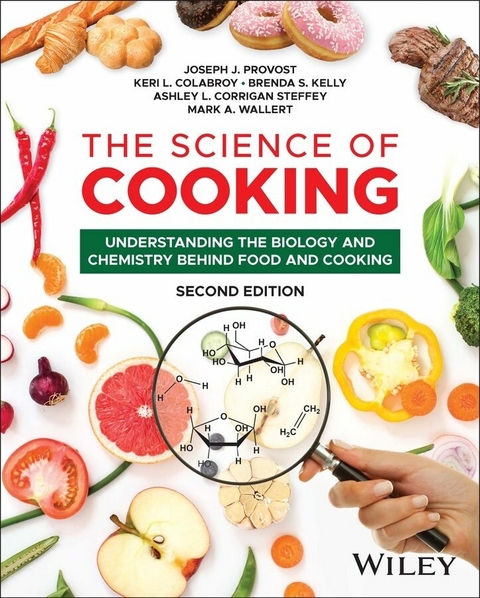
The Science of Cooking (eBook)
621 Seiten
Wiley (Verlag)
978-1-394-15822-5 (ISBN)
PROVIDES A CLEAR AND ACCESSIBLE PATH TO LEARNING KEY SCIENTIFIC CONCEPTS THROUGH THE LENS OF FOOD AND COOKING
The Science of Cooking provides an engaging and relatable way to explore the science behind every meal. Designed for both science and non-science majors, this popular textbook breaks down complex, molecular-level processes into easily digestible concepts. More than 30 inquiry-driven activities covering science basics and food-focused topics are supported by a series of experiments that can be conducted in the lab, in the classroom, and at home with minimal equipment.
Now in its second edition, The Science of Cooking offers enhanced learning tools throughout, including new end-of-chapter questions, practice problems, and hands-on cooking labs. An entirely new 'Science for the Chef' section pairing real-world recipes with scientific explanations is accompanied by new chapters on foundational chemistry and biochemistry that connect theory to practical cooking skills.
The Science of Cooking:
- Is a unique approach to teaching all students core fundamentals of chemistry, biology and biochemistry in a food and cooking context.
- Provides clear explanations and practical insights to future chefs, dietitians, and scientists alike
- Includes learning objectives, key concepts and end of chapter questions
- Contains a new selection of detailed recipes that demonstrate scientific processes
- Integrates guided-inquiry activities that encourage active learning with structured exercises
- Features inquiry-based cooking labs that offer experiential learning opportunities to deepen student understanding
- Includes access to a companion website at http://scienceofcooking.bergbuilds.domains/, for adopting professors with downloadable guided-inquiry activities and laboratories.
Connecting classroom learning to real-world cooking, The Science of Cooking: Understanding the Biology and Chemistry Behind Food and Cooking, Second Edition is perfect for undergraduate students in chemistry, biochemistry, biology, food science, and nutrition, as well liberal arts majors taking introductory or general science courses.
Joseph J. Provost, PhD, Professor of Chemistry and Biochemistry, University of San Diego, California.
Keri L. Colabroy, PhD, Professor of Chemistry, Muhlenberg College, Allentown, Pennsylvania.
Brenda S. Kelly, PhD, Provost and Dean; Professor of Biology and Chemistry, Gustavus Adolphus College, St. Peter, Minnesota.
Ashley L. Corrigan Steffey, MS, Faculty of Chemistry, University of San Diego, California.
Mark A. Wallert, PhD, retired Professor of Biology, Bemidji State University, Bemidji, Minnesota.
PROVIDES A CLEAR AND ACCESSIBLE PATH TO LEARNING KEY SCIENTIFIC CONCEPTS THROUGH THE LENS OF FOOD AND COOKING The Science of Cooking provides an engaging and relatable way to explore the science behind every meal. Designed for both science and non-science majors, this popular textbook breaks down complex, molecular-level processes into easily digestible concepts. More than 30 inquiry-driven activities covering science basics and food-focused topics are supported by a series of experiments that can be conducted in the lab, in the classroom, and at home with minimal equipment. Now in its second edition, The Science of Cooking offers enhanced learning tools throughout, including new end-of-chapter questions, practice problems, and hands-on cooking labs. An entirely new Science for the Chef section pairing real-world recipes with scientific explanations is accompanied by new chapters on foundational chemistry and biochemistry that connect theory to practical cooking skills. The Science of Cooking: Is a unique approach to teaching all students core fundamentals of chemistry, biology and biochemistry in a food and cooking context. Provides clear explanations and practical insights to future chefs, dietitians, and scientists alike Includes learning objectives, key concepts and end of chapter questions Contains a new selection of detailed recipes that demonstrate scientific processes Integrates guided-inquiry activities that encourage active learning with structured exercises Features inquiry-based cooking labs that offer experiential learning opportunities to deepen student understanding Includes access to a companion website at www.wiley.com/go/provost/food_science_2e, for adopting professors with downloadable guided-inquiry activities and laboratories. Connecting classroom learning to real-world cooking, The Science of Cooking: Understanding the Biology and Chemistry Behind Food and Cooking, Second Edition is perfect for undergraduate students in chemistry, biochemistry, biology, food science, and nutrition, as well liberal arts majors taking introductory or general science courses.
| Erscheint lt. Verlag | 24.3.2025 |
|---|---|
| Sprache | englisch |
| Themenwelt | Naturwissenschaften ► Chemie ► Allgemeines / Lexika |
| Schlagworte | biochemistry of food • biology of cooking • Chemistry Of Cooking • food science inquiry-based learning • food science POGIL activities • food science textbook • kitchen chemistry • Molecular gastronomy • scientific principles cooking • taste and smell science |
| ISBN-10 | 1-394-15822-X / 139415822X |
| ISBN-13 | 978-1-394-15822-5 / 9781394158225 |
| Informationen gemäß Produktsicherheitsverordnung (GPSR) | |
| Haben Sie eine Frage zum Produkt? |
 PDF (Adobe DRM)
Kopierschutz: Adobe-DRM
Adobe-DRM ist ein Kopierschutz, der das eBook vor Mißbrauch schützen soll. Dabei wird das eBook bereits beim Download auf Ihre persönliche Adobe-ID autorisiert. Lesen können Sie das eBook dann nur auf den Geräten, welche ebenfalls auf Ihre Adobe-ID registriert sind.
Details zum Adobe-DRM
Dateiformat: PDF (Portable Document Format)
Mit einem festen Seitenlayout eignet sich die PDF besonders für Fachbücher mit Spalten, Tabellen und Abbildungen. Eine PDF kann auf fast allen Geräten angezeigt werden, ist aber für kleine Displays (Smartphone, eReader) nur eingeschränkt geeignet.
Systemvoraussetzungen:
PC/Mac: Mit einem PC oder Mac können Sie dieses eBook lesen. Sie benötigen eine
eReader: Dieses eBook kann mit (fast) allen eBook-Readern gelesen werden. Mit dem amazon-Kindle ist es aber nicht kompatibel.
Smartphone/Tablet: Egal ob Apple oder Android, dieses eBook können Sie lesen. Sie benötigen eine
Geräteliste und zusätzliche Hinweise
Buying eBooks from abroad
For tax law reasons we can sell eBooks just within Germany and Switzerland. Regrettably we cannot fulfill eBook-orders from other countries.
aus dem Bereich