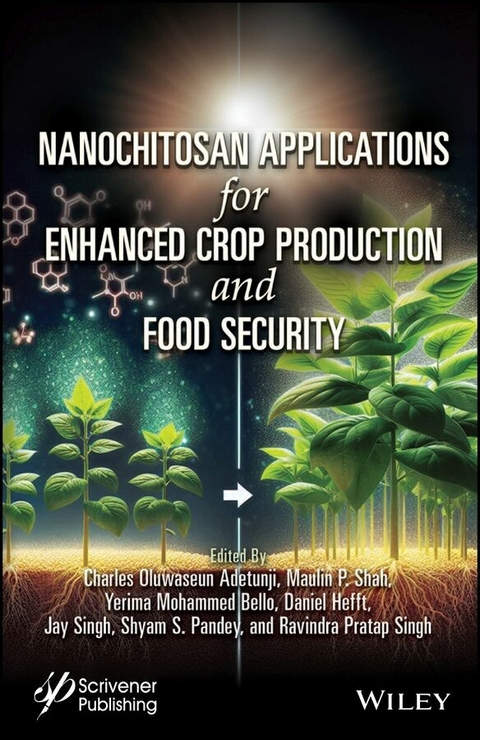
Nanochitosan Applications for Enhanced Crop Production and Food Security (eBook)
644 Seiten
Wiley-Scrivener (Verlag)
978-1-394-21489-1 (ISBN)
This unique, important, and timely book provides detailed information about the application of nanochitosan to increase agricultural productivity to enhance food security and nutrition.
Readers will find in Nanochitosan Applications for Enhanced Crop Production and Food Security detailed state-of-the-art information including:
- The modes of action through which nanochitosan perform numerous biological activities;
- State-of-the-art information and recent advancements in the application of nanochitosan, including targeted delivery, genetic manipulation, antimicrobial uses, curing infections in plants, controlled delivery of biologically active constituents, applications in the evaluation of carbon dioxide concentrations and humidity in controlled greenhouse environments, and their use as pressure sensors in agrichemical spraying equipment;
- Information on applying nanochitosan as a biofertilizer and bioinsecticide when applied on seeds and for foliar spraying of agricultural crops, soil amendment, and protection against pathogens and pests;
- The application of nanochitosan in the manufacturing of nanosensors in precision farming in the determination of crop growth, condition of soils, penetration of agrochemicals, diseases, and the level of environmental pollution to ensure a high level of safety for plant and soil health.
Audience
Researchers, scientists, and graduate students in agriculture, crop science, agricultural biotechnology, and agricultural engineering applications of nanochitosan, as well as policymakers, entrepreneurs, and investors in agriculture and food security.
Charles Oluwaseun Adetunji, PhD, is a professor in the Department of Microbiology at the Edo University Iyamho, in Edo State, Nigeria. Currently, he is the Director of Intellectual Properties and Technology Transfer. He has published more than 600 papers in peer-reviewed national and international journals as well as more than 50 books, 340 book chapters, and many scientific patents.
Maulin P. Shah, PhD, is the Chief Scientist and Head of the Industrial Wastewater Research Lab at Enviro Technology Ltd., Ankleshwar, Gujarat, India. He has published over 200 research publications in national and international journals. In addition to his authored works, he has edited over 65 books and serves as an editor and reviewer for over 150 journals.
Yerima Mohammed Bello, PhD, is the Academic Deputy Vice-Chancellor at Sokoto State University, Dangeda, Nigeria with over 26 years of research and teaching experience. He has published over 60 peer-reviewed articles in national and international journals as well as over 90 conference and workshop papers.
Daniel Hefft is a food engineer specializing in food process design and engineering. He lectures in food sciences and agriculture at various institutions and has been awarded research fellowships with the University of Birmingham, UK. Additionally, he has authored over 30 papers in internationally recognized books and journals. He is also the founder of Rheality Ltd., a company using a novel technology based on acoustic sensing and machine learning for rheology measurements.
Jay Singh, PhD, is an assistant professor in the Department of Chemistry, Institute of Sciences, Banaras Hindu University, Varanasi, India. He has published over 80 international research papers and authored more than 15 book chapters and several books.
Shyam S. Pandey, PhD, is a professor in the Green Electronics Department, Graduate School of Life Science and Systems Engineering, Kyushu Institute of Technology, Kitakyushu, Japan. He has published more than 220 papers in international refereed journals, more than 500 papers in national and international conferences, and over 30 patents in India, Japan, Europe, and the United States.
Ravindra Pratap Singh, PhD, is an assistant professor in the Department of Biotechnology, Indira Gandhi National Tribal University, Amarkantak, India. He has authored over 55 articles in international peer-reviewed journals and edited eight books and over 40 book chapters of international repute.
This unique, important, and timely book provides detailed information about the application of nanochitosan to increase agricultural productivity to enhance food security and nutrition. Readers will find in Nanochitosan Applications for Enhanced Crop Production and Food Security detailed state-of-the-art information including: The modes of action through which nanochitosan perform numerous biological activities; State-of-the-art information and recent advancements in the application of nanochitosan, including targeted delivery, genetic manipulation, antimicrobial uses, curing infections in plants, controlled delivery of biologically active constituents, applications in the evaluation of carbon dioxide concentrations and humidity in controlled greenhouse environments, and their use as pressure sensors in agrichemical spraying equipment; Information on applying nanochitosan as a biofertilizer and bioinsecticide when applied on seeds and for foliar spraying of agricultural crops, soil amendment, and protection against pathogens and pests; The application of nanochitosan in the manufacturing of nanosensors in precision farming in the determination of crop growth, condition of soils, penetration of agrochemicals, diseases, and the level of environmental pollution to ensure a high level of safety for plant and soil health. Audience Researchers, scientists, and graduate students in agriculture, crop science, agricultural biotechnology, and agricultural engineering applications of nanochitosan, as well as policymakers, entrepreneurs, and investors in agriculture and food security.
1
The Role of Nanomaterials in Agriculture as Nanofertilizers
Wuna Muhammad Muhammad1*, Abdulqadir Bala Ibrahim2, Job Oloruntoba Samuel1, Ahmadu Shekwaga Khalifa1, Oluwafemi Adebayo Oyewole1, Charles Oluwaseun Adetunji3,4, Eniola K. I. T.4, Mohammed Bello Yerima5 and John Tsado Mathew6
1Department of Microbiology, Federal University of Technology, Minna, Nigeria
2Perishable Crops Research Department, Nigerian Stored Products Research Institute, Kano, Nigeria
3Department of Microbiology, Edo State University, Uzairue, Nigeria
4Department of Biological Sciences, Joseph Ayo Babalola University, Ikeji Arakeji, Osun State, Nigeria
5Department of Microbiology, Sokoto State University, Sokoto, Sokoto State, Nigeria
6Department of Chemistry, Ibrahim Badamasi Babangida University, Lapai, Niger State, Nigeria
Abstract
Nanomaterials form the fundamental building blocks of both nanoscience and nanotechnology. The use of nanomaterials has revolutionized agriculture through the innovation of novel techniques and products. Multiple applications of nanomaterials exist in agriculture including its use in precision farming, nanofertilizers, nanopesticides, nanoformulations, and nanosensors to trail products and nutrients levels, to increase the productivity without the contamination of soil and water, to enhance crop productivity, and to provide protection against various biotic and abiotic stresses. The implementation of nanofertilizers has generated considerable concerns pertaining to human safety, food safety, and security. There exist apprehensions regarding the transportation, toxicity, and bioavailability of these chemicals, alongside the possibility of unknown environmental ramifications on biological systems. These problems impede the acceptance and utilization of sustainable agriculture practices. The safety issues associated with nanoparticles in agriculture arise from their reactivity and unpredictability, which might potentially affect the well-being of agricultural workers who come into contact with these xenobiotics during the manufacturing and application procedures in the field. Additional investigation is required in order to ascertain the viability and applicability of incorporating these innovative intelligent fertilizers, taking into account their projected benefits.
Keywords: Nanomaterials, nanofertilizers, nanotechnology, sustainable agriculture
1.1 Introduction
The invention of the atomic force microscope (AFM) in 1986 has significantly contributed to the advancement of nanostructured materials in the field of nanotechnology. These materials hold promise for enhancing production and manufacturing processes across multiple industries [1]. The combination of nanotechnology and biotechnology has greatly expanded the use of nanomaterials in various fields such as mechanics, medicine, and the food industry [2, 3].
Nanotechnology involves the investigation of minute structures and the manipulation of individual atoms, molecules, or compounds to develop materials and technologies with distinctive characteristics [4]. Nanotechnology is an interdisciplinary field that combines various disciplines, including biology, chemical engineering, mechanical engineering, and electronics engineering. Its focus is on understanding, manipulating, and constructing devices and systems with exceptional functionalities and qualities at the atomic, molecular, and supramolecular levels [5]. Nanotechnology involves studying structures, devices, and materials that have at least one dimension between 1 nm and 100 nm. When the size of particles is reduced below this limit, the resulting material exhibits distinct biological and physicochemical properties compared to macroscale materials made from the same substances [5].
The prefix “nano” originates from the Greek term meaning “dwarf” [6]. The term “nano” is commonly used to describe things that are very small or miniature in size. This perception has led to the understanding that nanomaterials are tiny structures that act as a single unit, possessing unique characteristics and performance. These materials typically have sizes ranging from 1 nm to 100 nm, which has sparked a heightened level of interest and involvement. Nanomaterials exhibit notable mesoscopic properties, including a high surface-to-volume ratio, enhanced chemical and biological activity, catalytic behavior, strength, penetrability, enzymatic activation, and quantum characteristics, in comparison to bulk materials [7]. They are commonly used in various sectors due to their distinctive properties that enhance their ability to support diverse biological and biochemical activities [1, 5]. The exploration of nanomaterials in various aspects such as synthesis, categorization, applications, and evaluations has been stimulated [8].
Agriculture plays a crucial role in developing countries, providing support to over 60% of the population [9, 10]. The expanding human population has led to increased nutrient extraction to boost food grain production, reducing arable land, limiting water resources, degrading soil organic matter, and contributing to climate change. Consequently, the adoption of advanced agricultural technologies like nanotechnology has become imperative [11, 12]. The development of an innovative and efficient technology is crucial for improving production and reducing food waste, which is essential for maintaining sustainable and living standards and enhancing food security at a national level. Nanotechnology has the potential to improve the production of high-quality foods and enhance their nutritional bioavailability. Numerous research studies are currently investigating the broadening application of nanotechnology in agricultural production and food processing [13].
Nanotechnology is widely utilized in various aspects of agricultural product production, processing, storage, packaging, transportation, and marketing facilities [11]. The objective of employing nanomaterials in agriculture is to minimize chemical usage and distribution, decrease nutrient losses in fertilization, and enhance crop yield by controlling pests and nutrients [9, 14].
Nanotechnology has gained considerable attention in agriculture due to its potential applications, including the use of nanofertilizers and nanopesticides. These applications offer benefits such as product and nutrient tracking, increased productivity without soil and water contamination, and protection against biotic and abiotic stresses [15, 16]. Nanotechnology has the potential to serve as sensors for monitoring soil quality in agricultural fields, thereby contributing to the maintenance of crop health [17]. Nanotechnology has significantly impacted agriculture and the food industry through the implementation of innovative techniques like precision farming. Precision agriculture has several benefits, including enhanced plant nutrient absorption, improved input utilization, disease detection and control, increased resilience to environmental stresses, and efficient processing, storage, and packaging systems [18–21]. In addition, the application of nanoclays and zeolites enhances fertilizer efficiency and promotes soil fertility restoration by releasing bound nutrients [22]. Abd-Elrahman and Mostafa [11] conducted research on smart seeds that have a nanopolymer coating and are specifically engineered to germinate in favorable conditions.
1.2 Nanotechnology in Agriculture
The need for nanotechnology is emphasized by emerging issues such as the growing demand for safe and healthy food, heightened disease risk, and the potential impact of changing weather patterns on agricultural and fishery productivity [22, 23]. Nanotechnology has the potential to significantly impact the agriculture and food industries through its ability to enhance molecular disease treatment, facilitate rapid disease diagnosis, and improve plant nutrient absorption, among other applications [24]. Smart sensors and delivery systems have the potential to assist the agriculture industry in combating viral infections and other crop diseases. Joshi et al. [12] suggest that the use of nanostructured catalysts can enhance the effectiveness of pesticides and herbicides, thereby reducing the required dosage. Nanotechnology can contribute to environmental preservation through the utilization of renewable energy sources, filters, and catalysts, which effectively mitigate pollution and remediate existing contaminants [25].
Nanotechnology has the potential to revolutionize agriculture by aiding in the understanding of biochemical processes in crops. This can be achieved by replacing traditional methods of analyzing environmental challenges and applying nanotechnology to enhance production [13]. Nanotechnology, environmentally friendly technologies, and agricultural biotechnology have the potential to significantly impact various aspects of the agricultural-value chain, leading to synchronized public benefits, legal considerations, moral implications, and environmental effects [13]. The use of nanoscale agrochemicals in agriculture, including nanofertilizers, nanopesticides, nanosensors, and nanoformulations, has significantly transformed conventional agricultural methods, enhancing their sustainability and efficiency (Figure 1.1).
Nanotechnology has various agricultural applications, such as...
| Erscheint lt. Verlag | 17.3.2025 |
|---|---|
| Sprache | englisch |
| Themenwelt | Naturwissenschaften ► Biologie ► Ökologie / Naturschutz |
| Schlagworte | Agricultural commodities • Biocompatibility • biodegradable • Biofertilizers • bioinsecticides • chronic food insecurity • cost-effectiveness • crop production • environment-friendly tools • from pests and pathogens • genetic manipulation • Malnutrition • Nanochitosan • targeted delivery |
| ISBN-10 | 1-394-21489-8 / 1394214898 |
| ISBN-13 | 978-1-394-21489-1 / 9781394214891 |
| Informationen gemäß Produktsicherheitsverordnung (GPSR) | |
| Haben Sie eine Frage zum Produkt? |
 EPUB (Adobe DRM)
Kopierschutz: Adobe-DRM
Adobe-DRM ist ein Kopierschutz, der das eBook vor Mißbrauch schützen soll. Dabei wird das eBook bereits beim Download auf Ihre persönliche Adobe-ID autorisiert. Lesen können Sie das eBook dann nur auf den Geräten, welche ebenfalls auf Ihre Adobe-ID registriert sind.
Details zum Adobe-DRM
Dateiformat: EPUB (Electronic Publication)
EPUB ist ein offener Standard für eBooks und eignet sich besonders zur Darstellung von Belletristik und Sachbüchern. Der Fließtext wird dynamisch an die Display- und Schriftgröße angepasst. Auch für mobile Lesegeräte ist EPUB daher gut geeignet.
Systemvoraussetzungen:
PC/Mac: Mit einem PC oder Mac können Sie dieses eBook lesen. Sie benötigen eine
eReader: Dieses eBook kann mit (fast) allen eBook-Readern gelesen werden. Mit dem amazon-Kindle ist es aber nicht kompatibel.
Smartphone/Tablet: Egal ob Apple oder Android, dieses eBook können Sie lesen. Sie benötigen eine
Geräteliste und zusätzliche Hinweise
Buying eBooks from abroad
For tax law reasons we can sell eBooks just within Germany and Switzerland. Regrettably we cannot fulfill eBook-orders from other countries.
aus dem Bereich