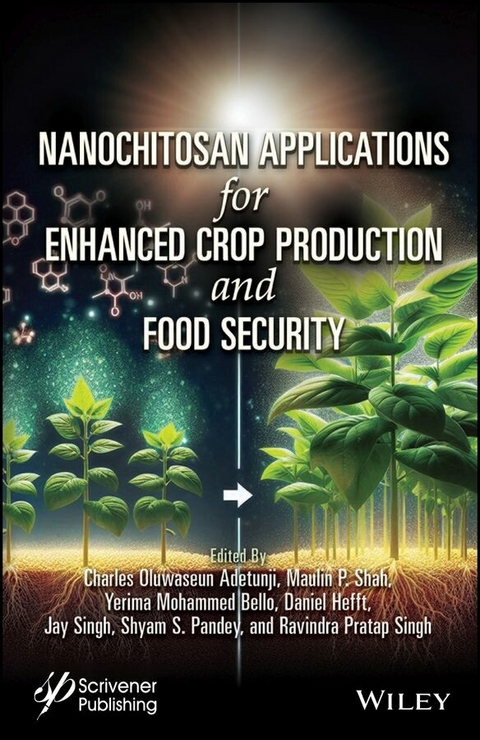
Nanochitosan Applications for Enhanced Crop Production and Food Security (eBook)
441 Seiten
Wiley-Scrivener (Verlag)
978-1-394-21493-8 (ISBN)

This unique, important, and timely book provides detailed information about the application of nanochitosan to increase agricultural productivity to enhance food security and nutrition.
Readers will find in Nanochitosan Applications for Enhanced Crop Production and Food Security detailed state-of-the-art information including:
- The modes of action through which nanochitosan perform numerous biological activities;
- State-of-the-art information and recent advancements in the application of nanochitosan, including targeted delivery, genetic manipulation, antimicrobial uses, curing infections in plants, controlled delivery of biologically active constituents, applications in the evaluation of carbon dioxide concentrations and humidity in controlled greenhouse environments, and their use as pressure sensors in agrichemical spraying equipment;
- Information on applying nanochitosan as a biofertilizer and bioinsecticide when applied on seeds and for foliar spraying of agricultural crops, soil amendment, and protection against pathogens and pests;
- The application of nanochitosan in the manufacturing of nanosensors in precision farming in the determination of crop growth, condition of soils, penetration of agrochemicals, diseases, and the level of environmental pollution to ensure a high level of safety for plant and soil health.
Audience
Researchers, scientists, and graduate students in agriculture, crop science, agricultural biotechnology, and agricultural engineering applications of nanochitosan, as well as policymakers, entrepreneurs, and investors in agriculture and food security.
Charles Oluwaseun Adetunji, PhD, is a professor in the Department of Microbiology at the Edo University Iyamho, in Edo State, Nigeria. Currently, he is the Director of Intellectual Properties and Technology Transfer. He has published more than 600 papers in peer-reviewed national and international journals as well as more than 50 books, 340 book chapters, and many scientific patents.
Maulin P. Shah, PhD, is the Chief Scientist and Head of the Industrial Wastewater Research Lab at Enviro Technology Ltd., Ankleshwar, Gujarat, India. He has published over 200 research publications in national and international journals. In addition to his authored works, he has edited over 65 books and serves as an editor and reviewer for over 150 journals.
Yerima Mohammed Bello, PhD, is the Academic Deputy Vice-Chancellor at Sokoto State University, Dangeda, Nigeria with over 26 years of research and teaching experience. He has published over 60 peer-reviewed articles in national and international journals as well as over 90 conference and workshop papers.
Daniel Hefft is a food engineer specializing in food process design and engineering. He lectures in food sciences and agriculture at various institutions and has been awarded research fellowships with the University of Birmingham, UK. Additionally, he has authored over 30 papers in internationally recognized books and journals. He is also the founder of Rheality Ltd., a company using a novel technology based on acoustic sensing and machine learning for rheology measurements.
Jay Singh, PhD, is an assistant professor in the Department of Chemistry, Institute of Sciences, Banaras Hindu University, Varanasi, India. He has published over 80 international research papers and authored more than 15 book chapters and several books.
Shyam S. Pandey, PhD, is a professor in the Green Electronics Department, Graduate School of Life Science and Systems Engineering, Kyushu Institute of Technology, Kitakyushu, Japan. He has published more than 220 papers in international refereed journals, more than 500 papers in national and international conferences, and over 30 patents in India, Japan, Europe, and the United States.
Ravindra Pratap Singh, PhD, is an assistant professor in the Department of Biotechnology, Indira Gandhi National Tribal University, Amarkantak, India. He has authored over 55 articles in international peer-reviewed journals and edited eight books and over 40 book chapters of international repute.
This unique, important, and timely book provides detailed information about the application of nanochitosan to increase agricultural productivity to enhance food security and nutrition. Readers will find in Nanochitosan Applications for Enhanced Crop Production and Food Security detailed state-of-the-art information including: The modes of action through which nanochitosan perform numerous biological activities; State-of-the-art information and recent advancements in the application of nanochitosan, including targeted delivery, genetic manipulation, antimicrobial uses, curing infections in plants, controlled delivery of biologically active constituents, applications in the evaluation of carbon dioxide concentrations and humidity in controlled greenhouse environments, and their use as pressure sensors in agrichemical spraying equipment; Information on applying nanochitosan as a biofertilizer and bioinsecticide when applied on seeds and for foliar spraying of agricultural crops, soil amendment, and protection against pathogens and pests; The application of nanochitosan in the manufacturing of nanosensors in precision farming in the determination of crop growth, condition of soils, penetration of agrochemicals, diseases, and the level of environmental pollution to ensure a high level of safety for plant and soil health. Audience Researchers, scientists, and graduate students in agriculture, crop science, agricultural biotechnology, and agricultural engineering applications of nanochitosan, as well as policymakers, entrepreneurs, and investors in agriculture and food security.
| Erscheint lt. Verlag | 7.3.2025 |
|---|---|
| Sprache | englisch |
| Themenwelt | Naturwissenschaften ► Biologie ► Ökologie / Naturschutz |
| Schlagworte | Agricultural commodities • Biocompatibility • biodegradable • Biofertilizers • bioinsecticides • chronic food insecurity • cost-effectiveness • crop production • environment-friendly tools • from pests and pathogens • genetic manipulation • Malnutrition • Nanochitosan • targeted delivery |
| ISBN-10 | 1-394-21493-6 / 1394214936 |
| ISBN-13 | 978-1-394-21493-8 / 9781394214938 |
| Informationen gemäß Produktsicherheitsverordnung (GPSR) | |
| Haben Sie eine Frage zum Produkt? |
 PDF (Adobe DRM)
Kopierschutz: Adobe-DRM
Adobe-DRM ist ein Kopierschutz, der das eBook vor Mißbrauch schützen soll. Dabei wird das eBook bereits beim Download auf Ihre persönliche Adobe-ID autorisiert. Lesen können Sie das eBook dann nur auf den Geräten, welche ebenfalls auf Ihre Adobe-ID registriert sind.
Details zum Adobe-DRM
Dateiformat: PDF (Portable Document Format)
Mit einem festen Seitenlayout eignet sich die PDF besonders für Fachbücher mit Spalten, Tabellen und Abbildungen. Eine PDF kann auf fast allen Geräten angezeigt werden, ist aber für kleine Displays (Smartphone, eReader) nur eingeschränkt geeignet.
Systemvoraussetzungen:
PC/Mac: Mit einem PC oder Mac können Sie dieses eBook lesen. Sie benötigen eine
eReader: Dieses eBook kann mit (fast) allen eBook-Readern gelesen werden. Mit dem amazon-Kindle ist es aber nicht kompatibel.
Smartphone/Tablet: Egal ob Apple oder Android, dieses eBook können Sie lesen. Sie benötigen eine
Geräteliste und zusätzliche Hinweise
Buying eBooks from abroad
For tax law reasons we can sell eBooks just within Germany and Switzerland. Regrettably we cannot fulfill eBook-orders from other countries.
aus dem Bereich