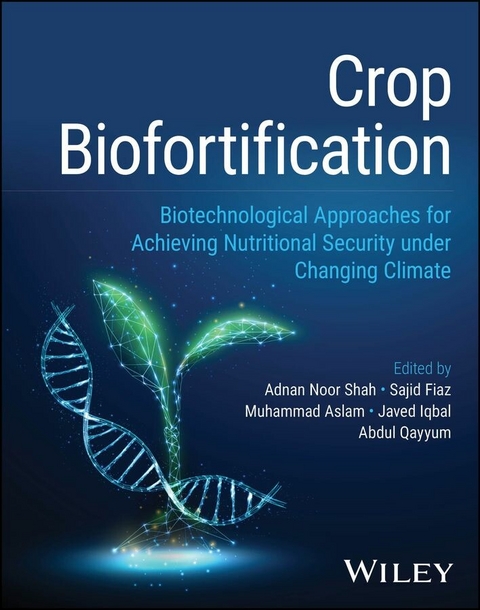
Crop Biofortification (eBook)
1366 Seiten
Wiley (Verlag)
978-1-394-27325-6 (ISBN)
Develop more nutritious crops to aid in the fight against world hunger with this timely volume
One in nine people worldwide suffer from hunger or food scarcity. Massively increasing food production is one of the most urgent scientific projects in the modern world, particularly as a changing climate places increasing pressure on the global food supply and on sustainable food production processes. Biofortification is a process in which plant breeding, improved agronomic practices, and/or modern biotechnology are employed to increase nutrient density of crops without sacrificing any of their desirable characteristics. It's an essential tool in the global fight against hunger.
Crop Biofortification offers an up-to-the-minute overview of this essential subject and its recent advances. It covers all the latest methodologies and techniques deployed in biofortification, as well as surveying plant responses to genetically induced biofortification and the effect of climate change on biofortified crops. Designed to allow for the application of these techniques at the field level, it's a significant contribution towards the search for a sustainable global food supply.
Crop Biofortification readers will also find:
- Presentation of recent advances in omics, particularly metabolomics, which can decipher potential changes in plants caused by biofortification
- Detailed discussion of methods for increasing the nutritional content of edible plants to address specific nutritional deficiencies
- Contributions towards a road map for increasing global food production by 70% before the year 2050
Crop Biofortification is ideal for researchers, policymakers, and professionals interested in the potential biofortification of crop plants, as well as graduate and advanced undergraduate students in agronomy, plant physiology, plant breeding and genetics, agricultural biotechnology, and related fields.
Adnan Noor Shah, is Assistant Professor in the Department of Agricultural Engineering, Khwaja Fareed University of Engineering and Information Technology, Punjab, Pakistan. He specializes in nitrogen metabolism and efficient utilization of nitrogen fertilizers by crop plants, and serves as editor for multiple leading plant science and agronomy journals.
Sajid Fiaz, is Assistant Professor in the Institute of Molecular Biology and Biotechnology, University of Lahore, Pakistan. His research focuses on the development of high-quality rice through genome editing, as well as multi-omics approaches for improving plant traits.
Muhammad Aslam, is Associate Professor in the Department of Plant Breeding and Genetics, Faculty of Agriculture, University of Agriculture, Faisalabad, Pakistan. His research focuses on the development of maize and maize hybrids.
Javed Iqbal, is Assistant Professor in the Department of Botany, Bacha Khan University, Khyber Pakhtunkhwa, Pakistan. His research group focuses on developing eco-friendly and sustainable avenues for synthesizing novel functional nanomaterials from medicinal plants.
Abdul Qayyum, is Assistant Professor in the Department of Agronomy, University of Haripur, Pakistan. His research focuses on plant physiology, the improvement of agronomic traits through selection, plant nutrition, and related subjects.
Develop more nutritious crops to aid in the fight against world hunger with this timely volume One in nine people worldwide suffer from hunger or food scarcity. Massively increasing food production is one of the most urgent scientific projects in the modern world, particularly as a changing climate places increasing pressure on the global food supply and on sustainable food production processes. Biofortification is a process in which plant breeding, improved agronomic practices, and/or modern biotechnology are employed to increase nutrient density of crops without sacrificing any of their desirable characteristics. It s an essential tool in the global fight against hunger. Crop Biofortification offers an up-to-the-minute overview of this essential subject and its recent advances. It covers all the latest methodologies and techniques deployed in biofortification, as well as surveying plant responses to genetically induced biofortification and the effect of climate change on biofortified crops. Designed to allow for the application of these techniques at the field level, it s a significant contribution towards the search for a sustainable global food supply. Crop Biofortification readers will also find: Presentation of recent advances in omics, particularly metabolomics, which can decipher potential changes in plants caused by biofortificationDetailed discussion of methods for increasing the nutritional content of edible plants to address specific nutritional deficienciesContributions towards a road map for increasing global food production by 70% before the year 2050 Crop Biofortification is ideal for researchers, policymakers, and professionals interested in the potential biofortification of crop plants, as well as graduate and advanced undergraduate students in agronomy, plant physiology, plant breeding and genetics, agricultural biotechnology, and related fields.
List of Contributors
Muhammad Aaqil
College of Food Science and Technology
Yunnan Agricultural University
Kunming
China
Banzeer Ahsan Abbasi
Department of Botany
Rawalpindi Women University
Rawalpindi
Pakistan
FNU Abdullah
Department of Soil and Crop Sciences
Texas A&M University
Texas
USA
Muhammad Adnan
Department of Agriculture
University of Swabi
Anbar
Pakistan
Kafeel Ahmad
Department of Botany
University of Sargodha
Sargodha
Pakistan
Mushtaq Ahmad
Horticultural Research Institute
National Agricultural Research Center
Islamabad
Pakistan
Shakeel Ahmad
Institute of Agronomy
Bahauddin Zakariya University
Multan
Pakistan
Department of Soil and Environmental Sciences
Muhammad Nawaz Shareef University of Agriculture
Multan
Pakistan
Zeeshan Ahmed
Xinjiang Institute of Ecology & Geography
Chinese Academy of Sciences
Urumqi
China
Cele National Station of Observation and Research for Desert-Grassland Ecosystems
Chinese Academy of Sciences
Urumqi
China
College of Life Science
Shenyang Normal University
Shenyang
China
Ahmad Ali
Center for Plant Sciences and Biodiversity
University of Swat
Charbagh
Pakistan
Ayesha Ali
Department of Botany
Government College University Lahore
Lahore
Pakistan
Basharat Ali
Department of Agricultural Engineering
Khwaja Fareed University of Engineering and Information Technology
Rahim Yar Khan
Pakistan
Muqarrab Ali
Department of Climate Change
Muhammad Nawaz Shareef University of Agriculture
Multan
Pakistan
Ruqayya Ali
Department of Botany
Government College University Lahore
Lahore
Pakistan
Umed Ali
Department of Agriculture
Mir Chakar-Khan Rind University
Sibi
Pakistan
Muaz Ameen
Department of Botany
University of Agriculture Faisalabad
Faisalabad
Pakistan
Aqsa Anjum
Department of English Literature and Applied Linguistics
Government Post Graduate College
Timergara
Pakistan
Shakeel Ahmad Anjum
Department of Agronomy
University of Agriculture
Faisalabad
Pakistan
Sumera Anwar
Department of Botany
Government College Women University Faisalabad
Faisalabad
Pakistan
Uneebullah Arif
Department of Forestry and Range Management
Gomal University
Dera Ismail Khan
Pakistan
Uzma Arif
Horticultural Research Institute
National Agricultural Research Center
Islamabad
Pakistan
Yunus Emre Arvas
Van Yuzuncu Yil University
Faculty of Science
Department of Molecular Biology and Genetics
Tusba-Van
Turkey
Karadeniz Technical University
Faculty of Science
Department of Biology
Ortahisar- Trabzon
Turkey
Muhammad Ashraf
Institute of Molecular Biology and Biotechnology
The University of Lahore
Lahore
Pakistan
Umair Ashraf
Department of Botany
Division of Science and Technology
University of Education
Lahore
Pakistan
Dilawar Aslam
Department of Plant Breeding and Genetics
University of Agriculture
Faisalabad
Pakistan
Muhammad Aslam
Department of Botany
Division of Science and Technology
University of Education
Lahore
Pakistan
Areeba Azhar
Department of Botany
Government College University Lahore
Lahore
Pakistan
Hafeezullah Babar
Soil Fertility Research Institute
Agriculture Research Center
Tandojam
Pakistan
Mohammad Safdar Baloch
Department of Agronomy
Gomal University
Dera Ismail Khan
Pakistan
Ghazala Batool
Departmemt of Bioinformatics
University of Agriculture
Faisalabad
Pakistan
Mohamed Behnassi
Economic Social & Environmental Council (ESEC- Rabat);
Ministry of Higher Education
Scientific Research and Innovation
Morocco
Mahpara Khatoon Bhutto
Department of Agronomy
Sindh Agriculture University
Tandojam
Pakistan
Marya Bibi
Department of Agronomy
Horticulture & Plant Science
South Dakota State University
Brookings
USA
Yamin Bibi
Department of Agronomy
Sayed Jamaluddin Afghani University
Salar Bagh
Afghanistan
Noman Ali Buttar
Department of Agricultural Engineering
Khwaja Fareed University of Engineering and Information Technology
Rahim Yar Khan
Pakistan
Shah Fahad
Department of Agronomy
Abdul Wali Khan University Mardan
Khyber Pakhtunkhwa
Pakistan
Areej Fatima
Department of Botany
Government College University Lahore
Lahore
Pakistan
Sajid Fiaz
Institute of Molecular Biology and Biotechnology
The University of Lahore
Lahore
Pakistan
Muhammad Adeel Ghafar
Department of Botany
Government College University Faisalabad
Faisalabad
Pakistan
Muhammad Salman Hameed
National Key Laboratory of Green Pesticide
International Joint Research Center for Intelligent Biosensor Technology and Health
Central China Normal University
Wuhan
China
Pat (J S) Heslop Harrison
Key Laboratory of Plant Resources Conservation and Sustainable Utilization/Guangdong Provincial Key
Laboratory of Applied Botany
South China Botanical Garden
Chinese Academy of Sciences
Guangzhou
China
Department of Genetics and Genome Biology
University of Leicester
Institute for Environmental Futures
Leicester
United Kingdom
South China National Botanical Garden
Chinese Academy of Sciences
Guangzhou
China
Wiwiek Harsonowati
Research Center for Horticulture
National Research and Innovation Agency (BRIN)
Cibinong
Indonesia
Shah Hassan
Department of Agricultural Extension Education & Communication
The University of Agriculture
Peshawar
Pakistan
Waseem Hassan
Department of Soil and Environmental Sciences
Muhammad Nawaz Shareef University of Agriculture
Multan
Pakistan
Muhammad Baqir Hussain
Department of Soil and Environmental Sciences
MNS University of Agriculture
Multan
Pakistan
Saddam Hussain
Department of Agronomy
University of Agriculture
Faisalabad
Pakistan
Sajjad Hyder
Department of Botany
GC Women University
Sialkot
Pakistan
Shumaila Ijaz
School of Biomedical Engineering
Shenzhen University Medical School
Shenzhen University
Shenzhen
China
Muhammad Imran
Department of Soil and Environmental Sciences
Muhammad Nawaz Shareef University of Agriculture
Multan
Pakistan
Javed Iqbal
Department of Botany
Bacha Khan University
Charsadda
Pakistan
Rashid Iqbal
Department of Agronomy
Faculty of Agriculture and Environment
The Islamia University of Bahawalpur
Bahawalpur
Pakistan
Maham Ishfaq
Institute of Molecular Biology and Biotechnology
The University of Lahore
Lahore
Pakistan
Muhammad Shoaib Ismail
Department of Agronomy
MNS University of Agriculture
Multan
Pakistan
Institute of Plant Nutrition and Soil Science
Kiel University
Kiel
Germany
Ghulam Hussain Jatoi
Department of Plant Pathology
Faculty of Crop...
| Erscheint lt. Verlag | 10.3.2025 |
|---|---|
| Sprache | englisch |
| Themenwelt | Naturwissenschaften ► Biologie |
| Weitere Fachgebiete ► Land- / Forstwirtschaft / Fischerei | |
| Schlagworte | Agricultural biotechnology • Agronomy • biochemistry • food security • Genetic Engineering • Genome editing • Metabolomics • mineral biofortification • Mineral malnutrition • nanoparticles • Plant breeding and genetics • Plant Physiology • Seed Priming |
| ISBN-10 | 1-394-27325-8 / 1394273258 |
| ISBN-13 | 978-1-394-27325-6 / 9781394273256 |
| Informationen gemäß Produktsicherheitsverordnung (GPSR) | |
| Haben Sie eine Frage zum Produkt? |
 EPUB (Adobe DRM)
Kopierschutz: Adobe-DRM
Adobe-DRM ist ein Kopierschutz, der das eBook vor Mißbrauch schützen soll. Dabei wird das eBook bereits beim Download auf Ihre persönliche Adobe-ID autorisiert. Lesen können Sie das eBook dann nur auf den Geräten, welche ebenfalls auf Ihre Adobe-ID registriert sind.
Details zum Adobe-DRM
Dateiformat: EPUB (Electronic Publication)
EPUB ist ein offener Standard für eBooks und eignet sich besonders zur Darstellung von Belletristik und Sachbüchern. Der Fließtext wird dynamisch an die Display- und Schriftgröße angepasst. Auch für mobile Lesegeräte ist EPUB daher gut geeignet.
Systemvoraussetzungen:
PC/Mac: Mit einem PC oder Mac können Sie dieses eBook lesen. Sie benötigen eine
eReader: Dieses eBook kann mit (fast) allen eBook-Readern gelesen werden. Mit dem amazon-Kindle ist es aber nicht kompatibel.
Smartphone/Tablet: Egal ob Apple oder Android, dieses eBook können Sie lesen. Sie benötigen eine
Geräteliste und zusätzliche Hinweise
Buying eBooks from abroad
For tax law reasons we can sell eBooks just within Germany and Switzerland. Regrettably we cannot fulfill eBook-orders from other countries.
aus dem Bereich