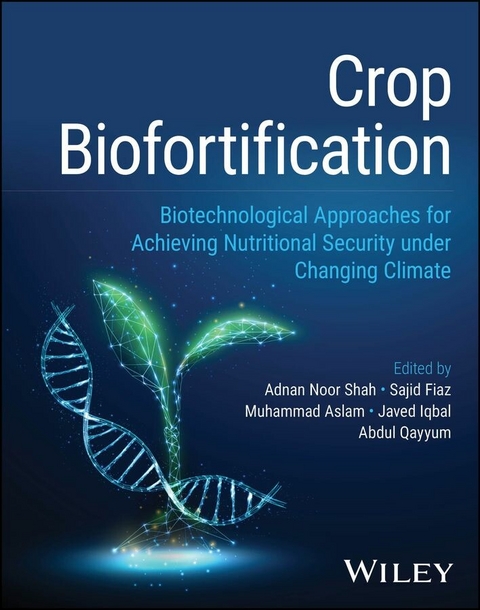
Crop Biofortification (eBook)
499 Seiten
Wiley (Verlag)
978-1-394-27326-3 (ISBN)
Develop more nutritious crops to aid in the fight against world hunger with this timely volume
One in nine people worldwide suffer from hunger or food scarcity. Massively increasing food production is one of the most urgent scientific projects in the modern world, particularly as a changing climate places increasing pressure on the global food supply and on sustainable food production processes. Biofortification is a process in which plant breeding, improved agronomic practices, and/or modern biotechnology are employed to increase nutrient density of crops without sacrificing any of their desirable characteristics. It's an essential tool in the global fight against hunger.
Crop Biofortification offers an up-to-the-minute overview of this essential subject and its recent advances. It covers all the latest methodologies and techniques deployed in biofortification, as well as surveying plant responses to genetically induced biofortification and the effect of climate change on biofortified crops. Designed to allow for the application of these techniques at the field level, it's a significant contribution towards the search for a sustainable global food supply.
Crop Biofortification readers will also find:
- Presentation of recent advances in omics, particularly metabolomics, which can decipher potential changes in plants caused by biofortification
- Detailed discussion of methods for increasing the nutritional content of edible plants to address specific nutritional deficiencies
- Contributions towards a road map for increasing global food production by 70% before the year 2050
Crop Biofortification is ideal for researchers, policymakers, and professionals interested in the potential biofortification of crop plants, as well as graduate and advanced undergraduate students in agronomy, plant physiology, plant breeding and genetics, agricultural biotechnology, and related fields.
Adnan Noor Shah, is Assistant Professor in the Department of Agricultural Engineering, Khwaja Fareed University of Engineering and Information Technology, Punjab, Pakistan. He specializes in nitrogen metabolism and efficient utilization of nitrogen fertilizers by crop plants, and serves as editor for multiple leading plant science and agronomy journals.
Sajid Fiaz, is Assistant Professor in the Institute of Molecular Biology and Biotechnology, University of Lahore, Pakistan. His research focuses on the development of high-quality rice through genome editing, as well as multi-omics approaches for improving plant traits.
Muhammad Aslam, is Associate Professor in the Department of Plant Breeding and Genetics, Faculty of Agriculture, University of Agriculture, Faisalabad, Pakistan. His research focuses on the development of maize and maize hybrids.
Javed Iqbal, is Assistant Professor in the Department of Botany, Bacha Khan University, Khyber Pakhtunkhwa, Pakistan. His research group focuses on developing eco-friendly and sustainable avenues for synthesizing novel functional nanomaterials from medicinal plants.
Abdul Qayyum, is Assistant Professor in the Department of Agronomy, University of Haripur, Pakistan. His research focuses on plant physiology, the improvement of agronomic traits through selection, plant nutrition, and related subjects.
Develop more nutritious crops to aid in the fight against world hunger with this timely volume One in nine people worldwide suffer from hunger or food scarcity. Massively increasing food production is one of the most urgent scientific projects in the modern world, particularly as a changing climate places increasing pressure on the global food supply and on sustainable food production processes. Biofortification is a process in which plant breeding, improved agronomic practices, and/or modern biotechnology are employed to increase nutrient density of crops without sacrificing any of their desirable characteristics. It s an essential tool in the global fight against hunger. Crop Biofortification offers an up-to-the-minute overview of this essential subject and its recent advances. It covers all the latest methodologies and techniques deployed in biofortification, as well as surveying plant responses to genetically induced biofortification and the effect of climate change on biofortified crops. Designed to allow for the application of these techniques at the field level, it s a significant contribution towards the search for a sustainable global food supply. Crop Biofortification readers will also find: Presentation of recent advances in omics, particularly metabolomics, which can decipher potential changes in plants caused by biofortificationDetailed discussion of methods for increasing the nutritional content of edible plants to address specific nutritional deficienciesContributions towards a road map for increasing global food production by 70% before the year 2050 Crop Biofortification is ideal for researchers, policymakers, and professionals interested in the potential biofortification of crop plants, as well as graduate and advanced undergraduate students in agronomy, plant physiology, plant breeding and genetics, agricultural biotechnology, and related fields.
| Erscheint lt. Verlag | 10.3.2025 |
|---|---|
| Sprache | englisch |
| Themenwelt | Naturwissenschaften ► Biologie |
| Weitere Fachgebiete ► Land- / Forstwirtschaft / Fischerei | |
| Schlagworte | Agricultural biotechnology • Agronomy • biochemistry • food security • Genetic Engineering • Genome editing • Metabolomics • mineral biofortification • Mineral malnutrition • nanoparticles • Plant breeding and genetics • Plant Physiology • Seed Priming |
| ISBN-10 | 1-394-27326-6 / 1394273266 |
| ISBN-13 | 978-1-394-27326-3 / 9781394273263 |
| Informationen gemäß Produktsicherheitsverordnung (GPSR) | |
| Haben Sie eine Frage zum Produkt? |
 PDF (Adobe DRM)
Kopierschutz: Adobe-DRM
Adobe-DRM ist ein Kopierschutz, der das eBook vor Mißbrauch schützen soll. Dabei wird das eBook bereits beim Download auf Ihre persönliche Adobe-ID autorisiert. Lesen können Sie das eBook dann nur auf den Geräten, welche ebenfalls auf Ihre Adobe-ID registriert sind.
Details zum Adobe-DRM
Dateiformat: PDF (Portable Document Format)
Mit einem festen Seitenlayout eignet sich die PDF besonders für Fachbücher mit Spalten, Tabellen und Abbildungen. Eine PDF kann auf fast allen Geräten angezeigt werden, ist aber für kleine Displays (Smartphone, eReader) nur eingeschränkt geeignet.
Systemvoraussetzungen:
PC/Mac: Mit einem PC oder Mac können Sie dieses eBook lesen. Sie benötigen eine
eReader: Dieses eBook kann mit (fast) allen eBook-Readern gelesen werden. Mit dem amazon-Kindle ist es aber nicht kompatibel.
Smartphone/Tablet: Egal ob Apple oder Android, dieses eBook können Sie lesen. Sie benötigen eine
Geräteliste und zusätzliche Hinweise
Buying eBooks from abroad
For tax law reasons we can sell eBooks just within Germany and Switzerland. Regrettably we cannot fulfill eBook-orders from other countries.
aus dem Bereich