


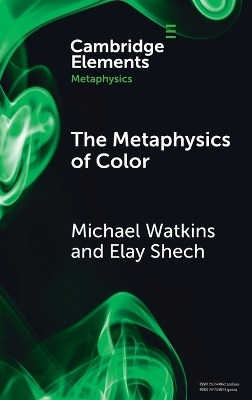
The Metaphysics of Color
Seiten
2025
Cambridge University Press (Verlag)
978-1-009-49444-1 (ISBN)
Cambridge University Press (Verlag)
978-1-009-49444-1 (ISBN)
This Element discusses philosophical issues surrounding color metaphysics, arguing that colors are objective features of our world, independent of our experiences. It challenges, that perceptual variation makes objectivism untenable and that colors are ontologically unnecessary. This title is also available as Open Access on Cambridge Core.
This Element offers an opinionated and selective introduction to philosophical issues concerning the metaphysics of color. The opinion defended is that colors are objective features of our world; objects are colored, and they have those colors independent of how they are experienced. It is a minority opinion. Many philosophers thinking about color experience argue that perceptual variation, the fact that color experiences vary from observer to observer and from viewing condition to viewing condition, makes objectivism untenable. Many philosophers thinking about colors and science argue that colors are ontologically unnecessary; nothing to be explained requires an appeal to colors. A careful look at arguments from perceptual variation shows that those arguments are not compelling, and especially once it is clear how to individuate colors. Moreover, a careful look at scientific explanations shows that colors are explanatorily essential. This title is also available as Open Access on Cambridge Core.
This Element offers an opinionated and selective introduction to philosophical issues concerning the metaphysics of color. The opinion defended is that colors are objective features of our world; objects are colored, and they have those colors independent of how they are experienced. It is a minority opinion. Many philosophers thinking about color experience argue that perceptual variation, the fact that color experiences vary from observer to observer and from viewing condition to viewing condition, makes objectivism untenable. Many philosophers thinking about colors and science argue that colors are ontologically unnecessary; nothing to be explained requires an appeal to colors. A careful look at arguments from perceptual variation shows that those arguments are not compelling, and especially once it is clear how to individuate colors. Moreover, a careful look at scientific explanations shows that colors are explanatorily essential. This title is also available as Open Access on Cambridge Core.
1. Into the Rabbit hole: why colors seem so challenging; 2. A brief history of the problem and possible solutions; 3. Out of the Rabbit hole; 4. Reweaving the rainbow; 5. Realism in the Metaphysics of Science; 6. Conclusion; References.
| Erscheinungsdatum | 10.04.2025 |
|---|---|
| Reihe/Serie | Elements in Metaphysics |
| Zusatzinfo | Worked examples or Exercises |
| Verlagsort | Cambridge |
| Sprache | englisch |
| Themenwelt | Kunst / Musik / Theater |
| Geisteswissenschaften ► Philosophie ► Metaphysik / Ontologie | |
| Naturwissenschaften | |
| ISBN-10 | 1-009-49444-9 / 1009494449 |
| ISBN-13 | 978-1-009-49444-1 / 9781009494441 |
| Zustand | Neuware |
| Informationen gemäß Produktsicherheitsverordnung (GPSR) | |
| Haben Sie eine Frage zum Produkt? |
Mehr entdecken
aus dem Bereich



aus dem Bereich
eine philosophische Reise
Buch | Softcover (2024)
Goldmann (Verlag)
CHF 21,90


