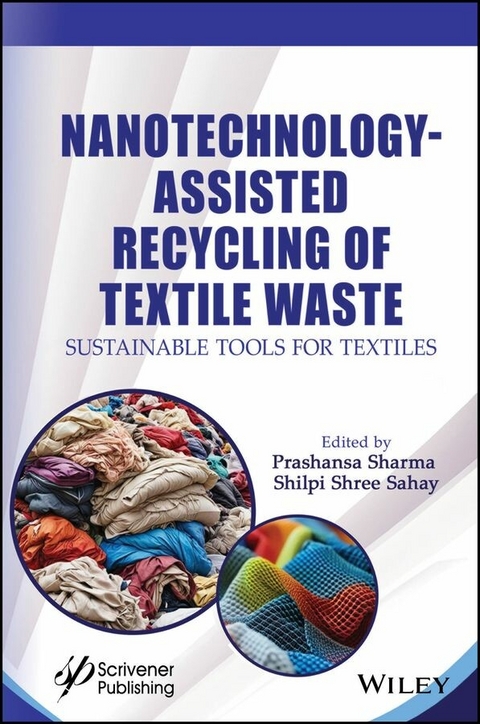
Nanotechnology-Assisted Recycling of Textile Waste (eBook)
756 Seiten
Wiley-Scrivener (Verlag)
978-1-394-17499-7 (ISBN)
Discover how innovative nanotechnology can turn waste into opportunity, offering insights and strategies to create a greener, more eco-friendly textile industry.
This book investigates nanotechnology-assisted sustainable solutions and their potential to transform waste into opportunity by fostering innovative designs and in-depth knowledge of sustainable waste management and nanotechnology applications.
Divided into four comprehensive parts, comprising 16 chapters, Nanotechnology Assisted Recycling of Textile Waste, provides insights into the potential of nanotechnology in revolutionizing textile recycling and shaping the future of sustainable textiles.
Part I sets the stage with an insightful overview of textile waste and management, exploring the conceptual dimensions and challenges in handling and organizing textile waste. It also describes the innovative realm of textile recycling. In Part II, the spotlight shines on comprehensive, sustainable, and productive recycling of waste using nanotechnology. Here, readers are invited to explore the transformative contributions of nanotechnology in shaping sustainable textile design and characterizing functional properties of novel recycled nano-textiles. Future perspectives of nanotechnology in textile applications, particularly concerning waste recycling, are also examined. Part III explores deeper into the advanced application of recycled and nano-assisted novel textiles generated through waste. From sports textiles to technical textiles, this section explores the diverse applications of recycled waste, bolstered by nano-engineered innovations. Finally, Part IV addresses the critical aspects of quality control and regulatory compliance in the realm of advanced nano-textile materials through an exploration of global legislation, schemes, and standards.
Readers will find in this book:
- research findings and innovative approaches to cope with the challenges and issues of textile waste;
- systematic and scientific knowledge on textile waste recycling techniques using nanotechnology;
- knowledge of complex scientific research findings in a simple and understandable form;
- comprehensive coverage of a broad range of topics, including sustainable textile waste management.
Audience
The book will be read by a range of researchers, engineers and students in technical textiles, textile technology and engineering, textile chemistry, fiber science, textile processing technologies and manufacturing, fashion and apparel technology, materials science, environmental science. This book will help designers and clothing manufacturers, and all those in textile and environmental domains, who are engaged in waste management.
Prashansa Sharma, PhD, is an assistant professor in the Department of Home Science, MMV, Banaras Hindu University, Varanasi, Uttar Pradesh, India. With over ten years of experience in both teaching and research, her areas of expertise encompass nano-textiles, green synthesis, and the application of nanotechnology in textiles. She has contributed significantly to her field with numerous research papers, books, and book chapters.
Shilpi Shree Sahay works in the Department of Home Science, Banaras Hindu University, Varanasi, Uttar Pradesh, India. She specializes in clothing and textiles, focusing on nano-textile science and eco-friendly textile finishing. With a master's degree from BHU, her research interests include developing nanoparticles and enhancing textile functionality.
Discover how innovative nanotechnology can turn waste into opportunity, offering insights and strategies to create a greener, more eco-friendly textile industry. This book investigates nanotechnology-assisted sustainable solutions and their potential to transform waste into opportunity by fostering innovative designs and in-depth knowledge of sustainable waste management and nanotechnology applications. Divided into four comprehensive parts, comprising 16 chapters, Nanotechnology Assisted Recycling of Textile Waste, provides insights into the potential of nanotechnology in revolutionizing textile recycling and shaping the future of sustainable textiles. Part I sets the stage with an insightful overview of textile waste and management, exploring the conceptual dimensions and challenges in handling and organizing textile waste. It also describes the innovative realm of textile recycling. In Part II, the spotlight shines on comprehensive, sustainable, and productive recycling of waste using nanotechnology. Here, readers are invited to explore the transformative contributions of nanotechnology in shaping sustainable textile design and characterizing functional properties of novel recycled nano-textiles. Future perspectives of nanotechnology in textile applications, particularly concerning waste recycling, are also examined. Part III explores deeper into the advanced application of recycled and nano-assisted novel textiles generated through waste. From sports textiles to technical textiles, this section explores the diverse applications of recycled waste, bolstered by nano-engineered innovations. Finally, Part IV addresses the critical aspects of quality control and regulatory compliance in the realm of advanced nano-textile materials through an exploration of global legislation, schemes, and standards. Readers will find in this book: research findings and innovative approaches to cope with the challenges and issues of textile waste; systematic and scientific knowledge on textile waste recycling techniques using nanotechnology; knowledge of complex scientific research findings in a simple and understandable form; comprehensive coverage of a broad range of topics, including sustainable textile waste management. Audience The book will be read by a range of researchers, engineers and students in technical textiles, textile technology and engineering, textile chemistry, fiber science, textile processing technologies and manufacturing, fashion and apparel technology, materials science, environmental science. This book will help designers and clothing manufacturers, and all those in textile and environmental domains, who are engaged in waste management.
1
Overview of Textile Waste
Amisha Singh, Shilpi Shree Sahay and Prashansa Sharma*
Department of Home Science (Clothing and Textile), MMV, Banaras Hindu University, Varanasi, U.P., India
Abstract
The textile sector is one of the oldest sectors. After food, clothing comes as the next primary human necessity. Rapid population growth encourages the textile sector to boost production to meet the demand for clothing and apparel, which leads to a significant amount of textile waste. The resulting waste is handled via landfilling or incineration procedures, both of which have a detrimental environmental impact. A significant volume of textile effluent is produced through wet processing because it uses a lot of water and chemicals. When textile waste is dumped on the ground or in water sources, it contaminates both the land and the water bodies. The improper disposal of textile waste leads to soil and water pollution.
By using effective waste management techniques, it is possible to reduce environmental contamination and thus establish a circular economy by turning waste into valuable goods. The present paper provides a thorough description of the various types and categories of textile waste and effluents, as well as the sources that produce them. This paper also discusses the major causes of textile waste and also highlights the impact of textile waste on the environment and human health. This study examines diverse textile processing steps along with a wide range of pollutants produced during textile processing and their toxic effects on weavers, employees, and the environment (air pollution, soil pollution, water, and noise pollution).
Keywords: Textiles, waste, fiber, production, pollution, environmental hazard, clothing
List of Abbreviations
| CAGR | Compound annual growth rate |
| CO2 | Carbon dioxide |
| PET | Polyethylene terephthalate |
| BOD | Biochemical oxygen demand |
| COD | Chemical oxygen demand |
| PVA | Polyvinyl alcohol |
| VOCs | Volatile organic compounds |
| TDS | Total dissolved solids |
| GHG | Greenhouse gases |
| CMW | COVID-19 medical waste |
| PPE | Personal protective equipment |
| OEF | Organization environmental footprint |
| PEF | Product environmental footprint |
| REACH | Registration, evaluation, authorization, and restriction of chemical |
| 5R | Refuse, reduce, reuse, recycle, and recover |
1.1 Introduction
Fabrics and fibers have been integral to human existence since ancient time, serving as the fundamental elements of clothing. Today, textiles play diverse roles from shielding the body against weather conditions to symbolizing social status and expressing individual style all while keeping pace with evolving trends. With market values of almost USD 1.3 trillion and employment opportunities for over 300 million people along the whole value chain, the textile industry is one of the largest and oldest industries in existence [1]. The dominant industry for clothing and apparel is the textile sector, which is regarded as a key sector for consumer goods. Over the past few decades, fast population expansion, rising global incomes, and improved living standards have all enabled an increase in both clothing manufacturing and demand. The average yearly consumption of textiles has increased by two times in the last two decades, from 7 to 13 kg per person, and reached the maximum amount of 100 million tons worldwide [2].
In the present era, Clothes are designed and produced for rapid trend transitions via depreciation, early disposal, and discard, which facilitates fast income, instead of considering how design and production might accommodate consumer needs and lead toward sustainability. By 2025, the textile industry’s demand for textile fibers is anticipated to grow, by around 400%, to reach 130 million tons, with an annual growth rate of 4.3% [3].
Between 2025 and 2026, the Indian textile and apparel market is forecasted to expand by a Compound annual growth rate (CAGR) of 10%, reaching over US$190 billion. India holds a 4% share in the global textile and clothing trade, and it is the leading producer of cotton worldwide. In the 2021–2022 cotton season, approximately 362.18 lakh bales were harvested, with an anticipated domestic consumption of 338 lakh bales. By 2030, India’s cotton production is expected to rise to 7.2 million tons (around 43 million bales of 170 kg each) due to increasing consumer demand. [4] As can be shown from statistics, as demand grew, the manufacturing sector developed, and mechanized manufacturing techniques acquired the place of manual labor incentive systems. This enabled to manufacture textiles at affordable prices along with higher productivity and a wide range of variety. This has led to an excessive stock of economical, mass-produced products that tend to low quality as well as a significant amount of textile fiber waste, having restricted end uses.
One of the most intricate and harmful industries is the textile sector. This is challenging because it entails a very extensive and diverse procedure, including raw material production, fabrication of textiles, apparel development, transportation, and waste disposal. It is polluting because a significant amount of waste is generated while manufacturing and consuming it. The processing and manufacturing procedure of textile materials such as the harvesting, extraction; agriculture; process to make fiber, fiber to yarn, and yarn to fabric; wet-processing of fiber or fabric; blow room; carding; draw frame; combing; roving frame; ring frame; spinning process sequences; weaving/knitting, dyeing/printing, and finishing steps; and transportation are additionally required an excessive number of natural resources and non-renewable resources. Aspects related to the environmental impact of fiber production and the subsequent disposal activities have also become more prominent as the demand for fabrics has increased. Several recent studies highlighted the threat and hazard the textile industry generates due to the use of large volumes of industrially dangerous and toxic chemicals during the manufacturing process and the discharge of pollutants during the lifecycle of a textile product in aquatic systems and the atmospheric micro-system. The textiles industry emits over 1.2 billion tons of greenhouse gas (GHG) emissions (more than all of the emissions from international flights and maritime shipping combined). Sixty-three percent of textile fibers are composed of petrochemicals, whose manufacture and disposal result in significant carbon dioxide (CO2) emissions [5]. One of the top three industries for water waste is the textile industry, which severely degrades freshwater supplies. For the production of one pair of jeans and one single t-shirt, respectively, approximately 8,500 and 2,600 liters of water are needed [6]. The mean lifespan of a piece of fabric is approximately 3 years, and more than one million tons of textile materials are discarded annually, the majority of which comes from domestic sources. About 3% of the total volume of residential waste is made up of textiles. Currently, about 80%–90% of textile waste produced is no longer biodegradable because it consists of polyester, which contains PET (polyethylene terephthalate). Compared to natural fibers, synthetic materials are non–eco-friendly and non-biodegradable. Developing nations produce more than 60% of the world’s apparel. The world’s leading producer of apparel today, accounting for over 32% of global exports, is Asia. The global supply is generated by arranging raw materials and finished products in shipping containers and then transported by rail and vehicles. The health and well-being of people living in coastal and rural regions around the world are commencing to be impacted by marine shipping pollution, which has expanded dramatically over the preceding 20 years. Because there is insufficient information and details available regarding the quality of the discarded textiles, it is difficult to determine whether they can be recycled, transformed, reduced, and recovered or should simply be disposed of and discarded as waste materials. Therefore, it becomes essential to inquire into how textile waste is managed in the most environment-friendly manner [7].
Waste
Waste is defined as any material or goods that has reached the end of its shelf life. They are considered a challenge because they degrade and diminish precious resources, the environment, and human health; occupy landfill space; and increase the expense of using current landfills and building new ones.
1.2 Textile Waste
Textiles perform a variety of purposes and are constructed from a variety of fiber types, blended in a range of ratios. Three classes—apparel, home furnishings, and industrial—can be used for classifying the applications of fiber. Growing product consumption is an indication of rising waste production globally, which prompted greater social responsibility and...
| Erscheint lt. Verlag | 27.2.2025 |
|---|---|
| Sprache | englisch |
| Themenwelt | Naturwissenschaften ► Chemie |
| Schlagworte | Applications • challenges • Material • nanomaterials • nanoparticles • nanotechnology • Properties • Recycled Textile • Recycling • sustainability • Technical Textiles • textile industry • Textiles • Waste • waste management |
| ISBN-10 | 1-394-17499-3 / 1394174993 |
| ISBN-13 | 978-1-394-17499-7 / 9781394174997 |
| Informationen gemäß Produktsicherheitsverordnung (GPSR) | |
| Haben Sie eine Frage zum Produkt? |
 EPUB (Adobe DRM)
Kopierschutz: Adobe-DRM
Adobe-DRM ist ein Kopierschutz, der das eBook vor Mißbrauch schützen soll. Dabei wird das eBook bereits beim Download auf Ihre persönliche Adobe-ID autorisiert. Lesen können Sie das eBook dann nur auf den Geräten, welche ebenfalls auf Ihre Adobe-ID registriert sind.
Details zum Adobe-DRM
Dateiformat: EPUB (Electronic Publication)
EPUB ist ein offener Standard für eBooks und eignet sich besonders zur Darstellung von Belletristik und Sachbüchern. Der Fließtext wird dynamisch an die Display- und Schriftgröße angepasst. Auch für mobile Lesegeräte ist EPUB daher gut geeignet.
Systemvoraussetzungen:
PC/Mac: Mit einem PC oder Mac können Sie dieses eBook lesen. Sie benötigen eine
eReader: Dieses eBook kann mit (fast) allen eBook-Readern gelesen werden. Mit dem amazon-Kindle ist es aber nicht kompatibel.
Smartphone/Tablet: Egal ob Apple oder Android, dieses eBook können Sie lesen. Sie benötigen eine
Geräteliste und zusätzliche Hinweise
Buying eBooks from abroad
For tax law reasons we can sell eBooks just within Germany and Switzerland. Regrettably we cannot fulfill eBook-orders from other countries.
aus dem Bereich