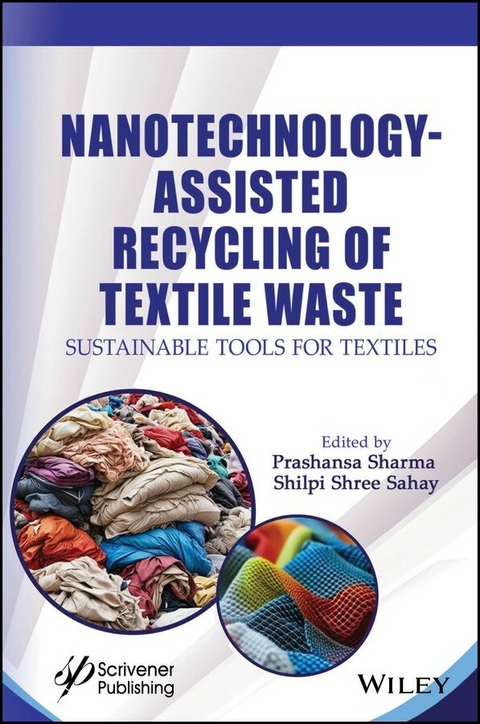
Nanotechnology-Assisted Recycling of Textile Waste (eBook)
526 Seiten
Wiley-Scrivener (Verlag)
978-1-394-17500-0 (ISBN)
Discover how innovative nanotechnology can turn waste into opportunity, offering insights and strategies to create a greener, more eco-friendly textile industry.
This book investigates nanotechnology-assisted sustainable solutions and their potential to transform waste into opportunity by fostering innovative designs and in-depth knowledge of sustainable waste management and nanotechnology applications.
Divided into four comprehensive parts, comprising 16 chapters, Nanotechnology Assisted Recycling of Textile Waste, provides insights into the potential of nanotechnology in revolutionizing textile recycling and shaping the future of sustainable textiles.
Part I sets the stage with an insightful overview of textile waste and management, exploring the conceptual dimensions and challenges in handling and organizing textile waste. It also describes the innovative realm of textile recycling. In Part II, the spotlight shines on comprehensive, sustainable, and productive recycling of waste using nanotechnology. Here, readers are invited to explore the transformative contributions of nanotechnology in shaping sustainable textile design and characterizing functional properties of novel recycled nano-textiles. Future perspectives of nanotechnology in textile applications, particularly concerning waste recycling, are also examined. Part III explores deeper into the advanced application of recycled and nano-assisted novel textiles generated through waste. From sports textiles to technical textiles, this section explores the diverse applications of recycled waste, bolstered by nano-engineered innovations. Finally, Part IV addresses the critical aspects of quality control and regulatory compliance in the realm of advanced nano-textile materials through an exploration of global legislation, schemes, and standards.
Readers will find in this book:
- research findings and innovative approaches to cope with the challenges and issues of textile waste;
- systematic and scientific knowledge on textile waste recycling techniques using nanotechnology;
- knowledge of complex scientific research findings in a simple and understandable form;
- comprehensive coverage of a broad range of topics, including sustainable textile waste management.
Audience
The book will be read by a range of researchers, engineers and students in technical textiles, textile technology and engineering, textile chemistry, fiber science, textile processing technologies and manufacturing, fashion and apparel technology, materials science, environmental science. This book will help designers and clothing manufacturers, and all those in textile and environmental domains, who are engaged in waste management.
Prashansa Sharma, PhD, is an assistant professor in the Department of Home Science, MMV, Banaras Hindu University, Varanasi, Uttar Pradesh, India. With over ten years of experience in both teaching and research, her areas of expertise encompass nano-textiles, green synthesis, and the application of nanotechnology in textiles. She has contributed significantly to her field with numerous research papers, books, and book chapters.
Shilpi Shree Sahay works in the Department of Home Science, Banaras Hindu University, Varanasi, Uttar Pradesh, India. She specializes in clothing and textiles, focusing on nano-textile science and eco-friendly textile finishing. With a master's degree from BHU, her research interests include developing nanoparticles and enhancing textile functionality.
Discover how innovative nanotechnology can turn waste into opportunity, offering insights and strategies to create a greener, more eco-friendly textile industry. This book investigates nanotechnology-assisted sustainable solutions and their potential to transform waste into opportunity by fostering innovative designs and in-depth knowledge of sustainable waste management and nanotechnology applications. Divided into four comprehensive parts, comprising 16 chapters, Nanotechnology Assisted Recycling of Textile Waste, provides insights into the potential of nanotechnology in revolutionizing textile recycling and shaping the future of sustainable textiles. Part I sets the stage with an insightful overview of textile waste and management, exploring the conceptual dimensions and challenges in handling and organizing textile waste. It also describes the innovative realm of textile recycling. In Part II, the spotlight shines on comprehensive, sustainable, and productive recycling of waste using nanotechnology. Here, readers are invited to explore the transformative contributions of nanotechnology in shaping sustainable textile design and characterizing functional properties of novel recycled nano-textiles. Future perspectives of nanotechnology in textile applications, particularly concerning waste recycling, are also examined. Part III explores deeper into the advanced application of recycled and nano-assisted novel textiles generated through waste. From sports textiles to technical textiles, this section explores the diverse applications of recycled waste, bolstered by nano-engineered innovations. Finally, Part IV addresses the critical aspects of quality control and regulatory compliance in the realm of advanced nano-textile materials through an exploration of global legislation, schemes, and standards. Readers will find in this book: research findings and innovative approaches to cope with the challenges and issues of textile waste; systematic and scientific knowledge on textile waste recycling techniques using nanotechnology; knowledge of complex scientific research findings in a simple and understandable form; comprehensive coverage of a broad range of topics, including sustainable textile waste management. Audience The book will be read by a range of researchers, engineers and students in technical textiles, textile technology and engineering, textile chemistry, fiber science, textile processing technologies and manufacturing, fashion and apparel technology, materials science, environmental science. This book will help designers and clothing manufacturers, and all those in textile and environmental domains, who are engaged in waste management.
| Erscheint lt. Verlag | 19.2.2025 |
|---|---|
| Sprache | englisch |
| Themenwelt | Naturwissenschaften ► Chemie |
| Schlagworte | Applications • challenges • Material • nanomaterials • nanoparticles • nanotechnology • Properties • Recycled Textile • Recycling • sustainability • Technical Textiles • textile industry • Textiles • Waste • waste management |
| ISBN-10 | 1-394-17500-0 / 1394175000 |
| ISBN-13 | 978-1-394-17500-0 / 9781394175000 |
| Informationen gemäß Produktsicherheitsverordnung (GPSR) | |
| Haben Sie eine Frage zum Produkt? |
 PDF (Adobe DRM)
Kopierschutz: Adobe-DRM
Adobe-DRM ist ein Kopierschutz, der das eBook vor Mißbrauch schützen soll. Dabei wird das eBook bereits beim Download auf Ihre persönliche Adobe-ID autorisiert. Lesen können Sie das eBook dann nur auf den Geräten, welche ebenfalls auf Ihre Adobe-ID registriert sind.
Details zum Adobe-DRM
Dateiformat: PDF (Portable Document Format)
Mit einem festen Seitenlayout eignet sich die PDF besonders für Fachbücher mit Spalten, Tabellen und Abbildungen. Eine PDF kann auf fast allen Geräten angezeigt werden, ist aber für kleine Displays (Smartphone, eReader) nur eingeschränkt geeignet.
Systemvoraussetzungen:
PC/Mac: Mit einem PC oder Mac können Sie dieses eBook lesen. Sie benötigen eine
eReader: Dieses eBook kann mit (fast) allen eBook-Readern gelesen werden. Mit dem amazon-Kindle ist es aber nicht kompatibel.
Smartphone/Tablet: Egal ob Apple oder Android, dieses eBook können Sie lesen. Sie benötigen eine
Geräteliste und zusätzliche Hinweise
Buying eBooks from abroad
For tax law reasons we can sell eBooks just within Germany and Switzerland. Regrettably we cannot fulfill eBook-orders from other countries.
aus dem Bereich