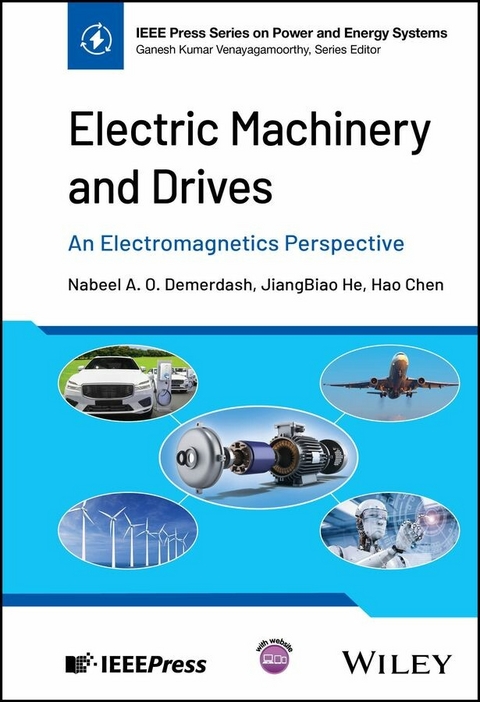
Electric Machinery and Drives (eBook)
923 Seiten
Wiley-IEEE Press (Verlag)
978-1-119-98554-9 (ISBN)
Comprehensive resource on the fundamentals of electric machinery and variable speed drives, and their many conventional and emerging applications
Electric Machinery and Drives: An Electromagnetics Perspective provides advanced concepts of electrical machinery with control/drives and emphasizes the necessity of integration of power electronics and control strategy when studying modern electrical machinery. The text incorporates the fundamentals of electric machinery, variable speed drives, and motor controls, with the scope of including both the introduction of detailed operating principles as well as the electromagnetic design and control details from scratch.
The authors start with the introduction of electric circuit notations and elementary concepts of electrical circuits, power electronics, magnetostatics, magnetic circuits, and fundamentals of electromechanical energy conversion. Later, the book elaborates on the operating principles of polyphase induction machines and synchronous machines, as well as the associated scale and vector controls of these machines.
To aid in reader comprehension, the text includes a solutions manual and accompanying video animations.
Electric Machinery and Drives also contains information on:
- Real and reactive power in single-phase and balanced three-phase circuits and devices using consumer system concepts and notations
- Forces and torques in simple magnetically linear and nonlinear, multi-excited electromechanical devices and systems
- Simplified T-equivalent circuit model and its use in performance calculations of induction machines and associated torque-slip (speed) characteristics
- Brush-commutator and brushless DC machines, and natural ABC frame and Park's two-reaction DQO frame state-space modeling of synchronous and induction machines
- Special machines, including single-phase induction machines, switched reluctance machines, and others
Electric Machinery and Drives is an ideal learning resource in undergraduate or graduate-level courses for all universities with electrical engineering programs across the world. Additionally, the text may be used as a fundamental reference by researchers and engineers in electrical, mechanical, automotive, aerospace, and automation engineering.
Nabeel A. O. Demerdash, PhD, IEEE Life Fellow, the recipient of the 1999 IEEE Nicola Tesla Technical Field Award, is an emeritus Professor in electrical engineering and the Director of the SEMPEED Consortium at Marquette University, USA. He has over 50 years of teaching and research experience in electric machines and drives in U.S. academia. He is the author and/or co-author of more than 250 technical articles, including more than 150 papers published in various IEEE Transactions and journals.
JiangBiao He, PhD, IEEE Senior Member, is an Associate Professor in Electrical Engineering at the University of Tennessee, Knoxville, USA. Previously, he was an Associate Professor at the University of Kentucky. Before he joined academia in 2019, he worked in multiple large industry R&D centers, most recently as a Lead Engineer at GE Global Research, Niskayuna, New York. His research interests include motor-drive systems and power electronic converters. He has authored and co-authored over 150 technical articles in IEEE journals and conferences, in addition to 10 granted patents.
Hao Chen, PhD, IEEE Senior Member, is an Associate Professor (Pre-Tenure) with the College of Electrical Engineering, Zhejiang University, Hangzhou, China. From 2016 to 2018, he was with the Department of Electrical and Computer Engineering, Marquette University, Milwaukee, WI, USA, as a Joint PhD Student. From 2019 to 2021, he was a Postdoctoral Research Fellow with the School of Electrical and Electronic Engineering, Nanyang Technological University, Singapore. From 2022 to 2023, he was a Researcher with the Department of Electrical Engineering, Chalmers University of Technology, Gothenburg, Sweden. His research interests include design and optimization of electric machines, power electronic drives, and motor controls. He has published over 50 papers in IEEE journals and conferences.
Comprehensive resource on the fundamentals of electric machinery and variable speed drives, and their many conventional and emerging applications Electric Machinery and Drives: An Electromagnetics Perspective provides advanced concepts of electrical machinery with control/drives and emphasizes the necessity of integration of power electronics and control strategy when studying modern electrical machinery. The text incorporates the fundamentals of electric machinery, variable speed drives, and motor controls, with the scope of including both the introduction of detailed operating principles as well as the electromagnetic design and control details from scratch. The authors start with the introduction of electric circuit notations and elementary concepts of electrical circuits, power electronics, magnetostatics, magnetic circuits, and fundamentals of electromechanical energy conversion. Later, the book elaborates on the operating principles of polyphase induction machines and synchronous machines, as well as the associated scale and vector controls of these machines. To aid in reader comprehension, the text includes a solutions manual and accompanying video animations. Electric Machinery and Drives also contains information on: Real and reactive power in single-phase and balanced three-phase circuits and devices using consumer system concepts and notationsForces and torques in simple magnetically linear and nonlinear, multi-excited electromechanical devices and systemsSimplified T-equivalent circuit model and its use in performance calculations of induction machines and associated torque-slip (speed) characteristicsBrush-commutator and brushless DC machines, and natural ABC frame and Park s two-reaction DQO frame state-space modeling of synchronous and induction machinesSpecial machines, including single-phase induction machines, switched reluctance machines, and others Electric Machinery and Drives is an ideal learning resource in undergraduate or graduate-level courses for all universities with electrical engineering programs across the world. Additionally, the text may be used as a fundamental reference by researchers and engineers in electrical, mechanical, automotive, aerospace, and automation engineering.
1
Electric Circuit Notations and Elementary Concepts
In this introductory chapter, we start by defining the electric circuit notations and elementary circuit concepts, including symbolisms used in representation of time‐domain and AC phasor variables, such as voltage and currents, used throughout Chapters 1–12 of this textbook. These include multivariable arrays, the so‐called vectors in matrix linear‐algebra parlance, as well as concepts of time‐domain instantaneous power and complex power in AC phasor formulation of electric circuits.
A basic and fundamental complex‐algebra concept to all that will follow is the well‐known Euler formulation that yields the following identities:
and
With these identities, Eqs. (1.1)–(1.3), we are ready to discuss frequency‐domain root mean square (RMS) phasor representation of time‐domain AC voltages and currents.
1.1 Frequency‐Domain RMS Phasor Representation of Time‐Domain AC Voltages and Currents
Here, lower‐case variables (symbols) such as v, i, e, and p stand for time‐domain voltages, currents, electromotive forces (emfs), and real powers, respectively. Also here, upper‐case variables (symbols) such as, V, I, E, and P stand for RMS magnitudes (absolute values) of voltage phasors, current phasors, emf phasors, and average real power in phasor complex power computations, respectively. Meanwhile, variables (symbols) such as , , , and stand for RMS phasor complex form voltages, currents, emfs, and complex power (real and reactive) in phasor complex power computations, respectively.
Accordingly, in steady‐state AC circuit analysis, one can write the following:
where V is the RMS AC voltage magnitude (absolute value), ω = (2πf) is the angular frequency in electrical radians per second, f is the AC frequency in Hertz, t is the time in seconds, and φ is the phase angle of the voltage signal.
Hence, based on the Euler identities given earlier, Eqs. (1.1)–(1.3), one can rewrite v(t) as follows:
or
In AC phasor form, the term (ejωt) is common to all voltage, current, and other signals. Hence, all the information that is needed is in terms (V) and (ejφ). Hence, in RMS phasor notation, the voltage, , can be written as follows in exponential phasor form:
or in Cartesian coordinate polar and rectangular complex forms as follows:
Similarly, for an instantaneous steady‐state time‐domain, current, i(t), given by the following equation:
The corresponding Euler formulation gives
and for the corresponding RMS phasor notation, the current, , can be written as follows:
or, in Cartesian coordinate polar and rectangular complex forms, the current, , can be written as follows:
In this text, is the conjugate of the phasor and is the conjugate of the phasor . Therefore,
and
1.2 Time‐Domain and RMS Frequency‐Domain Power Concepts Using Consumer System Formulation and Notations
Consider the two‐terminal “system or device” shown in Figure 1.1. The current i (or ) is taken to be flowing in a positive orientation when flowing into the terminal designated with a positive voltage polarity, v (or ). In such a case, the instantaneous input power, p(t), is given by the following:
where a positive p(t) means that real power (watts) is being consumed and a negative p(t) means that real power (watts) is being generated.
Figure 1.1 A summary graphical and formulation representation of the consumer system in the time‐domain and frequency‐domain phasor power computation.
Meanwhile, in phasor frequency‐domain, the complex power, , is given by the following:
where P is the real power in watts and Q is the reactive power in vars, and once again, P is positive means that watts is being consumed (as in a motoring mode) and P is negative means that watts is being generated (as in a generating mode), and Q is the reactive power in vars, in which Q is positive means that vars is being consumed (as in inductive loads) and Q is negative means that vars is being generated (as in capacitive loads). The reader is urged to examine the complex powers, , , , and , associated with the current phasors, , , , and , respectively, relative to the terminal voltage phasor, , associated with the two‐terminal system (or device), shown in Figure 1.1.
In the Consumer System Notation:
- Positive p(t) means watts is consumed (load/motoring).
- Negative p(t) means watts is generated (generator/source).
Now, for a multiterminal (or port), n, system (or device), the voltages can be written in matrix/array (vector) form in the time‐domain, , or phasor frequency‐domain, , respectively, as follows:
and
Similarly, the currents can be written in matrix/array (vector) form in the time‐domain, , or phasor frequency‐domain, , respectively, as follows:
and
Therefore, the instantaneous time‐domain power, p(t), can be written as follows in an n‐polyphase device:
where is the transpose of .
Meanwhile, the frequency‐domain phasor computation of the complex power, , can be written as follows:
That is,
where is the transpose of .
1.3 Elementary Concepts of Complex Real and Reactive Power in Balanced Three‐Phase Circuits and Devices Using Consumer System Notations
A balanced three‐phase set of current phasors, , , and , is shown in Figure 1.2. We will always assume counterclockwise rotation for such phasor diagrams throughout this textbook, unless it is explicitly stated otherwise. Accordingly, for an “observer” located at the star‐point in this diagram, the observer will see an a, b, c, a, b, c, … sequence, that is, a positive (+) sequence as designated in this figure. Meanwhile, if the rotation of this phasor diagram is reversed to a clockwise orientation, the sequence would become an a, c, b, a, c, b, … one, that is, a negative (−) sequence.
Figure 1.2 A balanced three‐phase set of current phasors, , , and , and the concepts of positive a, b, c and negative a, c, b sequencing.
If one would interchange the locations of the and phasors, as shown in Figure 1.3, and still preserve the counterclockwise rotation and the location of the star‐point “observer,” the result will be an a, c, b, a, c, b, … sequence. That is, one will be seeing a negative (−) sequence as designated in Figure 1.3.
Figure 1.3 Another approach to negative a, c, b sequencing in balanced three‐phase set of currents, , , and .
Meanwhile, we discuss complex power, , in the context of a balanced three‐phase Y‐connected impedance load with an isolated neutral, n. See Figure 1.4 in which the impedance per‐phase is , and the phase‐currents, , , and , which are also equal to the a, b, c line‐currents as depicted in this figure. Also, given in Figure 1.4 are the formulations for the phase (line‐to‐neutral) voltages, , , and , as well as phase‐currents. The phasor diagram of the voltages depicts the graphical/schematic phasor representation of the line‐to‐line voltages, , , and . Here, one can write the complex power, , as follows:
where P is the real power in watts and Q is the reactive power in vars. Again, here, one can write the following:
and in the case of a balanced three‐phase load, the power factor, PF, is
where the angle, θ, is the power factor angle given by
which is the angle of the impedance per‐phase, , where ; see Figure 1.4. Furthermore, in this balanced...
| Erscheint lt. Verlag | 14.2.2025 |
|---|---|
| Reihe/Serie | IEEE Press Series on Power and Energy Systems |
| Sprache | englisch |
| Themenwelt | Naturwissenschaften ► Physik / Astronomie |
| Technik ► Elektrotechnik / Energietechnik | |
| Schlagworte | Electrical circuits • electric circuit notations • Electric machinery • electromechanical energy conversion • magnetic circuits • magnetostatics • motor controls • polyphase induction machines • Power Electronics • Synchronous Machines • Variable speed drives |
| ISBN-10 | 1-119-98554-4 / 1119985544 |
| ISBN-13 | 978-1-119-98554-9 / 9781119985549 |
| Informationen gemäß Produktsicherheitsverordnung (GPSR) | |
| Haben Sie eine Frage zum Produkt? |
 EPUB (Adobe DRM)
Kopierschutz: Adobe-DRM
Adobe-DRM ist ein Kopierschutz, der das eBook vor Mißbrauch schützen soll. Dabei wird das eBook bereits beim Download auf Ihre persönliche Adobe-ID autorisiert. Lesen können Sie das eBook dann nur auf den Geräten, welche ebenfalls auf Ihre Adobe-ID registriert sind.
Details zum Adobe-DRM
Dateiformat: EPUB (Electronic Publication)
EPUB ist ein offener Standard für eBooks und eignet sich besonders zur Darstellung von Belletristik und Sachbüchern. Der Fließtext wird dynamisch an die Display- und Schriftgröße angepasst. Auch für mobile Lesegeräte ist EPUB daher gut geeignet.
Systemvoraussetzungen:
PC/Mac: Mit einem PC oder Mac können Sie dieses eBook lesen. Sie benötigen eine
eReader: Dieses eBook kann mit (fast) allen eBook-Readern gelesen werden. Mit dem amazon-Kindle ist es aber nicht kompatibel.
Smartphone/Tablet: Egal ob Apple oder Android, dieses eBook können Sie lesen. Sie benötigen eine
Geräteliste und zusätzliche Hinweise
Buying eBooks from abroad
For tax law reasons we can sell eBooks just within Germany and Switzerland. Regrettably we cannot fulfill eBook-orders from other countries.
aus dem Bereich