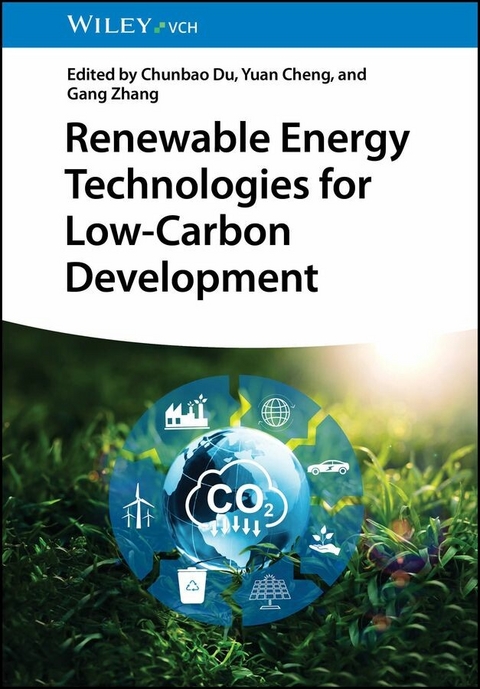
Renewable Energy Technologies for Low-Carbon Development (eBook)
609 Seiten
Wiley-VCH (Verlag)
978-3-527-84354-1 (ISBN)
Summary of cutting-edge research, latest advances, and future directions in low carbon and renewable energy systems
Renewable Energy Technologies for Low-Carbon Development provides a comprehensive overview of recent and cutting-edge research progress in a variety of current renewable energy and low carbon development research areas, focusing on sustainable energy from various perspectives such as thermoelectric power generation, organic solar cells, Na-ion, solar thermochemical energy storage, and nano-friction power generation. The book discusses the methodologies and research development of each renewable energy route based on its unique characteristics.
Following a brief overview of renewable energy, this book also reviews low-carbon research in traditional fossil energy and promotes the development of renewable energy with the sustainable recovery and utilization of carbon. Because of the uniqueness of CO2 in low-carbon development, CO2 storage and application are discussed separately.
Written by three highly qualified authors, Renewable Energy Technologies for Low-Carbon Development explores sample topics including:
- Thermoelectric power generators and their applications, application of nanomaterials in organic solar cells, and advances in low-temperature Na-ion battery energy storage
- Thermochemical energy storage for renewable solar energy utilization, and recent progress and new challenges in triboelectric nanogenerators
- Manufacturing, recovery, and reuse of wind turbine blades in wind power generation and electrocatalysts for oxygen reduction in fuel cells
- Carbon fiber in renewable energy development, sustainable carbon nanofluids of petroleum extraction, and carbon dioxide capture and chemical conversion into fuels
Renewable Energy Technologies for Low-Carbon Development is an essential reference on the subject for materials scientists, power engineers, electrochemists, electronics engineers, and all professionals working at energy supplying companies and in the broader chemical industry.
Dr. Chunbao Du is an associate professor at Yangtze Delta Region Academy of Beijing Institute of Technology, Jiaxing, China.
Prof. Yuan Cheng worked at Monash University in Australia as a full Professor.
Prof. Gang Zhang is a fellow of the Institution of Physics (IOP). He joined the Institute of High Performance Computing (IHPC) of Singapore in February 2013 and is now senior principal scientist.
1
Thermoelectric Power Generators and Their Applications
Jianxu Shi and Ke Wang
School of Automation, Xi'an University of Posts & Telecommunications, Xi'an, 710121, China
1.1 Introduction
Energy is a fundamental requirement for the development of human society. In recent decades, the rapid increase in energy demand has led to the emergence of an energy crisis. Moreover, in the industrial production process, the majority of energy is wasted in the form of heat, which further exacerbates theis crisis. Therefore, knowing how to convert these waste heat into effective electrical energy is beneficial to solving current energy problems. Thermoelectric conversion technology, achieving the conversion between heat or temperature gradients and electrical energy, may be a promising strategy. Thermoelectric conversion technology covers multiple stages, including material preparation, materials forming, device fabrication, and system integration. Among them, thermoelectric materials are the basis, while thermoelectric devices are the core that allows the leap from thermoelectric materials to thermoelectric conversion technology. Meantime, device design and fabrication covers such interdisciplinary scientific and technological issues as thermodynamics, thermal processing, interface physics and engineering, and reliability design.
In this section, we introduce the principle of thermal conversion technology, then discuss various thermoelectric materials, the preparation and forming of thermoelectric materials, and multifunctional thermoelectric devices. Finally, a conclusion and insightful outlook is given. Here, we present the advanced understanding of thermoelectric materials and some new‐type preparation and forming methods, which can provide new opportunities for the further advancement of thermoelectric conversion technology in a wide variety of applications.
1.2 Principles of Thermoelectric Conversion
1.2.1 Seebeck Effect
In 1823, Thomas Seebeck discovered that the compass pointer would slowly deflect when it was placed near a circuit composed of two different metals with a temperature gradient. This is the first observation of the phenomenon of electricity induced by temperature difference. Subsequently, he implemented comparative studies on various metals, and identified the existence of electromotance induced by temperature difference, which provides the fundamental principle for sensing temperature using thermocoupling. To commemorate his contributions, this phenomenon is called the Seebeck effect (Figure 1.1). With the Seebeck effect, the circuit is composed of two metals, A and B. In this circuit, metals A and B come into contact to form two nodes. Interestingly, there is a temperature difference ΔT between these two nodes, and then an electrical potential difference between the two nodes can be detected by a voltmeter connected in the circuit. With this effect, the generated thermoelectric electromotance has two fundamental properties: (i) the thermoelectric electromotance is only related to the temperature difference between the two nodes and does not rely on the temperature of the wire between the two nodes; (ii) the electromotance formed by the contact between conductors A and B, is independent of whether a third metal, C, is connected between the two nodes. These two fundamental properties render the wide application of the Seebeck effect in wearable devices, wireless sensor networks, and the aerospace field [1].
Figure 1.1 Diagram of the Seebeck effect.
1.2.2 Peltier Effect
Twelve years after the Seebeck effect was discovered, another fantastic thermoelectric phenomenon was observed by Peltier (Figure 1.2). It can be found that the contact junction in the circuit will surfer endothermic or exothermic experience, after powering on the circuit composed of two conductors, A and B. Considering that conductors A and B have different electron concentrations and the Fermi level, the contact between conductors A and B will cause unequal electron diffusion at the junction, resulting in the establishment of an electric field between the two metals at the junction, thus establishing the electrical potential difference. This thermoelectric phenomenon is calledsthe Peltier effect, which is the foundation of thermoelectric refrigeration. The Peltier electrical potential difference is a function of temperature, and the dependence of the Peltier electrical potential difference on temperature also varies for different junctions. When the current is reversed, the endothermic or exothermic behaviors of two junctions would also be reversed, thus it is suggested that the direction of heat flux (JQ) is dependent on the electrical current (JE) flow. After hundreds of years of research in thermoelectric materials, it is well known that if current flows from N‐type materials to P‐type materials, carriers willeconduct away the thermal energy and reduce temperature, thereby cooling the junction. Conversely, if electrical current flows from the P‐type conductor material into the N‐type conductor material, the temperature of the junctionwwill increase. The relationship between the thermal energy (Q) and electrical current (I) is dQ/dt = ПI with the Peltier coefficient (П), suggesting that the rate of heat generation is directly proportional to the intensity of the electrical current passed through the junction. The Peltier electrical potential of general metal junctions is µV level, while semiconductor junctions can be several orders of magnitude larger than it.
Figure 1.2 Diagram of the Peltier effect.
1.2.3 Thomson Effect
In 1851, W. Thomson derived the relationship between the Seebeck coefficient (S) and Peltier coefficient (П): S = П/T, and predicted that there should be a third thermoelectric phenomenon based on the thermodynamics. If a current goes across a uniform conductor with a certain temperature gradient, in addition to generating irreversible Joule heat, the conductor would also absorb or release amounts of heat. This phenomenon is called the Thomson effect, and the heat absorbed or released is called Thomson heat. Unlike the Seebeck and Peltier effects, the Thomson effect acts on the same conductor. Assuming the electrical current flows through a uniform conductor I, there will be a corresponding temperature difference (ΔT) in the direction of the electrical current. So the endothermic rate of the electrical current on this conductor can be written as dQ/dt = βIΔT with the Thomson coefficient (β). Subsequently, W. Thomson derived the relationship between the Seebeck coefficient (S), Peltier coefficient (П), and Thomson coefficient (β) using the theoretical approximation of balanced forces:
Thomson heat is also reversible, but it is difficult to measure the Thomson heat experimentally, due to the difficulty of distinguishing Thomson heat from Joule heat.
1.2.4 Evaluation Indicators for Thermoelectric Materials and Devices
In 1911, Altenkirch proposed a theoretical expression for the figure of merit (ZT) of thermoelectric materials, which is as follows [2, 3]:
where S, σ, and k are the Seebeck coefficient, electrical conductivity, and thermal conductivity of thermoelectric materials, respectively. The thermal conductivity is contributed by the carriers (kC and kB) and lattice vibration. Meantime, the multiple of S and σ2 is called the power factor. From Eq. (1.2), it is known that the value of ZT varies with temperature for a thermoelectric materias, and the value of ZT is proportional to the power factor but inversely proportional to the thermal conductivity of the material. To obtain high‐performance thermoelectric materials, i.e. thermoelectric materials with high ZT, the materials should have high conductivity and a large Seebeck coefficient.hHigh conductivity can reduce the heat loss caused by Joule heat, and a large Seebeck coefficient ensures the large electromotance of thermoelectric materials under specific temperature gradients. In addition, the low thermal conductivity is beneficial foe maintainingf the temperature gradient.
For a thermoelectric device, its maximum conversion efficiency (ηmax) is determined by the efficiency of the Carnot cycle and the ZT value of thermoelectric materials [4], as follows:
From Eq. (1.3), we can find the maximum conversion efficiency of thermoelectric devices increases with the increase of ZT and temperature difference. Therefore, increasing the value of ZT is usefulofor improvine the maximum thermoelectric conversion efficiency of thermoelectric devices.
1.3 Thermoelectric Materials
1.3.1 Traditional Thermoelectric Materials
GeTe material: GeTe is an extensively used thermoelectric material for working in the mid‐temperature range. GeTe is a semiconductor with a narrow band gap and large hole carrier concentration of...
| Erscheint lt. Verlag | 10.2.2025 |
|---|---|
| Sprache | englisch |
| Themenwelt | Naturwissenschaften ► Physik / Astronomie |
| Technik ► Elektrotechnik / Energietechnik | |
| Schlagworte | na-ion battery energy storage • organic solar cells • oxygen reduction fuel cells • Renewable solar energy • sustainable carbon nanofluids petroleum • Thermoelectric power generators • Triboelectric Nanogenerators • Wind Turbine Blades |
| ISBN-10 | 3-527-84354-X / 352784354X |
| ISBN-13 | 978-3-527-84354-1 / 9783527843541 |
| Informationen gemäß Produktsicherheitsverordnung (GPSR) | |
| Haben Sie eine Frage zum Produkt? |
 EPUB (Adobe DRM)
Kopierschutz: Adobe-DRM
Adobe-DRM ist ein Kopierschutz, der das eBook vor Mißbrauch schützen soll. Dabei wird das eBook bereits beim Download auf Ihre persönliche Adobe-ID autorisiert. Lesen können Sie das eBook dann nur auf den Geräten, welche ebenfalls auf Ihre Adobe-ID registriert sind.
Details zum Adobe-DRM
Dateiformat: EPUB (Electronic Publication)
EPUB ist ein offener Standard für eBooks und eignet sich besonders zur Darstellung von Belletristik und Sachbüchern. Der Fließtext wird dynamisch an die Display- und Schriftgröße angepasst. Auch für mobile Lesegeräte ist EPUB daher gut geeignet.
Systemvoraussetzungen:
PC/Mac: Mit einem PC oder Mac können Sie dieses eBook lesen. Sie benötigen eine
eReader: Dieses eBook kann mit (fast) allen eBook-Readern gelesen werden. Mit dem amazon-Kindle ist es aber nicht kompatibel.
Smartphone/Tablet: Egal ob Apple oder Android, dieses eBook können Sie lesen. Sie benötigen eine
Geräteliste und zusätzliche Hinweise
Buying eBooks from abroad
For tax law reasons we can sell eBooks just within Germany and Switzerland. Regrettably we cannot fulfill eBook-orders from other countries.
aus dem Bereich