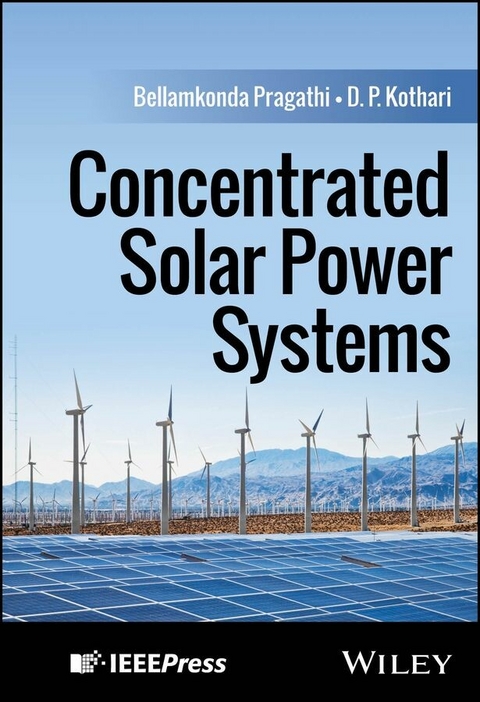
Concentrated Solar Power Systems (eBook)
486 Seiten
Wiley-IEEE Press (Verlag)
978-1-394-27236-5 (ISBN)
Follow the performance assessment tools and methods currently used for concentrated solar power technology (CSP) in this unique, single source overview
The search for renewable energy sources and methods for harnessing them is perhaps the most significant challenge of the twenty first century, which faces the potentially existential crises of global climate change. Concentrated solar power, or CSP, has the potential to revolutionize energy production. Its integration of thermal energy and its capacity to work with traditional power generation cycles make it an ideal tool for a newly sustainable world.
Concentrated Solar Power Systems is an advanced-level book offering both theoretical and practical perspectives on CSP. Its thorough overview of this technology includes the foundational scientific principles, system design and development, and growing applications. It offers a one-stop source for the performance assessment tools and methods currently deployed in the area of concentrated solar power.
Readers will also find:
- Case studies throughout showing CSP harnessed to meet real energy needs
- Detailed discussion of topics including site selection, feasibility analysis, environmental assessments, and more
- Analysis of specific technologies including linear Fresnel reflectors, parabolic troughs, concentrating photovoltaic systems, and many others
Concentrated Solar Power Systems is ideal for students and researchers involved or interested in the design, production, development, optimization, and application of CSP technology.
Bellamkonda Pragathi, PhD, MTech, is an Associate Professor at DVR & Dr HS MIC College of Technology, Kanchikacherla, India and currently holds 6 patents.
D. P. Kothari, PhD, ME, is a Director of Research and Senior Professor at S.B. Jain Institute of Technology, Management and Research, Nagpur, India. Dr. Kothari obtained his PhD in 1976 from BITS-PILANI, Rajasethan, and has been honored as an IEEE Fellow after 50 years of professional experience.
Follow the performance assessment tools and methods currently used for concentrated solar power technology (CSP) in this unique, single source overview The search for renewable energy sources and methods for harnessing them is perhaps the most significant challenge of the twenty first century, which faces the potentially existential crises of global climate change. Concentrated solar power, or CSP, has the potential to revolutionize energy production. Its integration of thermal energy and its capacity to work with traditional power generation cycles make it an ideal tool for a newly sustainable world. Concentrated Solar Power Systems is an advanced-level book offering both theoretical and practical perspectives on CSP. Its thorough overview of this technology includes the foundational scientific principles, system design and development, and growing applications. It offers a one-stop source for the performance assessment tools and methods currently deployed in the area of concentrated solar power. Readers will also find: Case studies throughout showing CSP harnessed to meet real energy needs Detailed discussion of topics including site selection, feasibility analysis, environmental assessments, and more Analysis of specific technologies including linear Fresnel reflectors, parabolic troughs, concentrating photovoltaic systems, and many others Concentrated Solar Power Systems is ideal for students and researchers involved or interested in the design, production, development, optimization, and application of CSP technology.
1
Conventional Energy Sources
An important factor to consider when deciding whether a country is considered developed is the amount of energy consumed per person. Maximum energy output is defined by a country's needs, and these needs can only be satisfied if everyone has access to sufficient amounts of energy for things like electricity, transportation, and agriculture. The majority of the world's resources, including coal, oil, and natural gas, are now produced via conventional methods to satisfy global demand. India presently imports about 75% of its crude oil, but this ratio is expected to climb significantly shortly due to the country's expanding economy and rapid expansion. Although only 6% of the world's primary energy is consumed there, India is home to 18% of the world's population. The majority of the world's electricity is generated by burning coal, oil, and natural gas. To create energy, these fossil fuels are burned, which increases the amount of carbon dioxide in the atmosphere and releases several hazardous compounds. The rise in global temperatures is a result of the potent greenhouse gas (GHG) carbon dioxide. The second drawback of using fossil fuels as a source of energy is that their proven reserves have a short shelf life—less than a century, in certain cases. Finding a different electricity production source is required as a result. Power production planning is significantly influenced by two important factors. The principal energy source, which might be any of the three fossil fuels, is an essential component. It is well recognized that all three of these fuels contribute to global warming and environmental harm. The second group of topics relates to the economics of electrical power. Significant losses are experienced during power production, transmission, and distribution. A challenging task that could cut expenses as well as losses in reducing losses or discovering an alternative strategy, like a smart grid or microgrid. The general public and those who create and administer regulations both want access to electricity while avoiding contributing to global warming [1].
1.1 Energy Resources and Their Potential
1.1.1 Oil
Depending on how much oil is used, the world has been split into three categories. Some nations are oil rich, while others are highly industrialized with productive farmland. The majority of the Middle Eastern or Arabian countries are the first group's representatives. The Organization for Economic Cooperation and Development (OECD) is the representative of the other group. There is a third group, which lacks oil and is not as developed as the OECD group. The question of whether oil‐producing nations will continue to supply the world with oil until the supply runs out, decide to hoard the oil for their use, or limit sales to nations who support their policies has long been a concern. The Arab nations' lack of food resources led to the current system, in which oil is supplied to industrialized nations. They received food in exchange for the oil, though it wasn't a formal barter deal. The Arab nations gradually became more powerful economically, established new ventures, and began to voice their opinions on global affairs. There is now a kind of unspoken divide between the Arabs and the developed nations. The current terrorism situation and American operations in the Middle East are further highlighting the contrasts, and when the oil taps run dry, the distinctions will become clearer. In the beginning, Arabs were content to receive food in exchange for oil, which helped keep the scales balanced. As can be seen, the exchange rate between food and oil was one bushel of food for every barrel of crude oil between 1950 and 1973, even though the scales had tipped in favor of oil suppliers. Two bushels per barrel in 1974, 5 bushels per barrel between 1975 and 1998, 6 bushels in 1999, and currently 10 bushels or more per barrel of crude oil, which grew by currency rates. Oil is undoubtedly necessary for agriculture and the transportation of food, but the Arab nations have located food sources outside of the OECD [2].
1.1.2 Natural Gas
Over the past 15 years, technology for producing power from natural gas has advanced. By 2020, it's anticipated that natural gas utilization in the creation of power would rise by 87%. According to the most accurate projections, natural gas will support 30% of energy generation in industrialized countries while providing 17% of electricity in emerging nations. Many nations intend to use natural gas since it has been technically developed for use in combined‐cycle gas turbines, which are used to generate power. Additionally, while producing the same amount of energy as coal and oil, gas emits less carbon dioxide. It is a cleaner fuel and is utilized in public transportation, such as in Delhi, specifically to preserve the environment. With roughly 33% of global consumption occurring in the former Soviet Union, gas usage for power is already high in those nations. Up to 63% of electricity in the former Soviet Union's nations is anticipated to be produced from gas by 2025. In 2001, the East European nations generated 9% of their electricity from gas; to reach their goal of 50% electricity generation, they plan to import more gas from Russia. Gas consumption for electricity generation in Western Europe increased to 413 billion cubic meters in 2000 and is anticipated to reach 670 billion cubic meters by 2025, having a declining share. Due to the region's use of nuclear energy, the gas portion of power generation is expected to rise from 17% in 2001 to 38% in 2025. Since the 1973 oil crisis, when Western European countries first experienced fluctuating natural gas use. The European Union began limiting the use of gas for generating electricity in 1975. It was 5% in 1981 and stayed there throughout the 1980s. The region began importing gas from Russia, North Africa, and recently discovered sources in the North Sea in the early 1990s; as a result, the share of gas in the electricity market rose, and this pattern is still present today.
Africa and Asia do not yet consume a lot of gas. Nearly one‐fourth of the gas consumed by Asian nations is consumed in Japan, which imports all of its gas as liquefied natural gas (LNG). India will end up being a major gas user, and 12.6% of its power is produced using gas.
The majority of the gas used in the United States is imported from Canada, but some gas is also obtained by pipelines from the Alaskan North Sea. From 18% in 2001 to 24% in 2025, gas is anticipated to have a larger part of the electricity market. All of the recently built power plants in the United States, totaling 141,000 MW, are gas based. Overseas imports are probably going to keep rising. In 2002, the United States brought in 4.8 million metric tons of gas or 4% of global consumption. At roughly 46 million metric tons in 2010, the import had more than doubled since 2002. As a result, in addition to importing oil, the United States imports enormous amounts of gas. By 2025, Canada wants to grow its gas‐powered electricity generation from 3% to 11%.
The price of natural gas is rising. Prices have more than doubled since 1993. Gas was priced at $2.55 per million British thermal unit (BTU) in 2000, but by 2003 it had risen to $6.31. Russia, Iran, and Qatar, three nations with respective gas reserves of 31%, 15%, and 9%, stand to gain from international gas trading [3].
1.1.3 Coal
The earliest source of energy for producing electricity is coal. It is disliked in developed countries because it creates more carbon dioxide than oil and gas, along with numerous other air pollutants. In addition to carbon dioxide, it also releases sulfur dioxide, nitrous oxide, mercury, and particulate matter. Electricity production uses 64% of all coal production. In 2001, the production was 94.5 Exa Joule (EJ) equivalent. By 2025, it is anticipated that production will rise to 138 EJ. However, all projections indicate that coal will have a decreasing role in the production of power. Although its share of power will drop to 31% by 2025, it was responsible for 34% of electricity in 2001 and 40% of electricity in 2005. By 2025, coal‐fired energy will only account for 12% of all electricity produced in Europe, down from 20% now. In 2001, the United States used 40% of the world's coal, compared to 27% combined use by China and India. Coal was used to generate 72% of the electricity in China and India. By 2025, China will produce 73% more power from coal than it does today. However, India's use of coal for energy production will decrease to 63%. By 2025, it is expected that the proportion of coal in US electricity will mostly remain unchanged at 50%.
Coal made up 27% of the electricity in Eastern Europe and the former Soviet Union in 2001. The availability of Russian gas, however, will cause this percentage to decline by 6% by 2025. Eastern Europe is becoming the most polluted region in the world due to the burning of coal. In general, Europe is phasing out the use of coal for electricity. The majority of those coal mines received government funding. Only three nations—the United Kingdom, Germany, and Spain—continue to manufacture hard coal as a result of the European Union's strategy of lowering or eliminating such subsidies. Table 1.1 lists the coal deposits found worldwide.
Table 1.1 Coal deposits in the world.
| Region | Deposit... |
|---|
| Erscheint lt. Verlag | 5.2.2025 |
|---|---|
| Sprache | englisch |
| Themenwelt | Naturwissenschaften ► Physik / Astronomie |
| Technik ► Elektrotechnik / Energietechnik | |
| Schlagworte | concentrating photovoltaic system • Concentrating Solar Power • Conventional energy source • grid integration of PV system • parabolic trough collector • Power generation • renewable energy source • solar energy. • Solar Irradiance • Thermal Storage System |
| ISBN-10 | 1-394-27236-7 / 1394272367 |
| ISBN-13 | 978-1-394-27236-5 / 9781394272365 |
| Informationen gemäß Produktsicherheitsverordnung (GPSR) | |
| Haben Sie eine Frage zum Produkt? |
 EPUB (Adobe DRM)
Kopierschutz: Adobe-DRM
Adobe-DRM ist ein Kopierschutz, der das eBook vor Mißbrauch schützen soll. Dabei wird das eBook bereits beim Download auf Ihre persönliche Adobe-ID autorisiert. Lesen können Sie das eBook dann nur auf den Geräten, welche ebenfalls auf Ihre Adobe-ID registriert sind.
Details zum Adobe-DRM
Dateiformat: EPUB (Electronic Publication)
EPUB ist ein offener Standard für eBooks und eignet sich besonders zur Darstellung von Belletristik und Sachbüchern. Der Fließtext wird dynamisch an die Display- und Schriftgröße angepasst. Auch für mobile Lesegeräte ist EPUB daher gut geeignet.
Systemvoraussetzungen:
PC/Mac: Mit einem PC oder Mac können Sie dieses eBook lesen. Sie benötigen eine
eReader: Dieses eBook kann mit (fast) allen eBook-Readern gelesen werden. Mit dem amazon-Kindle ist es aber nicht kompatibel.
Smartphone/Tablet: Egal ob Apple oder Android, dieses eBook können Sie lesen. Sie benötigen eine
Geräteliste und zusätzliche Hinweise
Buying eBooks from abroad
For tax law reasons we can sell eBooks just within Germany and Switzerland. Regrettably we cannot fulfill eBook-orders from other countries.
aus dem Bereich