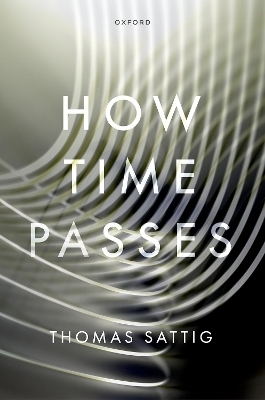
How Time Passes
Oxford University Press (Verlag)
978-0-19-892916-1 (ISBN)
Time organizes things in a dynamic fashion, whereas space organizes things in a static fashion-so things in time undergo passage, whereas things in space do not. What makes the temporal organization of things dynamic? What is the nature of the passage of time? Traditional discussions of passage have taken one of two perspectives. Some philosophers start with passage as a phenomenon that occurs in the physical world. They ask what constitutes this objective phenomenon. Theirs is a project in metaphysics and the foundations of physics. Others begin with passage as a phenomenon that is given in our experiences of the world. They ask what constitutes this subjective phenomenon. Theirs is a project in philosophy of mind and cognitive science.
In How Time Passes, Thomas Sattig gives both perspectives on passage equal weight. The first part of the book concerns the existence and nature of physical passage. The second part is concerned with the existence and nature of experiential passage. In both parts, the standard kind of explanation of passage is juxtaposed with a new kind of explanation. On the tripartite approach, which has dominated classical and contemporary philosophy of time, the denizens of time undergo passage, in virtue of changing with respect to what is past, what is present, and what is future. On the geometrical approach, the denizens of time undergo passage, in virtue of being temporally organized in a manner that does not involve the holding of any geometrical relations between them.
Thomas Sattig is Professor of Theoretical Philosophy at the University of Tübingen. From 2002 to 2005, he was a British Academy Postdoctoral Fellow and a Junior Research Fellow at Brasenose College, Oxford. Sattif has held tenure-track positions as Assistant Professor at Tulane University and at Washington University in St. Louis. He has been a regular Visiting Professor at USI, Lugano since 2019.
Introduction
Part A. Physical Passage
1: Tensed Tripartite Passage
2: Tenseless Tripartite Passage
3: Geometrical Passage
4: Physical Passage and Spacetime
Conclusion and Map of Part A
Part B. Experiential Passage
5: Temporal Experience
6: Explaining Experiential Passage
7: The Structure of Experiential Time
8: Geometrical Accounts of Experiential Passage
Conclusion and Map of Part B
| Erscheinungsdatum | 12.04.2025 |
|---|---|
| Zusatzinfo | 70 black and white figures |
| Verlagsort | Oxford |
| Sprache | englisch |
| Maße | 160 x 240 mm |
| Gewicht | 490 g |
| Themenwelt | Geisteswissenschaften ► Philosophie ► Metaphysik / Ontologie |
| Naturwissenschaften ► Physik / Astronomie | |
| ISBN-10 | 0-19-892916-1 / 0198929161 |
| ISBN-13 | 978-0-19-892916-1 / 9780198929161 |
| Zustand | Neuware |
| Informationen gemäß Produktsicherheitsverordnung (GPSR) | |
| Haben Sie eine Frage zum Produkt? |
aus dem Bereich