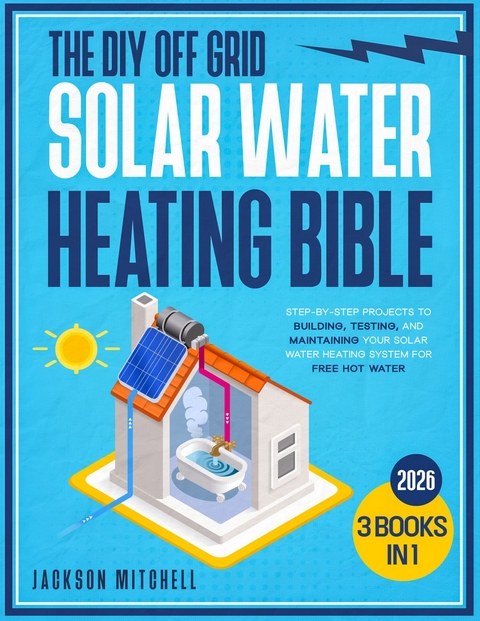
The DIY Off Grid Solar Water Heating Bible (eBook)
99 Seiten
Jackson Mitchell (Verlag)
9780000650788 (ISBN)
Heat Your Water for Zero Dollars: The Solar Revolution Awaits!
Imagine Never Paying for Hot Water Again...
Unleash the Power of the Sun and Enjoy Unlimited Hot Water with Simple DIY Projects - No More Sky-High Energy Bills or Reliance on the Grid!
Cold mornings and expensive hot showers are a reality for too many. Each year, the cost of heating water eats a larger portion of your budget, not to mention the environmental toll of traditional energy sources.
'The DIY Off Grid Solar Water Heating Bible' is here to change the game. This comprehensive guide is your ticket to escaping the endless cycle of rising energy costs and embracing a sustainable, cost-effective way to heat your water.
Designed for beginners and seasoned DIYers alike, this book is packed with practical advice, easy-to-follow projects, and insider tips to transform your home's water heating system.
Inside this book, you will learn:
✅ Dive Into DIY Savings with Your Own Solar Heater
✅ Master the Basics with Simple Installation Secrets
✅ Heat More, Use Less with Max Efficiency Tips
✅ Keep It Running Smoothly with Easy Maintenance Mastery
✅ Hot Water in Any Weather through Innovative Storage Solutions
✅ Enjoy Hot Showers Year-Round with Climate Adaptation Tricks
✅ Tailor-Made Solutions for Your Home with Real-Life System Fits
✅ Slash Your Carbon Footprint with the Green Living Guide
✅ Gain Confidence with Every Page through Step-By-Step Projects
With rising utility costs and the ongoing impact on our planet, there's never been a more crucial time to switch to renewable energy sources.
This book demolishes the myth that solar water heating is too complex or expensive for the average person. It's written for those who dare to take the leap towards a more independent, sustainable lifestyle.
Why this book stands apart: It's not just a manual; it's a movement towards self-sufficiency and environmental stewardship.
Are you ready to dive into the solar water heating revolution?
Say goodbye to cold showers and high energy costs. Pick up your copy today and tap into the unlimited power of the sun! Simply scroll back up and get your copy to get started!
CHAPTER 1
SOLAR WATER
HEATING BASICS
Photo by Justin Lim on Unsplash
Solar power provides a clean and renewable way to heat water using only sunshine as fuel. As concerns grow over fossil fuel dependence and climate change, solar water heating technology offers homeowners and businesses an environmentally friendly method to offset conventional water heating costs and carbon footprint. Understanding how these systems function can help more people benefit from the free energy of the sun.
Solar water heaters capture heat from sunlight using solar thermal collectors, most commonly mounted on a south-facing roof to maximize exposure. Within the collectors, a heat-absorbing surface selectively coated to absorb sunlight has a heat-transfer fluid flowing through tubing attached. As the sun's rays strike the collector surface and are transformed into heat, this thermal energy is conveyed through the fluid. The fluid is then transported via an insulated, closed-loop piping system to a well-insulated storage tank located indoors.
How Solar Water Heating Systems Work
Solar water heating systems harness the sun's energy to provide hot water, offering an eco-friendly and cost-effective alternative to traditional water heating methods. Here's a detailed breakdown of how these systems work, tailored for beginners:
Basic Components
Solar Collectors
These are panels or tubes placed on your roof or a sunny area, designed to capture and absorb solar radiation. There are mainly two types:
-
Flat-Plate Collectors: These resemble solar panels but contain water pipes or tubes beneath a glass or plastic cover, which trap heat from the sun.
-
Evacuated Tube Collectors: These consist of rows of parallel, transparent glass tubes, each containing a metal absorber tube. The vacuum within each glass tube acts as an insulator, enhancing efficiency by reducing heat loss.
Heat Transfer Fluid
This fluid circulates through the collectors, absorbing heat. In warmer climates, water itself can be the heat transfer fluid. In colder regions, a non-freezing, heat-transfer fluid is used to prevent system damage from freezing temperatures.
Storage Tank
Once the fluid is heated, it's moved to an insulated storage tank, keeping the water warm until it's needed. Some systems have a single tank where the solar-heated fluid directly warms the potable water. Others use a two-tank system where the solar-heated fluid passes through a heat exchanger in the tank, heating the water indirectly.
Pump and Controls
These components circulate the heat-transfer fluid between the collector and the storage tank. The system may include sensors and controllers to optimize heat collection and prevent overheating.
How It Works
-
Absorption: The solar collector absorbs solar energy, converting it into heat. In flat-plate collectors, the sun warms the absorber plate. In evacuated tubes, sunlight passes through the outer glass tube, heating the absorber tube inside.
-
Heat Transfer: The heat-transfer fluid, flowing through pipes in the collector, absorbs this heat. In direct circulation systems, potable water is heated directly in the collectors. In indirect systems, a separate fluid collects the heat, then transfers it to the water in a storage tank via a heat exchanger.
-
Storage: The heated water is stored in an insulated tank, maintaining its temperature until needed. In systems with a backup, if the water isn't hot enough, a conventional heater can further warm the water to the desired temperature.
-
Distribution: When hot water is turned on in the house, the solar-heated water is drawn from the top of the storage tank, while colder water at the bottom of the tank is circulated back into the system to be reheated.
Considerations for Efficiency
-
Collector Orientation and Tilt: Maximizing exposure to the sun is crucial. Collectors are usually installed facing south (in the Northern Hemisphere) and tilted to match the location's latitude for optimal absorption.
-
System Sizing: The system should be sized based on the household's hot water needs, considering the number of occupants and usage patterns.
-
Climate Compatibility: In colder regions, systems need freeze protection and might require more sophisticated designs, like evacuated tube collectors or closed-loop systems with antifreeze.
Solar water heating systems represent a seamless blend of ancient principles and modern technology, offering a sustainable solution to meet hot water needs while reducing energy costs and environmental impact. With advancements in technology and increased awareness, they continue to become a more common sight in homes around the world, contributing significantly to global efforts in sustainable living.
Types of Solar Water Heaters
Solar water heaters can be broadly categorized based on their technology, circulation systems, and the way they heat water. Here are the primary types:
1. Based on Technology
Flat-Plate Collectors
Flat-plate solar collectors are a widely used technology in solar water heating systems. They consist of a dark-colored absorber plate made of metal, typically copper or aluminum, which is known for its high thermal conductivity and heat-absorbing capacity. This absorber plate is coated with a special material to enhance its heat absorption and minimize reflection. Water or a heat-transfer fluid flows through tubes or channels attached to the absorber plate, allowing the heat captured by the plate to be transferred to the fluid.
The entire assembly is encased in a durable, insulated metal box to retain heat, and covered with a sheet of glass or clear plastic to create a greenhouse effect, further enhancing heat retention. This design is efficient at converting solar energy into heat and is particularly effective in moderate to hot climates where the incidence of sunlight is high and consistent.
Flat-plate collectors are versatile and can be easily integrated into residential buildings for domestic hot water production, as well as in smaller-scale commercial settings such as hotels, hospitals, and schools. Their simplicity in design and operation makes them a reliable and cost-effective choice for harnessing solar energy for water heating.
Evacuated Tube Collectors
Evacuated tube collectors represent a more technologically advanced solution for solar water heating, characterized by their use of transparent glass tubes to house metal absorber tubes. The space between the outer glass tube and the inner metal tube is evacuated, creating a vacuum. This vacuum acts as an excellent insulator, significantly reducing heat loss from the absorber tube to the surroundings, which is a common challenge in thermal systems.
The absorber tubes within are usually coated with selective materials that excel at absorbing solar radiation and converting it to heat while minimizing radiative heat loss. The heat is then transferred to the water or heat-transfer fluid flowing through the system. The evacuated tube design is particularly beneficial in colder climates because the vacuum insulation keeps the heat from escaping, making these collectors more efficient than flat-plate collectors in such environments.
These collectors are also well-suited for applications that require higher temperatures, including certain industrial processes, space heating, or even cooling through absorption refrigeration systems. Despite their higher initial cost compared to flat-plate collectors, their superior performance in less ideal conditions and versatility in application make evacuated tube collectors a valuable option for solar water heating across a range of climates and needs.
2. Based on Circulation System
Active (Pumped) Systems
These systems use electric pumps, valves, and controllers to circulate water or heat-transfer fluid through the collectors and into the home.
-
Direct Circulation Systems: Pump water directly through the collectors and into the home, best for climates where freezing temperatures are rare.
-
Indirect Circulation Systems: Use a non-freezing heat-transfer fluid through collectors and a heat exchanger to heat water, suitable for freeze-prone areas.
Passive Systems
Rely on natural convection to circulate water through the system, making them generally simpler and potentially more reliable due to fewer moving parts.
-
Integral Collector-Storage (ICS) or Batch Systems: Feature one or more black tanks or tubes in an insulated, glazed box. Cold water passes through the solar collector, which preheats the water before it enters the conventional backup water heater.
-
Thermosyphon Systems: Heated water rises naturally into a tank while cooler water sinks to the collector, inducing circulation. These require careful installation to ensure the collector is positioned below the storage tank to prevent issues with water flow and overheating.
3. Based on How They Heat Water
Direct (Open Loop) Systems
Water to be used in the home flows directly through the...
| Erscheint lt. Verlag | 9.10.2024 |
|---|---|
| Sprache | englisch |
| Themenwelt | Naturwissenschaften ► Physik / Astronomie |
| ISBN-13 | 9780000650788 / 9780000650788 |
| Informationen gemäß Produktsicherheitsverordnung (GPSR) | |
| Haben Sie eine Frage zum Produkt? |
 EPUB (Adobe DRM)
Größe: 4,0 MB
Kopierschutz: Adobe-DRM
Adobe-DRM ist ein Kopierschutz, der das eBook vor Mißbrauch schützen soll. Dabei wird das eBook bereits beim Download auf Ihre persönliche Adobe-ID autorisiert. Lesen können Sie das eBook dann nur auf den Geräten, welche ebenfalls auf Ihre Adobe-ID registriert sind.
Details zum Adobe-DRM
Dateiformat: EPUB (Electronic Publication)
EPUB ist ein offener Standard für eBooks und eignet sich besonders zur Darstellung von Belletristik und Sachbüchern. Der Fließtext wird dynamisch an die Display- und Schriftgröße angepasst. Auch für mobile Lesegeräte ist EPUB daher gut geeignet.
Systemvoraussetzungen:
PC/Mac: Mit einem PC oder Mac können Sie dieses eBook lesen. Sie benötigen eine
eReader: Dieses eBook kann mit (fast) allen eBook-Readern gelesen werden. Mit dem amazon-Kindle ist es aber nicht kompatibel.
Smartphone/Tablet: Egal ob Apple oder Android, dieses eBook können Sie lesen. Sie benötigen eine
Geräteliste und zusätzliche Hinweise
Buying eBooks from abroad
For tax law reasons we can sell eBooks just within Germany and Switzerland. Regrettably we cannot fulfill eBook-orders from other countries.
aus dem Bereich